Gyuto Club

The Best Mercer Knives

The culinary-school knife, judged on what its maker actually states: a published HRC 56 ±1, a published 15-degree blade angle, an NSF mark — and no alloy grade anywhere.

By Stephen V.Last updated How we pick

Buy the Genesis 8-inch chef’s knife. It is a precision-forged, full-tang, bolstered German-steel knife for roughly the price of a stamped one, and it is the knife a great many culinary schools put in a first-year kit. If you are furnishing a kitchen rather than buying one blade, the Genesis 6-piece beechwood-and-glass block is the honest version of a knife block: five knives, all forged, none of them filler.

Mercer is usually written about as the brand that tells you nothing. That is how this site used to describe it too. It turns out to be wrong. Mercer Culinary’s own product pages publish, per model, an “HRC” of “56+/-1” and a “Blade angle” of “15°”— two figures the marketplace listings for the same knives omit entirely, and two figures most makers in this price band never state at all. They also publish an NSF certification and a “Limited Lifetime Warranty (25 Years For Corporate Users).”

What Mercer does notpublish is the steel. Every Genesis page says “High-Carbon German Steel” and stops there — no X50CrMoV15, no alloy designation of any kind, and no country of origin or weight either. So this page ranks Mercer knives on the figures Mercer states, names the one it withholds, and says where our own earlier numbers came from and why they are gone. We own none of these knives; our methodology page sets out what we do instead, and our review of the Genesis 8-inch covers the top pick in detail.

How this is funded: we earn a commission if you buy through our links, at no extra cost to you. As an Amazon Associate we earn from qualifying purchases. It never changes which knife we recommend, and we’ll tell you when we’d skip one. Full disclosure.

Quick picks

Ranked on steel, hardness, geometry and buyer fit. Select a row to jump to the full write-up. We have not cut with every one of these — here is exactly how we compared them instead.

#KnifeBest forPrice
1
Mercer Culinary Genesis 8-inch Chef's Knife

Mercer Culinary Genesis 8-inch Chef's Knife

A fully forged German-steel knife at a stamped-knife price, and the one knife at this money whose maker publishes both a hardness range and a blade angle. It is the culinary-school standby for a reason — bolster, full tang and a grippy Santoprene handle for around the cost of a decent stamped blade.

Best overall
$40.00 · View on Amazon

Price as of November 4, 2026. #ad How we’re funded

2
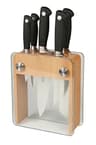
Mercer Culinary Genesis 6-Piece Forged Block Set

Mercer Culinary Genesis 6-Piece Forged Block Set

The best-value real knife set: the forged Genesis chef's knife you'd buy on its own, plus the four other blades you actually reach for, in a beech-and-tempered-glass block. The listing describes 'German stainless steel blades with thick bolsters and full tangs' across the set — not the stamped filler most cheap blocks pad the count with.

Best set
$199.99 · View on Amazon

Price as of November 4, 2026. #ad How we’re funded

3
Mercer Culinary Genesis 7-inch Santoku (M20707)

Mercer Culinary Genesis 7-inch Santoku (M20707)

A genuinely forged santoku for roughly the price of a stamped one. Same published figures, bolster, full tang and grippy Santoprene handle as the Genesis chef's knife — the value answer in this shape, by a distance.

Best santoku
$40.06 · View on Amazon

Price as of November 4, 2026. #ad How we’re funded

4
Mercer Culinary Genesis 7-inch Nakiri (M20907)

Mercer Culinary Genesis 7-inch Nakiri (M20907)

The sane way to find out whether you like the nakiri shape. Forged German steel, full tang, bolster, grippy handle — around a quarter of what the Japanese nakiris cost, and soft enough that a beginner can sharpen it on a cheap stone.

Best vegetable knife
$50.49 · View on Amazon

$53.956% off

Price as of November 4, 2026. #ad How we’re funded

5
Mercer Culinary Genesis 5-inch Utility Knife (M20405)

Mercer Culinary Genesis 5-inch Utility Knife (M20405)

A forged, full-tang, bolstered utility knife for about the price of a takeaway. Nothing here is exciting and nothing is wrong: soft German steel, a grippy handle, and a 127 mm blade that does the small jobs a chef's knife is clumsy at.

Best small knife
$23.31 · View on Amazon

Price as of November 4, 2026. #ad How we’re funded

6
Mercer Culinary 12-inch Ceramic Honing Rod

Mercer Culinary 12-inch Ceramic Honing Rod

Mercer's ceramic rod covers the same ground as the SHARPAL — a hard, fine ceramic surface for Japanese edges — in restaurant-supply trim, and it is the longer rod of the two at 12 inches. Neither maker publishes a grit figure; the SHARPAL publishes an adjustable angle guide and this one does not, so pick on whether you need the guide or the length.

Best rod to pair with one
$68.70 · View on Amazon

Price as of November 4, 2026. #ad How we’re funded

The picks in full

#1Best overall

Mercer Culinary Genesis 8-inch Chef's Knife

A fully forged German-steel knife at a stamped-knife price, and the one knife at this money whose maker publishes both a hardness range and a blade angle. It is the culinary-school standby for a reason — bolster, full tang and a grippy Santoprene handle for around the cost of a decent stamped blade.

Strengths

  • Precision forged with a full tang and bolster, and Mercer publishes HRC 56 ±1 and a 15° blade angle for it
  • Santoprene handle grips even when wet — a safety win
  • NSF certified, limited lifetime warranty; hard to beat for the money

Trade-offs

  • Mercer names no alloy grade — only “High-Carbon German Steel”
  • Not as refined in the hand as a Wüsthof or Zwilling
  • At 56 ±1 HRC the steel is soft, so plan on honing often and sharpening regularly
Blade steelHigh-carbon German stainless (grade not published)
Hardness56 ±1 HRC
Blade length203 mm
WeightNot published
Edge geometry15° blade angle (per side not stated)
HandleSantoprene, ergonomic
ConstructionForged, full tang, bolstered

Specs read from the manufacturer listing, on November 3, 2026. “Not published” means the maker does not state that figure.

#2Best set

Mercer Culinary Genesis 6-Piece Forged Block Set

The best-value real knife set: the forged Genesis chef's knife you'd buy on its own, plus the four other blades you actually reach for, in a beech-and-tempered-glass block. The listing describes 'German stainless steel blades with thick bolsters and full tangs' across the set — not the stamped filler most cheap blocks pad the count with.

Strengths

  • Forged, full-tang, bolstered blades throughout, not stamped block-filler
  • Five knives that earn their slot: 8-inch chef, 8-inch wavy-edge bread, 6-inch boning, 5-inch utility, 3.5-inch paring
  • Grippy Santoprene handles across the set, and NSF certified

Trade-offs

  • Mercer's NSF certification on this set reads “NSF Knives Only” — the block is not covered
  • Hand wash only, and the tempered-glass block face shows every smudge
  • No santoku, no shears and no honing rod — budget for a rod separately
Blade steelHigh-carbon German stainless (grade not published)
Hardness56 ±1 HRC
Blade lengthNot published
WeightNot published
Edge geometry15° blade angle (per side not stated)
HandleSantoprene, ergonomic
ConstructionPrecision forged, full tang, bolstered (all blades)

Specs read from the manufacturer listing, on November 3, 2026. “Not published” means the maker does not state that figure.

#3Best santoku

Mercer Culinary Genesis 7-inch Santoku (M20707)

A genuinely forged santoku for roughly the price of a stamped one. Same published figures, bolster, full tang and grippy Santoprene handle as the Genesis chef's knife — the value answer in this shape, by a distance.

Strengths

  • Forged, full-tang and bolstered at a price where almost everything else is stamped
  • Granton edge helps release sticky slices
  • Santoprene handle keeps its grip with wet or oily hands

Trade-offs

  • At Mercer's published 56 ±1 HRC the steel is soft — expect to hone before most sessions
  • Mercer calls the model “Granton Edge” and never explains the scallops anywhere on its page
  • Fit and finish is workmanlike, not refined
Blade steelHigh-carbon German stainless (grade not published)
Hardness56 ±1 HRC
Blade length178 mm
WeightNot published
Edge geometry15° blade angle, granton (per side not stated)
HandleSantoprene, non-slip
ConstructionForged, full tang, bolstered

Specs read from the manufacturer listing, on November 3, 2026. “Not published” means the maker does not state that figure.

#4Best vegetable knife

Mercer Culinary Genesis 7-inch Nakiri (M20907)

The sane way to find out whether you like the nakiri shape. Forged German steel, full tang, bolster, grippy handle — around a quarter of what the Japanese nakiris cost, and soft enough that a beginner can sharpen it on a cheap stone.

Strengths

  • Forged and full-tang at a price where nakiris are usually stamped novelties
  • Soft steel is very easy to bring back to sharp
  • Santoprene handle grips wet

Trade-offs

  • Mercer's published 56 ±1 HRC will not hold a push-cutting edge like a VG-MAX or FC61 blade
  • Thicker behind the edge than the Japanese nakiris, so it wedges in dense veg
Blade steelHigh-carbon German stainless (grade not published)
Hardness56 ±1 HRC
Blade length178 mm
WeightNot published
Edge geometry15° blade angle (per side not stated)
HandleSantoprene, non-slip
ConstructionForged, full tang, bolstered

Specs read from the manufacturer listing, on November 3, 2026. “Not published” means the maker does not state that figure.

#5Best small knife

Mercer Culinary Genesis 5-inch Utility Knife (M20405)

A forged, full-tang, bolstered utility knife for about the price of a takeaway. Nothing here is exciting and nothing is wrong: soft German steel, a grippy handle, and a 127 mm blade that does the small jobs a chef's knife is clumsy at.

Strengths

  • Forged and full-tang at a price where utility knives are usually stamped
  • Santoprene handle grips with wet hands — the reason culinary schools issue these
  • Soft enough that a beginner can sharpen it back in five minutes

Trade-offs

  • Mercer's published 56 ±1 HRC will not hold an edge anywhere near as long as the VG10 pettys
  • Thicker behind the edge than the Japanese knives, so it wedges in dense produce
Blade steelHigh-carbon German stainless (grade not published)
Hardness56 ±1 HRC
Blade length127 mm
WeightNot published
Edge geometry15° blade angle (per side not stated)
HandleSantoprene, non-slip
ConstructionForged, full tang, bolstered

Specs read from the manufacturer listing, on November 3, 2026. “Not published” means the maker does not state that figure.

#6Best rod to pair with one

Mercer Culinary 12-inch Ceramic Honing Rod

Mercer's ceramic rod covers the same ground as the SHARPAL — a hard, fine ceramic surface for Japanese edges — in restaurant-supply trim, and it is the longer rod of the two at 12 inches. Neither maker publishes a grit figure; the SHARPAL publishes an adjustable angle guide and this one does not, so pick on whether you need the guide or the length.

Strengths

  • Ceramic surface suits hard edges that a grooved steel would chip
  • 12-inch rod is long enough for any kitchen knife you own
  • Commercial-kitchen brand at a sane price

Trade-offs

  • Mercer does not publish a grit figure for the ceramic on this listing
  • Brittle like every ceramic rod — store it where it cannot fall
TypeDry ceramic rod (lightly abrades)
MaterialCeramic rod
Length12-inch rod

Specs read from the manufacturer listing, on August 10, 2026. “Not published” means the maker does not state that figure.

What Mercer actually publishes

We read five of Mercer’s own Genesis product pages for this roundup — the M20608 chef’s knife, the M20707 Granton santoku, the M20907 nakiri, the M20405 utility knife and the M20050 six-piece block set — and every one of them carries the same published spec block:

  • Steel:“High-Carbon German Steel.” No grade.
  • HRC:“56+/-1.” A range, not a single number, which is the more honest way to publish a heat treatment.
  • Blade angle:“15°.” Per model, on all five pages.
  • Construction:“Precision Forged.”
  • Handle:“Santoprene®.”
  • Certifications:“NSF” — and on the block set, the narrower “NSF Knives Only.”
  • Warranty:“Limited Lifetime Warranty (25 Years For Corporate Users).”

The feature copy is identical across the range as well, down to the sentence: “Taper ground edge allows for added stability, easy honing, long lasting sharpness.” That consistency is the useful part. It means the Genesis line is one knife in several shapes rather than a tiered range dressed up as one, so choosing a Mercer is a question about geometry, not about which version of the steel you are getting.

Where our old numbers came from, and why they are gone

Until this page, this site described the Genesis knives as X50CrMoV15 at around 58 HRC, ground to about 20° per side. None of those three figures was Mercer’s. They were the German forged-knife benchmarks, borrowed from the maker that does publish them: Wüsthof states 58 Rockwell for its forged blades after “over fifty-four manufacturing steps,” 55 to 57 for its sheet-cut ones, and about 14° per side on its current edge. Applying that to Mercer was a reasonable inference and it was still an inference.

Mercer’s own pages now settle it, and they settle it downward: 56 ±1, not 58. Two Rockwell points is not much in the hand, but a figure a maker publishes beats a figure we reasoned to, so the published one is what our spec cards above carry and the inferred one is gone. The alloy claim is gone too — Mercer names no grade, so neither do we. If you see “X50CrMoV15” attached to a Genesis knife on a marketplace listing, that is a seller’s description, not a maker’s spec. Our steel guide explains what the designation would have told you if it were published.

The 15-degree figure, and why we have not resolved it

Mercer publishes “15°” and does not say whether that is per side or the total included angle. Those are very different knives. Fifteen degrees per side is a Japanese-leaning working edge, the same figure MAC publishes for its Chef Series. Fifteen degrees total would mean 7.5° per side, thinner than any factory edge on this site — Miyabi’s hand-honed 9.5 to 12° is the most acute we track, on steel at 61 HRC.

Our reading, stated as a reading: it is almost certainly per side, because a 7.5° bevel on steel published at 56 Rockwell would roll the first time it met a carrot board. But Mercer does not say so, and we are not going to print an inference as a spec twice on the same page. What to do about it is simple and does not depend on the answer: when you sharpen, match the bevel that is physically on the blade rather than a number off a web page. Lay the edge on a marked stone and look at where the scratch pattern lands. The angle guide covers how to read that, and how to sharpen a knife is the method.

One practical consequence is worth flagging. If the 15° is per side, a fixed 20° pull-through sharpener will grind the geometry away over a handful of uses. A Genesis is cheap enough that plenty of owners do exactly that, and it is still the wrong tool — whetstone vs electric sharpener sets out the trade.

56 ±1 HRC is the whole trade

Everything you will like and everything you will not like about a Mercer follows from that number. On the published figures it sits at the soft end of the Western working range: Wüsthof 58, Zwilling around 57, Victorinox around 55 to 56, and the Japanese knives this site mostly writes about at 60 to 61.

What soft steel buys you is forgiveness. The edge deforms instead of chipping, a burr comes up on a 1000-grit stone in a couple of minutes, and a wandering sharpening angle does not ruin anything. It is genuinely the best steel to learn on, which is most of why it ends up in culinary-school kits alongside a rod and a roll.

What it costs you is edge retention. A Genesis will not hold a push-cutting edge through a long prep session the way a 60 HRC gyuto does, and nothing about forging or bolsters changes that — hardness is the variable, and the hardness chart sets out what each band actually gets you. Plan on honing before most sessions and a stone every few weeks of real use. If that sounds like work, the Japanese shortlist is the other way to spend the money.

NSF, and the clause that tells you who this line is for

Every Genesis page carries an “NSF” certification line. NSF certification is a commercial-kitchen standard about sanitation — materials, surfaces and the absence of places food can lodge — not a performance rating. It will not make a knife sharper. It does tell you the handle and the blade junction were built to be cleaned in a working kitchen, which is a real and under-rated thing in a knife you are going to use every day.

The warranty line is more revealing: “Limited Lifetime Warranty (25 Years For Corporate Users).” A maker that writes a separate term for corporate buyers is a maker whose main customer is a restaurant group or a cooking school, not a home cook. That is the whole character of the Genesis line. It is also worth noting the set’s certification reads “NSF Knives Only”— the beechwood and tempered-glass block is not part of the certification.

Where each pick earns its place

  • Genesis 8-inch chef’s knife (M20608) — buy this one. 203 mm, precision forged, full tang, bolster, Santoprene handle, and the model whose page we read the 56 ±1 and the 15° off. The honest reservations: no alloy grade, no published weight, and a fit and finish that is workmanlike rather than refined next to a Wüsthof Classic. Mercer also sells this knife as the M21078 with a shortbolster, which is a different knife to sharpen — a full bolster that runs down to the heel stops a stone reaching the last few millimeters of edge. Knife anatomy explains the part, and it is worth checking which variant a listing is actually selling you.
  • Genesis 6-piece block set (M20050) — the set that is not filler. Mercer itemizes it: a 3.5-inch paring knife, a 5-inch utility knife, a 6-inch stiff boning knife, an 8-inch wavy-edge bread knife and an 8-inch chef’s knife, in a beechwood and tempered-glass block. Five knives you would plausibly buy on their own, which is the test we apply to every set on the sets page. Cons: no santoku, no shears and no honing rod, so budget for a rod separately; hand wash only; the glass block face shows every smudge; and the NSF line covers the knives, not the block.
  • Genesis Granton santoku (M20707) — the cheap way into the shape. 178 mm, same published figures, with scalloped sides. Mercer calls the model “Granton Edge” and then never explains the scallops anywhere on the page, which is a fair summary of how the feature is sold across the industry; the one source we found that actually ran the knives concluded the hollows help on long slicers and are unnecessary on short, already-thin santokus. Granton edge vs straight edge has that argument in full. Take the scallops because they come free here, not because they are the reason to buy.
  • Genesis nakiri (M20907) — find out whether you like a nakiri. 178 mm of flat edge, forged and bolstered, at roughly a quarter of what the Japanese nakiris on our nakiri roundup cost. The cons are geometric rather than sloppy: it is thicker behind the edge than a Japanese nakiri so it wedges in dense vegetables, and at 56 ±1 HRC it will not hold a push-cutting edge the way a VG-MAX blade does. The flat profile is push-cut only either way — how to use a nakiri is the technique that stops people blaming the knife.
  • Genesis 5-inch utility (M20405) — the cheapest small knife worth owning. 127 mm, forged, full tang, bolstered, at a price where almost every competitor is stamped. Its honest limitation is overlap: if you already own a paring knife and a chef’s knife, this fills a narrow gap. Petty vs utility knife is the right place to decide whether you need one.
  • Mercer 12-inch ceramic rod — the thing to buy with the knife. A soft forged edge rolls, and a rolled edge is a honing job rather than a sharpening job. The reason we pick Mercer’s ceramic rod over a grooved steel is that it suits a mixed block: a ceramic surface is safe on both a 56 HRC Genesis and a 60 HRC Japanese blade, where a ribbed steel rod is the wrong mechanism for the latter. Cons: Mercer publishes no grit figure for the ceramic, and like every ceramic rod it is brittle, so store it where it cannot fall. How to hone a knife is the stroke, and honing steel vs whetstone is which tool to buy first.

Living with a 56 HRC forged knife

Hone often, sharpen when honing stops working. Soft steel rolls rather than chips, and a rolled edge comes back in ten seconds on a rod. When a rod no longer brings it back, the edge has worn rather than bent and it needs a stone. A 1000/6000 combination stone is the whole kit for this knife — the whetstone roundup has the options.

Do not put it in the dishwasher. Mercer’s own care text is unambiguous: “It is not recommended to wash your knife in a dishwasher,” with hand washing in warm water and mild soap, drying, rinsing off any chlorine or bleach immediately, and no prolonged soaking. The wider reasoning is in knives in the dishwasher. “High-carbon German cutlery steel resists rust, corrosion, and discoloration” is Mercer’s own wording — resists, not immune; why knives rust covers the difference.

Store it where nothing touches the edge. Mercer says so itself — “Always store cutlery in a cutlery block or sheath to preserve the cutting edges and prevent personal injury” — which is one of the better arguments for the block set over loose knives in a drawer. Knife care is the rest of it.

Where a Mercer is the wrong answer

If you want edge retention, buy harder steel: a Tojiro DP or a Shun sits at 60 to 61 HRC with a published figure, and Japanese vs German knives sets out what that changes. If you want the refined version of the same construction, buy a Wüsthof Classic and read Mercer vs Wüsthof first — the gap is finish and two Rockwell points, not category. If you want the lightest, most nimble budget knife rather than a heavy forged one, the stamped Victorinox Fibrox is the other standard answer and Victorinox vs Mercer is that decision.

How we ranked these

By how much of the decision each knife lets you make from published figures, then by what the shape is for. Mercer’s own five product pages are cited below and every number on this page traces to one of them; where a figure comes from a listing or a distributor rather than from Mercer, the page says so. We own none of these knives and claim no test results, which is why there is no score column. Prices come only from our live price layer, with the date they were read.

Frequently asked questions

Which Mercer knife should I buy first?

The Genesis 8-inch chef's knife. It is precision forged with a full tang and a bolster, Mercer publishes HRC 56 ±1 and a 15-degree blade angle for it, and it costs about what a stamped knife costs. If you want more than one knife in the same purchase, the 6-piece beechwood-and-glass block set is five forged knives rather than a block padded out with filler.

How hard are Mercer Genesis knives?

Mercer publishes 'HRC 56+/-1' on its own product pages — the M20608 chef's knife, the M20707 Granton santoku, the M20907 nakiri, the M20405 utility knife and the M20050 block set all state it. That is the soft end of the Western working range: Wüsthof publishes 58 Rockwell for its forged knives, Zwilling around 57, and the Japanese knives on this site run 60 to 61. Soft steel is easy to sharpen and does not hold an edge as long.

What steel do Mercer Genesis knives use?

Mercer does not say. Every Genesis page gives the steel as 'High-Carbon German Steel' and names no alloy grade. Marketplace listings often fill the gap with X50CrMoV15, which is plausible for the category and is not Mercer's published figure, so we no longer state it. The hardness range Mercer does publish — 56 ±1 HRC — tells you more about how the knife will behave than the grade would.

What angle are Mercer knives sharpened to?

Mercer publishes a 'Blade angle' of 15 degrees on every Genesis page we read, and does not state whether that is per side or the total included angle. Our reading is that it is per side, because 7.5 degrees per side on steel published at 56 Rockwell would not survive a working kitchen — but that is our reading, not Mercer's statement. Sharpen by matching the bevel physically on the blade rather than a number, and avoid fixed 20-degree pull-through devices, which would reprofile a 15-degree edge.

Are Mercer knives NSF certified?

Yes, and Mercer publishes it per model. NSF is a commercial-kitchen sanitation standard about materials and cleanable surfaces, not a performance rating — it will not make a knife sharper. One detail worth knowing: the 6-piece block set's certification line reads 'NSF Knives Only', so the beechwood and tempered-glass block is not covered by it.

What is Mercer's warranty?

Mercer publishes a 'Limited Lifetime Warranty (25 Years For Corporate Users)' on each Genesis product page. The separate corporate term is a useful tell about who the line is built for: restaurant groups and culinary schools rather than home kitchens.

Mercer Genesis or Mercer Renaissance?

This page ranks the Genesis line, because that is the line we can tie to verified live listings with a price from our own daily check. Genesis is the Santoprene-handled working range — grippy when wet, NSF, built to be issued in a kit. Renaissance is the dressier line with a different handle. If your knife is going to live in a commercial kitchen or a knife roll, the Genesis handle is the reason to pick it.

Why does the same Mercer chef's knife have two model numbers?

Because Mercer sells the Genesis 8-inch chef's knife in two bolster variants: the M20608 with a standard bolster and the M21078 with a short bolster. It matters when you sharpen. A bolster that runs all the way down to the heel blocks a stone from reaching the last stretch of edge, so a short bolster is the easier knife to maintain. Check which one a listing is actually selling before you buy.

Are Mercer knives good for culinary school?

They are the default for a reason: forged construction, a handle that grips with wet or oily hands, NSF certification, and a price that survives a knife being lost or borrowed. The soft 56 ±1 HRC steel is also the right thing to learn sharpening on, because it raises a burr quickly and forgives an imperfect angle. Our page on what culinary-school kits actually need goes through the full list.

Can you sharpen a Mercer on a whetstone?

Yes, and it is the best knife on this site to start with. At a published 56 ±1 HRC the steel is soft enough that a 1000-grit stone raises a burr in a couple of minutes and a slightly wobbly angle does not ruin the edge. A 1000/6000 combination stone plus a rod between sessions is the whole maintenance kit for a Genesis.

Sources

  • Genesis® Chef's Knife 8" (20.3 cm) — Mercer Culinary — Mercer's own page for Item No. M20608, and the source of the two figures its marketplace listings omit: a 'Steel' of 'High-Carbon German Steel' with NO alloy grade named, an 'HRC' of '56+/-1', a 'Blade angle' of '15°' (the page does not state whether that is per side or inclusive), 'Construction' of 'Precision Forged', a 'Handle' of 'Santoprene®', 'Certifications' of 'NSF' and a 'Limited Lifetime Warranty (25 Years For Corporate Users)'. Features published verbatim: 'Precision forged construction for better strength and durability', 'Ergonomic Santoprene® handle offers superior comfort and a non slip grip, even with wet hands', 'High-carbon German cutlery steel resists rust, corrosion, and discoloration', 'Bolster strengthens the knife, adds durability, and provides excellent balance', 'Tang provides excellent balance' and 'Taper ground edge allows for added stability, easy honing, long lasting sharpness'. Care: 'It is not recommended to wash your knife in a dishwasher' and 'Always store cutlery in a cutlery block or sheath to preserve the cutting edges and prevent personal injury'. NO country of origin and NO weight are published (accessed November 3, 2026)
  • Genesis® Granton Edge Santoku 7" (17.8 cm) — Mercer Culinary — Mercer's own page for Item No. M20707, which publishes the same line figures as the chef's knife — 'High-Carbon German Steel', 'HRC' '56+/-1', 'Blade angle' '15°', 'Precision Forged', 'Santoprene®', 'NSF', 'Limited Lifetime Warranty (25 Years For Corporate Users)' — and names the model 'Granton Edge Santoku' while publishing NO explanation of the granton scallops anywhere on the page; its only edge feature is the 'Taper ground edge' line shared across the range (accessed November 3, 2026)
  • Genesis® Nakiri 7" (17.8 cm) — Mercer Culinary — Mercer's own page for Item No. M20907, confirming the figures are published per model and not just on the flagship: 'High-Carbon German Steel', 'HRC' '56+/-1', 'Blade angle' '15°', 'Precision Forged', 'Santoprene®', 'NSF' and a 'Limited Lifetime Warranty (25 Years For Corporate Users)' (accessed November 3, 2026)
  • Genesis® Utility Knife 5" (12.7 cm) — Mercer Culinary — Mercer's own page for Item No. M20405, with the identical published set: 'High-Carbon German Steel', 'HRC' '56+/-1', 'Blade angle' '15°', 'Precision Forged', 'Santoprene®', 'NSF' and a 'Limited Lifetime Warranty (25 Years For Corporate Users)' (accessed November 3, 2026)
  • Genesis® 6-Pc. Knife Block Set Beechwood & Tempered Glass — Mercer Culinary — Mercer's own page for Item No. M20050, which itemizes the set as a 3.5-inch paring knife, a 5-inch utility knife, a 6-inch stiff boning knife, an 8-inch wavy-edge bread knife and an 8-inch chef's knife in a 'Beechwood and Tempered Glass' block, and publishes 'High-Carbon German Steel', 'HRC' '56+/-1', 'Blade angle' '15°', 'Precision Forged', 'Santoprene®' and a 'Limited Lifetime Warranty (25 Years For Corporate Users)'. Its certification line reads 'NSF Knives Only' — the block itself is not covered (accessed November 3, 2026)
  • Mercer Culinary M20050 Genesis 6-Piece Wood / Glass Knife Block Set — WebstaurantStore — The distributor listing for this set: 'German stainless steel blades with thick bolsters and full tangs', 'Ergonomic, easy-to-grip, soft Santoprene knife handles', 'Features a beech wood and tempered glass knife block' and 'Includes a paring, utility, boning, bread, and chef's knife' — itemized as a 3 1/2 inch paring, 5 inch utility, 6 inch boning, 8 inch wavy edge bread and 8 inch chef's knife in an 8 inch L x 3 1/4 inch W x 9 inch H block, blade material 'High Carbon Stainless Steel', features 'Hand Wash Only Non-Slip Handles NSF Certified'. No Rockwell hardness figure is printed (accessed August 26, 2026)
  • Mercer Culinary M21078 Genesis 8-inch Forged Chef Knife with Short Bolster — WebstaurantStore — The Genesis line's own chef-knife listing: 'Forged construction with short bolster', a 'Taper ground edge' for 'superior stability, easy-honing, and long-lasting sharpness', and 'Full tang creates better balance' — with no steel-grade designation and no Rockwell hardness figure printed anywhere on the page (accessed August 26, 2026)
  • The Difference Between WÜSTHOF Forged and Stamped Kitchen Knives — WÜSTHOF — Wüsthof's own account of both processes: forged blades start as a single piece of steel heated to over 2000°F and take 'over fifty-four manufacturing steps', hardened to '58 Rockwell'; non-forged blades are 'cut from a high-quality steel sheet using a precision laser' in 'thirty-five manufacturing steps' and run 'between 55 and 57 Rockwell' (accessed August 18, 2026)
  • Why Do Some Knife Blades Have Hollows? — America's Test Kitchen (Cook's Illustrated) — The only testing-based account of hollow/Granton edges we could find from a source that actually ran the knives. It gives the origin — the hollows were 'patented in 1928 by what's now the Granton Knives Co. in Sheffield, England' — notes that 'Many sources claim the design prevents food from clinging to the blade' and then states a second purpose: 'The scallops make the blade thinner and lighter to help it slide through food' while 'maintaining some rigidity at the spine for control'. On santokus its testers were unconvinced: 'we didn't find them necessary since these blades are short (6.5 to 7 inches) and are already razor-thin', and its winning santoku has no Granton edge. On slicing knives it found the hollows useful, reducing friction and helping produce even slices (accessed October 20, 2026)
  • Rockwell hardness test — Wikipedia — Definition of the Rockwell C (HRC) scale used to state knife-steel hardness (accessed July 21, 2026)

Per-knife specs (steel, HRC, blade length, geometry) are read from each maker’s spec sheet or product listing and dated on the individual review cards above. “Not published” means the manufacturer does not state that figure — we flag it rather than guess.

Keep reading
