Is a 1000 Grit Whetstone Enough?
For a kitchen knife, in normal condition, used by someone who will strip the burr properly: yes. The finer stone changes how the edge feels, not whether it cuts.
How this is funded: we earn a commission if you buy through our links, at no extra cost to you. As an Amazon Associate we earn from qualifying purchases. It never changes which knife we recommend, and we’ll tell you when we’d skip one. Full disclosure.
Yes — for a kitchen knife in normal condition, a single 1000-grit stone gets you a genuinely sharp edge, and it is the one stone you cannot do without. The two conditions are that the knife is not damaged, and that you actually remove the burr. Everything finer is a preference about edge feel; everything coarser is a repair tool.
This gets asked constantly, usually by someone who has bought a 1000/6000 combination stone and wants to know whether the 6000 side matters, or who is looking at a single 1000 and wondering what they are missing. The honest answer is that the grit sequence is not a ladder of sharpness where each step gets you closer to “sharp.” It is a sequence of jobs, and only one of those jobs is sharpening.
What each grit band actually does
Coarse, roughly 200 to 600: removing metal.This band exists to change the shape of the blade — grinding out a chip, resetting a bevel that has been sharpened at the wrong angle for years, thinning a blade behind the edge. It is fast and it is destructive, and using it when you do not need it shortens the life of the knife.
Medium, roughly 800 to 1500: sharpening.This is where an edge is created. The two bevels are ground until they intersect, and that intersection is the apex — the thing that does the cutting. A knife is sharp or not sharp depending on whether that apex exists along the whole edge. 1000 grit is the center of this band, which is why it is the standard first stone in every recommendation on this site and most others.
Fine, roughly 3000 to 8000: refining.The 1000 leaves a scratch pattern, and in cross-section those scratches are a row of microscopic saw teeth along the apex. A fine stone reduces them. The edge becomes smoother, more reflective and lower-friction. It does not become more apexed, because it was already apexed — this is the step that changes how an edge feels rather than whether it cuts.
Very fine and stropping, above 8000: polishing. Useful for razors and for people who enjoy it. For a kitchen knife that will meet an onion within the hour, the returns are real but small. Our stropping guide covers where it does pay off.
Note that these bands are not a single standard. Japanese water stones, American diamond grades and sandpaper all number differently — DMT’s published chart puts its Fine diamond at 600 mesh / 25 micron and its Extra-Fine at 1200 mesh / 9 micron, which are not the same scale as a 1000-grit water stone at all. Compare within a system, not across systems; our grit guide lays the scales side by side.
The two conditions, in detail
Condition one: the knife is not damaged
A 1000-grit stone removes steel slowly, by design. That is exactly what you want when you are refreshing an edge and exactly what you do not want when you are removing a 1 mm chip or correcting a bevel that has been rounded over by years of pull-through sharpener use. Grinding damage out on a 1000 takes a very long time, and because all that work happens in one spot it dishes the stone, which then grinds a convex bevel on everything you sharpen afterwards.
So: if the edge has visible nicks, if light reflects off flat spots along it, or if the knife will not take an edge at all no matter how long you spend, you need a coarse stone first. Our troubleshooting guide covers how to tell the difference, and the chipped knife guide covers the repair.
Condition two: you remove the burr
This is where almost every “my 1000 grit stone is not enough” complaint actually comes from. As you grind, steel folds over the apex into a thin wire — the burr. It feels sharp when you test it with a thumbnail and it collapses the first time it meets a carrot, which is why people conclude they need a finer stone when what they needed was to strip the wire off.
The fix is alternating, progressively lighter passes at the end of your session — a few per side, then one per side, with barely any pressure — followed by a strop or a few passes on a clean surface. Hard Japanese steel in particular leaves a tenacious burr, because hard steel does not bend away easily. Our sharpening walkthrough covers the deburring sequence, and the sharpness tests tell you whether it worked.
| 400 and below | 1000 | 3000–6000 | |
|---|---|---|---|
| Job | Reshape and repair | Create the edge | Refine the edge |
| Needed for a dull but undamaged knife | No | Yes | No |
| Needed for a chipped or badly rolled edge | Yes | Yes, after the coarse stone | No |
| Effect on how the edge feels | Toothy, aggressive, short-lived | Sharp with bite — good on skins and sinew | Smooth and gliding — good on fish and tomato |
| Risk of overuse | High — removes blade life | Low | None, beyond wasted time |
| Typical strokes in a session | Many, only when required | The bulk of the work | A handful |
So when should you buy a second stone?
Buy a coarse stone (around 400) when you have actual damage, or if you have inherited a drawer of neglected knives to rescue. A three-grit 400/1000/6000 kit is the economical way to get there, and our whetstone roundup covers the field.
Buy a finishing stone when the kind of cutting you do rewards it. Raw fish, tomatoes, thin slices off anything with a delicate surface: a smoother edge genuinely performs better. Rough breaking-down work, chicken skin, fibrous vegetables: 1000-grit bite is arguably better. This is a preference, not a hierarchy.
Or buy the combination and stop thinking about it. The practical reality is that a 1000/6000 combination stone costs very little more than a good single 1000, so for most kitchens the question answers itself at the till. Our combination stone roundup compares the grit pairings, and 1000 vs 6000 is the head-to-head.
Two things that matter more than a second grit
Keeping the stone flat.Water stones dish with use — that is normal and expected — and a dished stone grinds a convex bevel, which is a far bigger obstacle to a sharp edge than the absence of a 6000-grit pass. A flattening plate and the pencil-grid routine in our flattening guide is the single best accessory purchase after your first stone.
Knowing whether your stone soaks. There are two families of water stone: soaking stones, which must be submerged until saturated, and splash-and-go stones, which need only surface water. Using a soaking stone dry makes it feel glazed and slow, which is another reason people wrongly conclude their 1000 is not up to the job. Our soaking guide covers which is which.
And one maintenance note for hard Japanese edges, from the maker rather than from us: Shun’s own FAQ asks owners not to use a diamond steel for regular honing, because “diamond steels are for sharpening and will remove metal from your knife before it is necessary.” The same restraint applies to reaching for a coarse stone when a 1000 would do. Most kitchen knives are over-ground, not under-ground.
If you want one 1000 and nothing else
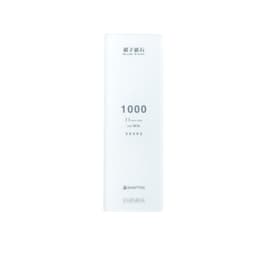
Shapton GlassStone 1000
The upgrade once you know you're sticking with sharpening: a thin, hard ceramic layer bonded to glass. It's splash-and-go (no soaking), stays dead flat far longer than a soft stone, and cuts fast. You'll pay for it.
Read the Shapton Glass 1000 reviewPrice as of October 16, 2026. #ad How we’re funded
If you want the finishing stone too, for almost nothing
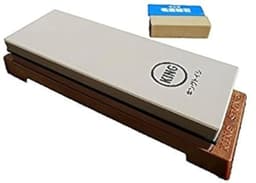
King (Matsunaga) KW-65 1000/6000 Combination Whetstone
The stone that has taught more people to sharpen than any other. One side 1000-grit to set an edge, one side 6000-grit to polish it, made in Japan, for the price of a takeout dinner. Start here.
Read the King KW-65 review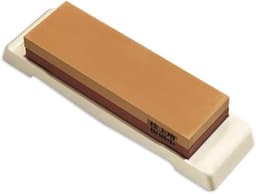
If you want a working kitchen finish rather than a polish
Naniwa Combination Ceramic 1000/3000 (QA-0124)
A harder, cleaner-feeling Japanese ceramic than the King, in a practical 1000/3000 pairing — a 3000 finish is plenty sharp for a kitchen knife and gets there faster than jumping to 6000. A great step up from a learner stone.
See it against the fieldFrequently asked questions
Is a 1000 grit whetstone enough?
For a kitchen knife in normal condition, yes. 1000 grit is the stone that does the actual sharpening — it is where a new apex is formed — and a knife that comes off a 1000 with the burr properly removed will slice paper and tomato skin cleanly. A finer stone changes how the edge feels and how it reflects light, not whether it is sharp.
When is 1000 grit not enough?
Two cases. If the edge is chipped, badly rolled or has been reground at the wrong angle, you need a coarse stone — around 400 grit — first, because removing that much steel on a 1000 takes an hour and dishes the stone. And if you want a polished, low-friction finish on a hard Japanese blade, a 3000 to 6000 finishing stone is what produces it.
Do I need a 6000 grit whetstone?
Need, no. Want, possibly. A 6000-grit finish reduces the microscopic saw teeth left by the 1000, which makes the edge glide more and bite less. That is better for slicing raw fish or tomatoes and slightly worse for gripping a chicken skin. Most 1000/6000 combination stones cost barely more than a single 1000, so the question is usually moot.
Is 1000 grit finer than 6000?
No — on the Japanese water-stone scale, higher numbers are finer. 1000 is a medium sharpening stone; 6000 is a fine finishing stone; 400 is coarse and used for repair. The numbers count abrasive particles per unit area, so bigger number means smaller particles and a smoother scratch pattern.
Can I sharpen a Japanese knife with only a 1000 grit stone?
Yes, and many people do. A VG10 or VG-MAX edge at around 60 HRC takes a 1000-grit edge well. Two cautions specific to hard Japanese steel: use light pressure, because hard steel leaves a tenacious burr that wants stripping rather than bending off, and keep the stone flat, since a dished stone grinds a convex bevel.
Is 3000 grit enough as a finishing stone?
Yes — 3000 is a perfectly good finish for a kitchen knife, and some people prefer it to 6000 because it leaves slightly more bite for cutting through skins. A 1000/3000 combination is a sensible pairing for a working kitchen, where the jump from 1000 is small enough that the finishing pass takes only a few strokes.
What grit whetstone should I buy first?
1000, every time — either as a single stone or as the coarse side of a 1000/6000 or 1000/3000 combination. A kitchen knife that is simply dull needs exactly this grade, and buying a fine stone first is the classic beginner mistake: it is slow, unforgiving, and it will not form a new edge on a knife that has lost one.
How do I know if my 1000 grit edge is actually sharp?
Test it rather than looking at it. A properly apexed and deburred 1000-grit edge will slice through printer paper without catching, bite into a tomato skin under its own weight, and shave hair off your forearm. If it fails those, the problem is almost always a burr that was never removed or an apex that was never formed — not a missing finishing stone.
Sources
- Japanese Water Stones — Sharpening Supplies — The two families of water stone: soaking stones that must be submerged until saturated, and splash-and-go stones that need only surface water (accessed August 13, 2026)
- Sharpening stone — Wikipedia — Reference on water, oil and diamond stones: Japanese water-stone grit ranges, why stones dish in the middle with use, and why a diamond plate retains its flatness (accessed August 13, 2026)
- Knife sharpening — Wikipedia — Reference on edge angle, coarse-to-fine grit progression, and honing vs sharpening (accessed July 21, 2026)
- How to Sharpen a Knife With a Whetstone — Montana Knife Company — Master-bladesmith walkthrough of whetstone angle, grit progression and deburring (accessed July 21, 2026)
- DMT Diamond and Ceramic Color-Coded Grit Chart — Sharpening Supplies — DMT's own color codes with the mesh and micron figure for each grade (Coarse 325/45 µm, Fine 600/25 µm, Extra-Fine 1200/9 µm) (accessed August 11, 2026)
- Shun Knives FAQ — Shun Cutlery (Kai USA) — Shun's own answers: 'Shun hardens VG10 and VG-Max steel to 60-61 Rockwell and SG2 to 61-62', 'Shun knives, for example, are sharpened to a 16 degree angle on each side of the blade', and on rods, 'Please do not use a diamond steel for regular honing. Diamond steels are for sharpening and will remove metal from your knife before it is necessary' (accessed August 28, 2026)
- Comparing Naniwa Stones — Sharpening Supplies — Line-by-line record of which stones in one maker's range soak (Traditional, Aotoishi, Lobster, Hibiki — 'soaked for several minutes') and which are splash-and-go (Chocera Pro, S1/S2 Advance, diamond) (accessed August 13, 2026)
Per-knife specs (steel, HRC, blade length, geometry) are read from each maker’s spec sheet or product listing and dated on the individual review cards above. “Not published” means the manufacturer does not state that figure — we flag it rather than guess.
Keep reading
Whetstone Grit Guide
What every number on a stone means, from 220 to 8000.
Read the guide1000 vs 6000 Grit
The two sides of a combination stone, head to head.
Compare themBest Combination Whetstones
Two grits in one block — the field, compared.
See the picksHow to Sharpen a Knife
The motion, the angle and the burr, step by step.
Learn the methodHow to Test Knife Sharpness
Repeatable tests, so you know whether the stone did its job.
Run the testsHow to Flatten a Whetstone
The maintenance that decides whether your 1000 stays useful.
Learn the method