Sharpening a Damascus Knife
The pattern is on the cladding, the edge is on the core. Sharpen the core correctly and the pattern is never at risk — it is polishing the flats that destroys it.
How this is funded: we earn a commission if you buy through our links, at no extra cost to you. As an Amazon Associate we earn from qualifying purchases. It never changes which knife we recommend, and we’ll tell you when we’d skip one. Full disclosure.
Sharpening will not ruin the pattern. The thing that ruins the pattern is polishing or sanding the flats of the blade — and nothing about correct sharpening involves touching the flats. If you take one thing from this page: the stone meets the last millimetre or two of the blade, at an angle, and the decorative layers live on the faces above that.
Here is the construction, in the makers’ own words. A Damascus kitchen knife is almost always san-mai— a hard core sandwiched in softer stainless. Shun publishes its Classic 8-inch as a “VG-MAX” core in “69 layer Damascus,” described as “34 layers of stainless Damascus cladding each side (68 total),” with a “16 degree edge each side.” ZWILLING publishes the Miyabi Kaizen II as an FC61 core at “60-62 HRC” under “48 layers of stainless steel.” The Enso HD line is published as a “VG10 stainless steel core. 61 Rockwell.” with “37-layer Damascus with a hammered tsuchime finish.”
In every one of those, the hard core runs down the middle and forms the edge. The cladding is a structural jacket — hard steel is brittle, so wrapping it in something more ductile makes the blade tougher — and the pattern is what that jacket looks like. So when you sharpen, you are sharpening the core. The layers are bystanders.
What sharpening actually changes
One visible thing, and it is not damage. The layers run through the blade in sheets, so grinding a bevel cuts across them and exposes a fresh cross-section. The result is a crisp line where core meets cladding, just above the bevel. Over years of sharpening that line migrates very slightly up the blade as the edge retreats. That is the normal life of a clad knife, and on a hammered (tsuchime) finish it is barely perceptible.
What does notchange: the pattern on the flats, the contrast, the finish. Those are only at risk from refinishing — polishing compound, sandpaper, a buffing wheel, or a well-meant attempt to “restore the shine.” A polishing wheel across the faces of a Damascus blade will flatten the contrast permanently. Do not do it. Washing and drying is the entire cosmetic maintenance routine.
What to look for in a stone for a clad blade
Pick for the core steel, not for the cladding.The core is a hard stainless at 60–62 HRC. That means you want stones that cut hard steel without needing excessive pressure, and it means skipping very coarse grits unless there is damage to remove.
1000 grit to set the edge. This is the workhorse. A 1000-grit water stone raises a burr on a 60 HRC core in a reasonable number of passes without removing more than necessary.
3000–6000 to refine.Worth it on this class of knife. A hard core holds a finer apex than soft Western steel can, so the polish you put on it actually survives some use. Beyond 6000 you are into diminishing returns for kitchen work — see our grit guide.
Hard, flat-staying stones over soft muddy ones.A soft stone dishes faster, and a dished stone grinds a convex bevel — which on a thin clad edge is the actual risk to the knife. If a stone needs soaking, know which kind you have: soaking stones must be submerged until saturated, while splash-and-go stones need only surface water. Our soaking guide covers which is which.
The method, start to finish
- Match the published angle.Shun publishes 16° per side; ZWILLING publishes 9.5–12° for the hand-honed Miyabi; most VG10 clad knives sit around 15°. Sharpening a 16° knife at 20° works but thickens the edge over time. Our angle guide shows how to find and hold it.
- Keep the stroke on the bevel.Spine low, consistent. Resist the temptation to lay the blade flat to “clean up” the face — that is how you scuff cladding.
- Raise a burr along the whole edge, then switch sides. Heel and tip included. Without a burr the two bevels have not met and there is no apex.
- Refine on 3000–6000 with lighter alternating passes. A few per side, decreasing pressure.
- Deburr gently. A dozen ultra-light passes on the finest stone, or a few strokes on a strop. Our stropping guide covers the spine-first stroke.
- Wash, dry, put it away dry. Stone slurry left on a blade dries into a grey film that looks like the pattern has faded. It has not.
Three mistakes that do cause damage
Polishing the flats. Covered above, and it is the only truly irreversible one.
Routine diamond honing.Shun’s own FAQ: “please do not use a diamond steel for regular honing. Diamond steels are for sharpening and will remove metal from your knife before it is necessary.” Use a ceramic rod for touch-ups on a hard core, and a ribbed steel on nothing harder than a German blade.
A pull-through carbide sharpener.Two carbide teeth tear steel out of the edge at a fixed angle that is almost never your knife’s angle. On a 60 HRC clad core, that means chipping along the apex and an edge that needs real grinding to recover — see fixing a chipped knife for what that costs you.
The three stones below are what we would put a Damascus-clad knife on: a hard splash-and-go 1000 for setting the edge, a 1000/3000 combination if you want one stone to do both jobs, and a three-grit option if you also need a repair grade.
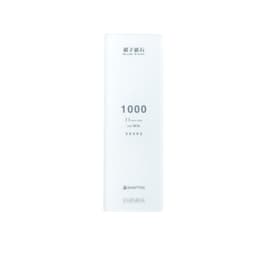
Our pick for hard clad cores
Shapton GlassStone 1000
The upgrade once you know you're sticking with sharpening: a thin, hard ceramic layer bonded to glass. It's splash-and-go (no soaking), stays dead flat far longer than a soft stone, and cuts fast. You'll pay for it.
Read the full Shapton reviewPrice as of October 6, 2026. #ad How we’re funded
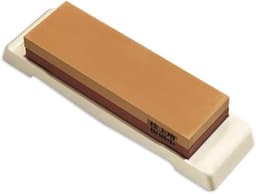
Set and refine on one stone
Naniwa Combination Ceramic 1000/3000 (QA-0124)
A harder, cleaner-feeling Japanese ceramic than the King, in a practical 1000/3000 pairing — a 3000 finish is plenty sharp for a kitchen knife and gets there faster than jumping to 6000. A great step up from a learner stone.
See it in the combination roundup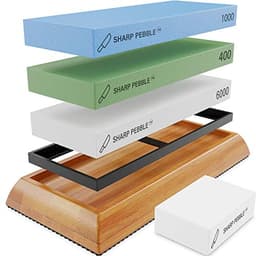
If you also need a repair grit
Sharp Pebble 400/1000/6000 Three-Grit XL Kit
The pick if you have knives that are actually dull or chipped, not just tired. Adding a 400 side means you can reset a bad edge without spending an hour on a 1000. Two extra-large stones and a base in one kit.
Compare the three-grit optionPrice as of October 6, 2026. #ad How we’re funded
Frequently asked questions
Will sharpening ruin a Damascus pattern?
Not if you sharpen the edge and leave the flats alone. A Damascus kitchen knife is san-mai: a hard core clad in patterned layers. Shun's own spec for the Classic 8-inch describes a VG-MAX core in '69 layer Damascus' — '34 layers of stainless Damascus cladding each side'. Sharpening grinds a bevel on the core steel at the edge. The pattern lives on the faces above that bevel and never touches the stone.
What grit whetstone for a Damascus knife?
The same grits as for any hard Japanese knife, because the core steel is what you are sharpening: 1000 grit to set the edge and 3000-6000 to refine it. Go coarser than 1000 only to remove a chip. The Damascus cladding is irrelevant to grit choice — it is softer than the core and it is not what forms the apex.
Can I use a diamond plate on a Damascus knife?
Yes for repair work, but water stones are the better routine choice. Diamond cuts fast, which on a hard thin core means it is easy to remove more than you intended, and the coarse scratch pattern needs refining afterwards anyway. Keep diamond for flattening stones and for grinding out chips.
Why does the pattern look different near the edge after sharpening?
Because you have exposed a new cross-section of the cladding. The layers run through the blade, so grinding a bevel cuts across them and reveals a new line where core meets cladding. That line moving slightly up the blade over years of sharpening is normal and unavoidable — it is not damage, and it is the only part of the pattern sharpening changes.
Should I etch or re-polish the pattern?
No, on a kitchen knife. Acid etching to deepen contrast is a refinishing operation, not maintenance: it attacks the softer layers preferentially and on a food knife it adds a chemical process for a cosmetic result. If the pattern has faded it is usually a smear of polish or oxide — a wash and a dry cloth is the whole fix.
Can I hone a Damascus knife on a steel rod?
Use ceramic, not a ribbed steel, and never a diamond rod routinely. These are hard cores — Shun hardens VG10 and VG-MAX to '60-61 Rockwell' per its own FAQ — and Shun's guidance is explicit: 'please do not use a diamond steel for regular honing. Diamond steels are for sharpening and will remove metal from your knife before it is necessary.'
Does Damascus cladding make the knife sharper?
No. Cladding is structural: a hard core is brittle, so wrapping it in softer stainless makes the whole blade tougher. A plain three-layer Tojiro does that job as well as 34 patterned layers. The pattern is a finish on top of the structure — which is also why sharpening does not compromise anything functional.
Sources
- Shun Classic 8-inch Chef's Knife — Shun Cutlery (Kai USA) — Shun's published spec for the knife itself: a 'VG-MAX' core in '69 layer Damascus' — described as '34 layers of stainless Damascus cladding each side (68 total)' — a '16 degree edge each side', an '8 in. (203mm)' blade, '6.7 oz (190 g)', an ebony-color Pakkawood D-shaped handle, 'Handcrafted in Seki City, Japan' and a 'Limited Lifetime Warranty'. No Rockwell figure appears on the product page (accessed August 28, 2026)
- Shun Knives FAQ — Shun Cutlery (Kai USA) — Shun's own answers: 'Shun hardens VG10 and VG-Max steel to 60-61 Rockwell and SG2 to 61-62', 'Shun knives, for example, are sharpened to a 16 degree angle on each side of the blade', and on rods, 'Please do not use a diamond steel for regular honing. Diamond steels are for sharpening and will remove metal from your knife before it is necessary' (accessed August 28, 2026)
- MIYABI Kaizen II 5000FCD 8-inch Chef's Knife — ZWILLING — Zwilling's published spec for the line: an 'FC61' core with fine carbide distribution at '60-62 HRC', '48 layers of stainless steel' Damascus over the core (49 total), an edge 'hand-honed using the historic Honbazuke method to an exceptionally sharp 9.5 to 12 degrees', a 'double ice-hardened FRIODUR' blade, a 'thicker and rounded bolster for increased comfort and balance', a black Pakkawood D-shaped handle, a 7.87 in blade at 0.44 lbs, handcrafted in Seki, Japan (accessed August 28, 2026)
- Enso Knives — Japanese Crafted HD, Hizashi, SG2, Hachi (Cutlery and More) — Published Enso HD line spec: 'VG10 stainless steel core. 61 Rockwell.', '37-layer Damascus with a hammered tsuchime finish', a triple-riveted canvas micarta handle, made in Seki, Japan (accessed August 18, 2026)
- Japanese kitchen knife — Wikipedia — Reference on gyuto/santoku/nakiri, single- vs double-bevel (kataba/ryoba) and edge angles (accessed July 21, 2026)
- Japanese Water Stones — Sharpening Supplies — The two families of water stone: soaking stones that must be submerged until saturated, and splash-and-go stones that need only surface water (accessed August 13, 2026)
- Knife sharpening — Wikipedia — Reference on edge angle, coarse-to-fine grit progression, and honing vs sharpening (accessed July 21, 2026)
Per-knife specs (steel, HRC, blade length, geometry) are read from each maker’s spec sheet or product listing and dated on the individual review cards above. “Not published” means the manufacturer does not state that figure — we flag it rather than guess.
Keep reading
Damascus Steel Explained
What the pattern is, what it does, and what you are paying for.
Read the guideHow to Sharpen a Knife on a Whetstone
The full step-by-step this page assumes you are following.
Learn the methodBest Whetstones for Kitchen Knives
The stones to do it on, compared by grit.
See the picksBest Sharpeners for Japanese Knives
Stones, guided systems and the electrics that can hold 15 degrees.
See the fieldShun Classic 8-inch Review
The 69-layer knife most people mean when they say Damascus.
Read the reviewVG10 Steel Guide
The core steel under most Damascus kitchen knives.
Read the guide