How to Sharpen Kitchen Shears
A pair of shears is two knives that have to stay in contact. That single fact decides everything: outside bevel only, one blade at a time, and nothing at all on the flat inner faces.
How this is funded: we earn a commission if you buy through our links, at no extra cost to you. As an Amazon Associate we earn from qualifying purchases. It never changes which knife we recommend, and we’ll tell you when we’d skip one. Full disclosure.
Sharpen kitchen shears the way you would sharpen two short knives that have to stay in contact: open the blades, lay a flat abrasive flush against the narrow bevel on the outsideface of one blade, stroke along it toward the outside of the shears, then rotate the pair 180 degrees and give the other blade the same treatment. Never abrade the flat inner faces. That is the whole method, and it is DMT’s own published sequence for scissors.
The reason this gets botched so often is that shears look like a knife and behave like a machine. A knife has one job: an apex that parts whatever it meets. A pair of shears has two edges that have to pass each other in continuous contact, shearing the food between them — which is why a pair can be perfectly sharp and still fold a chicken skin instead of cutting it. Sharpening is only one of the three things that can be wrong, and it is not the most common one.
First: is it actually dull?
Run this before you touch an abrasive. Close the shears slowly on a strip of printer paper, starting at the heel and working toward the tip.
- Cuts at the heel, slips at the tip. The pivot is loose. The blades are separating under load, so there is nothing to shear against. Tighten the pivot screw a little at a time until the blades move smoothly without flopping apart. No amount of sharpening substitutes for this.
- Feels gummy or sticky all the way along.Residue on the inner faces. Wash and dry the pair — by hand, because a dishwasher is hard on edges and on pivots for the same reasons the makers give for knives.
- You can see light glinting off flattened or nicked spots on the edge. That is wear or damage, and sharpening is the answer.
- There is a visible gap between the blades when closed. A blade is bent or the pivot is sprung. Sharpening will not close a gap; a cheap pair is finished and a good pair is a job for a repair service.
That diagnosis-first habit is the same one why knives get dull so fast argues for on knives: most of what people call dullness is something else, and grinding steel off is the one step you cannot undo.
The geometry that decides the method
Pick up a pair of kitchen shears and look at one blade end-on. You will see a narrow ground bevel on the outsideface — often quite wide and obtuse compared with a kitchen knife — and a flat, unbeveled inner face. The two inner faces are what ride against each other. That contact is the mechanism: the food is trapped between two edges moving past one another, not parted by a single apex.
Two rules fall straight out of that:
Rule one: only the outside bevel gets abraded.That is the surface that forms the cutting edge with the inner face, and it is the surface DMT’s instruction tells you to register against.
Rule two: the inner faces stay exactly as they are.Grind, strop or polish them and you remove material from the plane that keeps the blades touching. The result is a gap, and a pair of shears with a gap folds food. This is the single most common way an enthusiastic sharpener ruins a pair — usually by treating each blade as a tiny knife and giving it a bevel on both sides, the way our knife walkthrough describes for an actual knife.
DMT’s published sequence, and the detail worth noticing
We are leaning on DMT here because it is a sharpener maker that publishes per-tool instructions rather than general encouragement. Its scissors entry names the Diafold as the sharpener shown, with the Diafold Flat File, Mini-Hone or Mini-Sharp as alternatives, and gives three steps: align the sharpener flush with the bevel, “stroke smoothly toward outside of scissors,” then rotate the scissors 180° and repeat.
The detail worth noticing is the stroke direction, because DMT does not use the same one for every tool. For scissorsit says to stroke toward the outside of the scissors — along and off the bevel, away from the cutting edge. For pruners, one entry down, it says to “stroke into the bevel edge.” And on its guided knife instructions it says to “lightly stroke away from the body,” setting the clamp to the bevel angle, which it gives as “20° for most edges,” and to “progress to finer grits for the desired result.”
Those are three different instructions for three different jobs, from one maker, and the scissors one is deliberately the gentlest: stroking off the edge rather than into it raises less of a burr on a face you are not allowed to dress. Note also what DMT does notpublish for scissors: any angle in degrees. It does not need to, because “flush with the bevel” means the factory angle is the target. Its FAQ makes the governing point for all of this anyway — “sharpening at the proper angle is not as important as sharpening at a constant angle.”
What to sharpen them on
You need a flatabrasive wide enough to lay a bevel on, and that is the whole specification. DMT’s own scissors recommendation is one of its small folding tools, which is a sensible thing to keep in a drawer; what our registry carries is the bench-size equivalent, and a bench plate does the same job with more room to work.
One distinction matters when you pick a plate. An interrupted or “polka-dot” surface has recessed holes so debris falls away, which is excellent for knives and less good here, because a short bevel and a pointed shear tip can drop into a hole mid-stroke. DMT describes its Dia-Sharp plates as having a “continuous diamond surface” that “assures consistent, even sharpening every time” and says the sharpening surface “accommodates range of edges from large knives to small pointed tools” — which is exactly the case for using the continuous one on shears. It is also “guaranteed not to hollow or groove,” and flatness is the one property this job cannot do without.
On grit: DMT publishes its grades as Coarse 325 mesh (45 micron), Fine 600 mesh (25 micron) and Extra-Fine 1200 mesh (9 micron). Fine is the working grade for a pair that is merely dull. Reach for a coarse grade only if the edge is visibly nicked, and finish on something finer if you have it. The same coarse-to-fine logic applies on water stones, where a 1000-grit face does the work and a 3000 or 6000 refines it — our grit guide lays the scales out, and notes that they do not cross between systems.
| Works | Why | |
|---|---|---|
| Continuous-surface diamond plate | Best choice | Dead flat, never dishes, no holes for a tip to catch in |
| Interrupted / polka-dot diamond plate | Usable, with care | Flat and fast, but keep the tip clear of the recesses |
| Flat water stone (1000 grit) | Yes | A flat abrasive is a flat abrasive — keep it flat and know whether it soaks |
| Fine flat file | Yes | The traditional tool; DMT names its own folding flat file for scissors |
| Electric knife sharpener | No | EdgeCraft's own manual for the Trizor XV says not to sharpen scissors in it |
| Carbide pull-through | No | Sets a V angle on both sides — the one thing a shear blade must not get |
| Ceramic or steel honing rod | No | Round section cannot register flat against a short bevel |
| Dished stone | No | A hollow surface cannot make flush contact with the bevel at all |
The part nobody mentions: the pivot
Half of how a pair of shears feels is the pivot, and it is free to fix. A screw that has worked loose is the most common cause of a pair that “went blunt” overnight. Grit and dried food in the joint is the second. After sharpening, wash and dry the pair, put a single drop of food-safe oil on the pivot and work the blades through their full travel a dozen times. Then set the tension: tight enough that the blades stay in contact to the tip, loose enough that they close under their own weight when you hold the pair by one handle.
If your shears come apart — many kitchen pairs do, and the take-apart design exists precisely so the inner faces can be washed — use that. A single blade off the pivot lies on a plate like a short, wide knife, the bevel registers flat, and you can see what the abrasive is doing instead of guessing around the other handle.
Burr removal, which the shears do for you
On a knife, the burr — the thin wire of displaced steel that forms as you grind — has to be stripped deliberately, and failing to do it is why a freshly sharpened knife can die within a day. On shears you get most of it for free: open and close the pair a dozen times and make a few cuts through scrap paper, and the two blades shear the wire off each other as they pass.
What you must not do is “deburr” by running an abrasive or a strop along the inner faces. That is the same mistake as rule two above, dressed up as a finishing step. If a wire edge is still catching after a dozen closes, give the outside bevel one more very light pass instead.
When to stop and buy a new pair
Shears are cheap relative to knives, and three faults are not worth chasing: a bent blade, a sprung or worn-out pivot that will not hold tension, and ground-off micro-serrations on a poultry pair. In each case the geometry that makes shears work has gone, and an edge is not the missing piece.
One last honest note about this site: our registry carries no dedicated scissor sharpener and no folding flat file, so the picks above are the flat plates and stones we already cover, chosen for this job rather than invented for it. If you want a tool whose only purpose is scissors, DMT’s own small folding sharpeners are the ones its instructions name, and we would rather point you at that than pretend a product we track is something it is not. For the shears that arrive in a knife block — the sets where shears are the most-used piece in the box — see our set roundup, and knife care covers washing and storage for everything sharp in the drawer.
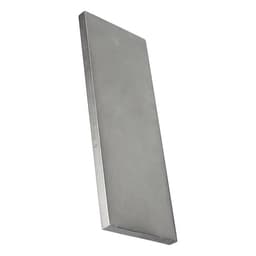
Best flat abrasive for shears
DMT D8F Dia-Sharp 8-inch Bench Stone, Fine
The single-grit, continuous-surface plate — no holes, so nothing catches a thin blade tip on the way across. Fine 600 is the grit a kitchen knife actually lives at, and this is the version to buy if you want one plate that does the job properly rather than two that do it adequately.
Read the Dia-Sharp D8F reviewPrice as of October 21, 2026. #ad How we’re funded
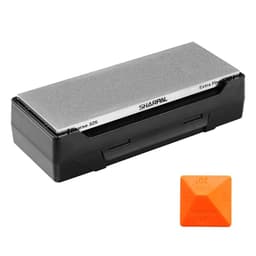
If the pair is badly neglected and needs a coarse grit first
SHARPAL 162N Dual-Grit Diamond Whetstone 8 x 3 in.
The value pick, and the one we would put in a beginner's hands. A full 8 x 3 inch face — wider than the DMT — at Coarse 325 and Extra Fine 1200, in a storage case whose lid doubles as a non-slip base. It even ships with an angle guide, which is the single thing beginners get wrong.
See it against the diamond fieldPrice as of October 21, 2026. #ad How we’re funded
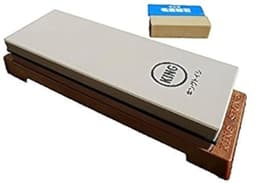
If you already own a water stone and want to use it
King (Matsunaga) KW-65 1000/6000 Combination Whetstone
The stone that has taught more people to sharpen than any other. One side 1000-grit to set an edge, one side 6000-grit to polish it, made in Japan, for the price of a takeout dinner. Start here.
Read the King KW-65 reviewFrequently asked questions
How do you sharpen kitchen shears?
On a flat abrasive, one blade at a time, working only the narrow bevel on the outside face. DMT's own scissors instruction is to align the sharpener flush with the bevel, 'stroke smoothly toward outside of scissors', then rotate the scissors 180 degrees and repeat on the other blade. The flat inner faces are never abraded — they are the mating surfaces that keep the two blades in contact.
Can you sharpen kitchen shears with a whetstone?
Yes. A whetstone is simply a flat abrasive, which is what the job needs — lay the outside bevel flush on the stone and push along it. Two cautions specific to stones: keep the stone flat, because a dished stone cannot register against a short bevel, and remember that soaking stones need to be saturated before use or they feel glazed and slow.
Can you put scissors through an electric knife sharpener?
Not the ones built for knives. EdgeCraft's own user guide for the Chef'sChoice Trizor XV says to 'not attempt to use this sharpener to sharpen either ceramic knives or scissors'. The slots present a blade at a fixed knife angle in a V, which is the wrong geometry for a single-bevel shear blade — some machines sell a dedicated scissor slot, and if yours does not have one, do not improvise.
What angle do you sharpen kitchen shears at?
The angle the factory already ground. DMT publishes an angle for knives — '20° for most edges' on its guided knife instructions — and publishes no angle at all for scissors, because the instruction is to match the existing bevel by laying the abrasive flush against it. That is the right approach: a shear bevel is short and wide, and inventing a new angle for it means grinding away a lot of steel for no benefit.
Why won't my shears cut even though they feel sharp?
Three causes that are not dullness. A loose pivot screw lets the blades separate under load, so they cut at the heel and slip at the tip. Dried food or sticky residue on the inner faces stops the blades riding against each other. And a bent blade or a sprung pivot opens a gap along the length. Check all three before you reach for a stone — sharpening a pair with a loose pivot changes nothing.
Should you sharpen both blades of a pair of shears?
Yes, and with the same number of passes at the same pressure. Each blade carries its own outside bevel and both do half the cutting, so working one and not the other leaves the pair asymmetric and the contact line uneven. DMT's instruction sequence is explicit about it: do one side, rotate 180 degrees, repeat.
How do you sharpen poultry shears or serrated kitchen shears?
Carefully, or not at all. Many poultry shears carry micro-serrations on one blade to grip skin and tendon; running them along a flat abrasive grinds those teeth off and you cannot put them back. If one blade is plain and the other serrated, sharpen only the plain blade's outside bevel. For genuinely serrated edges the tool is a tapered rod working one gullet at a time, which is a different job.
Can you sharpen take-apart shears more easily?
Much more easily, and it is worth checking whether yours separate before you start. A single blade off the pivot lies on a plate exactly like a short, wide knife: the bevel registers flat, you can see what the abrasive is doing, and nothing is in the way. Reassemble with a drop of food-safe oil on the pivot and tighten until the blades move smoothly without flopping.
How often do kitchen shears need sharpening?
Far less often than a knife, because shears do less work per week in most kitchens and their edges are thicker and more obtuse than a chef's knife's. Treat it as a once-a-year job, and run the diagnostic first: if a clean, correctly tensioned pair still fails to cut paper from heel to tip, then the edges need attention.
Sources
- Sharpening Instructions — DMT Diamond Sharpeners — DMT's own per-tool instruction page, covering Conventional Knives, Larger Knives, Scissors, Pruners, Serrated Knives, Chisels & Planes, Chainsaws and Flattening/Lapping as sections of one page. The SCISSORS entry names the Diafold as the sharpener shown, with the Diafold Flat File, Mini-Hone or Mini-Sharp as alternatives, and gives three steps: align the sharpener flush with the bevel, 'Stroke smoothly toward outside of scissors', then rotate the scissors 180 degrees and repeat. NO angle in degrees is published for scissors. The PRUNERS entry immediately after it instead says to 'Stroke into the bevel edge' — so one maker publishes OPPOSITE stroke directions for the two tools. The CONVENTIONAL KNIVES entry sets the clamp to the bevel angle, which it gives as '20° for most edges', says to 'Lightly stroke away from the body', to flip the knife and repeat on the opposite eyehook to hold the angle, and to progress to finer grits. Nothing on the page addresses dry or wet use; DMT's FAQ covers that separately (accessed October 20, 2026)
- DMT FAQ — DMT Diamond Sharpeners — DMT's own answers: on break-in, 'the diamond surface will seem aggressive in nature; the diamond sharpener will smooth after initial sharpening with no impact to long term performance. Your first few sharpenings are the break-in period'; 'DMT recommends you use DMT products dry or with water only'; care is to 'clean after each use with water and wipe dry' and 'After several sharpenings, use a mild kitchen abrasive cleanser and a nylon scrub brush'; on life, DMT sharpeners 'do not last forever, but they last for several years'; the polka-dot surfaces are 'slightly recessed' so debris falls away while Dia-Sharp's 'continuous diamond surface' suits 'small-pointed tools'; DMT recommends 'sharpening at a 20-degree angle' and notes 'sharpening at the proper angle is not as important as sharpening at a constant angle'; and the guarantee: 'If your product fails to perform due to defects in materials or workmanship, we will replace it regardless of age' (accessed September 18, 2026)
- 8-in. Dia-Sharp Bench Stone - Fine (D8F) — DMT Diamond Sharpeners — DMT's own product page for SKU D8F: 'Guaranteed not to hollow or groove', a 'precisely engineered Dia-Sharp Bench Stone with continuous diamond surface assures consistent, even sharpening every time', 'fine diamond (25 micron / 600 mesh) for honing a razor sharp edge', 'non-skid rubber feet with the diamond grit clearly marked on side of stone', a 'micronized monocrystalline diamond surface', 'No messy oils are needed either, allowing you to sharpen dry or with water', 'Sharpening surface accommodates range of edges from large knives to small pointed tools', suitable for 'edge repair and honing' and for 'flattening plane soles, irons and chisel backs', and 'Made in the USA'. DMT's own store price on the access date was substantially above what the Amazon listing has been running at. No weight is published (accessed October 7, 2026)
- DMT Diamond and Ceramic Color-Coded Grit Chart — Sharpening Supplies — DMT's own color codes with the mesh and micron figure for each grade (Coarse 325/45 µm, Fine 600/25 µm, Extra-Fine 1200/9 µm) (accessed August 11, 2026)
- Chef'sChoice 0101500 Trizor XV Electric Knife Sharpener - User Guide — A reproduction of EdgeCraft's own user guide for this model. It states that on a first sharpening of a European/American edge 'it may take up to 20 pair of pulls to fully re-angle the edge of a thin blade', that on a contemporary Asian blade 'only a few (1-2) pairs of alternating pulls... will be needed to develop a burr', that afterwards 'you should be able to re-sharpen to a razor sharp edge 3 or more times using only Stage 3', that serrated blades 'use only Stage 3' with 'five (5) to ten (10) pairs of alternating pulls', that you should 'not attempt to use this sharpener to sharpen either ceramic knives or scissors' nor 'ax blades or any blade that does not fit freely', and gives '125W on the nameplate' at 120V (accessed August 28, 2026)
- Knife sharpening — Wikipedia — Reference on edge angle, coarse-to-fine grit progression, and honing vs sharpening (accessed July 21, 2026)
- Sharpening stone — Wikipedia — Reference on water, oil and diamond stones: Japanese water-stone grit ranges, why stones dish in the middle with use, and why a diamond plate retains its flatness (accessed August 13, 2026)
- How to Sharpen a Knife With a Whetstone — Montana Knife Company — Master-bladesmith walkthrough of whetstone angle, grit progression and deburring (accessed July 21, 2026)
Per-knife specs (steel, HRC, blade length, geometry) are read from each maker’s spec sheet or product listing and dated on the individual review cards above. “Not published” means the manufacturer does not state that figure — we flag it rather than guess.
Keep reading
How to Sharpen a Serrated Knife
One gullet at a time, from the beveled side only — the right tool for serrated shears.
Learn the methodBest Diamond Sharpening Stones
Flat plates that never dish, which is what a short shear bevel needs.
See the picksSharpening Without a Whetstone
The three requirements any method has to meet, and the tricks that fail them.
Read the guideHow to Flatten a Whetstone
A dished stone cannot register against a short bevel. Here is the fix.
Learn the methodWhy Knives Get Dull So Fast
The same diagnosis-before-sharpening habit, applied to knives.
Read the guideProfessional Knife Sharpening
What a sharpening service charges, from two published rate cards.
Read the guide