Knives in the Dishwasher
Not a myth, and not mainly about the edge. Four things happen in there, the makers name three of them themselves, and only one category of kitchen knife is actually built for it.
How this is funded: we earn a commission if you buy through our links, at no extra cost to you. As an Amazon Associate we earn from qualifying purchases. It never changes which knife we recommend, and we’ll tell you when we’d skip one. Full disclosure.
The short answer: do not put a knife you care about in the dishwasher, and if you are going to do it anyway, own knives that are built for it — stamped commercial blades with textured polypropylene handles. This is not a knife-snob position. It is what the manufacturers themselves publish, and the damage is not the single vague “dulls the edge” effect people expect. There are four mechanisms, and they are separate.
ZWILLING names three of them in its own care instructions, which tell you to clean a knife “by hand using lukewarm water, mild dish soap and a non-scratch cloth or sponge” and rule the machine out for “aggressive chemical tablets,” “high temperatures” and “bumps and bangs with other objects.” The fourth is the handle, which the same page addresses separately: wooden handles are “not dishwasher-safe and should only be washed by hand.”
The four mechanisms, worst first
1. Physical contact — the one that actually dulls the edge. A dishwasher is a box in which loose items are sprayed hard with water for an hour. A knife in a basket rattles against the basket, against cutlery, and against whatever shifts mid-cycle. Each contact rolls or nicks the thin apex of the edge. This is why a dishwashered knife feels blunt long before it looks corroded, and it is also why loading orientation does not save it.
2. Detergent chemistry.Machine detergent is far more aggressive than hand dish soap by design — it has to work without scrubbing. It is alkaline and often chloride-bearing, and it is held against the steel, hot, for the length of the cycle. On stainless that attacks the passive chromium oxide film the blade depends on; the visible result is a grey haze on the blade faces and, in time, pitting. The rust and pitting guide covers how to tell cosmetic etching from permanent damage.
3. Heat.Dishwasher cycles are hot, and the dry cycle is hotter. Nothing in a run is hot enough to re-temper a blade and change its hardness — that takes far higher temperatures — but heat accelerates every chemical reaction in the box, and it is brutal on handle materials and on adhesives.
4. The handle.This is the damage that actually ends a knife’s life. Natural wood swells when soaked and shrinks unevenly as it dries, which lifts the finish and eventually loosens the scales from the tang. A loose handle is not repairable at home and it is a safety problem, not a cosmetic one. ZWILLING’s own maintenance advice for wooden handles — hand wash only, and “regularly treating the wood with oil (e.g. linseed oil) or wax (e.g. beeswax)” — tells you how much the material minds water.
Which knives are genuinely rated for it
Essentially one category: commercial stamped knives with textured polypropylene handles, built for kitchens that run everything through a dish machine by law and habit. The Dexter-Russell Sani-Safe is the canonical example — NSF certified, US-made, soft high-carbon stainless on a Grip-Tex handle. It still comes out duller than it went in, which is fine, because the blade re-sharpens in minutes.
Note how narrow that is. Mercer’s Genesis block set — a forged, NSF-certified line sold heavily into culinary schools — prints “Hand Wash Only” in the same feature list as its NSF certification. NSF certification is about whether a handle can be cleaned, not about whether it survives a domestic dishwasher. Those are different claims, and the listing makes both.
At the other end: a Shun Classic has a pakkawood D-handle and a VG-MAX core at ~60–61 HRC taken to 16° per side. There is no version of the dishwasher question for that knife. The same is true of any stainless-clad Japanese blade, including the Tojiro DP that we recommend to first-time buyers everywhere else on this site.
Point up or point down?
Point down. The reason is injury, not metallurgy: point-up loading leaves an edge and a tip at hand height in a basket you reach into, often without looking. Point-down costs you nothing.
What point-down does not do is protect the knife. The edge still sits against the basket, the blade still gets struck by neighbors, and the detergent and heat do not care which way round it is. If you have been loading carefully in the belief that it preserves the edge, that is the one piece of folk wisdom here that does not survive contact with how the machine works.
What to do instead, and what to do about the knives you already machined
The alternative takes about four seconds: rinse under warm water with a drop of dish soap, wipe with a non-scratch sponge from spine to edge, dry with a towel, put it away. Store it with its own space rather than loose in a drawer — ZWILLING’s wording is that a knife needs “its very own space away from other objects, so not simply thrown in the cutlery drawer,” meaning a block, drawer organizers or sleeves. The rest of the routine is in our care and storage guide.
For knives that have already been through it for years: check for a hazy etch (cosmetic), pitting along the edge (permanent — sharpen past it), and any movement at the handle (stop using it). Then sharpen. Most machine-dulled knives are completely recoverable, and the three picks below cover both ends of the problem: a knife that does not mind, a knife cheap enough not to mind about, and a guided sharpener for getting the rest of the drawer back.
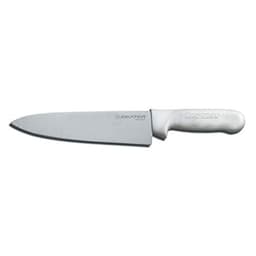
The one genuinely built for a dish machine
Dexter-Russell Sani-Safe 8-inch Chef's Knife (S145-8PCP)
The knife in the back of half the professional kitchens in America. NSF-certified, made in Massachusetts, and completely without charm — a light stamped blade in soft high-carbon stainless on a textured white polypropylene handle you can put through a commercial dishwasher.
See it in the professional roundupPrice as of October 6, 2026. #ad How we’re funded
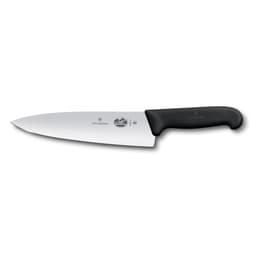
If a knife is going in anyway, make it this one
Victorinox Fibrox Pro 8-inch Chef's Knife
The knife that wins nearly every budget test, and the one to buy if you buy only one. A soft, stamped X50CrMoV15 blade at ~55-56 HRC and a grippy, non-slip handle — it dulls sooner than a hard Japanese knife but takes an edge back in seconds.
Read the full Victorinox reviewPrice as of October 6, 2026. #ad How we’re funded
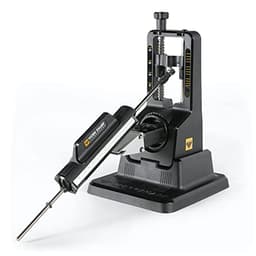
For recovering a drawer of machine-dulled knives
Work Sharp Precision Adjust Knife Sharpener
The guided system to buy if a whetstone has beaten you. The blade clamps, the angle sets by knob anywhere from 15 to 30 degrees in one-degree steps, and a rotating handle carries coarse diamond, fine diamond and a fine ceramic. It removes the one variable beginners cannot control: holding a consistent angle.
Read the full Work Sharp reviewPrice as of October 6, 2026. #ad How we’re funded
Frequently asked questions
Does the dishwasher really ruin knives?
Yes, through four separate mechanisms rather than one. ZWILLING names three of them in its own care instructions — 'aggressive chemical tablets', 'high temperatures' and 'bumps and bangs with other objects' — and the fourth is what hot water does to a wooden or composite handle. The edge damage people expect is real but is mostly caused by the blade knocking against the rack and other steel, not by the water.
Should knives go in the dishwasher point up or point down?
Point down, if they are going in at all. Point-up loading puts an exposed edge and tip at hand height in a basket you reach into, which is the main injury risk in the machine. Neither orientation protects the blade: the edge still contacts the basket and still gets hit by whatever shifts during the cycle. Loading advice is a safety answer, not a knife-care answer.
Which knives are actually dishwasher safe?
Commercial stamped knives with textured polypropylene handles, like the Dexter-Russell Sani-Safe, which is NSF certified and built for a commercial dish machine. Almost nothing else: Mercer's own Genesis set listing prints 'Hand Wash Only' alongside its NSF certification, and ZWILLING states that wooden-handled knives are 'not dishwasher-safe and should only be washed by hand'.
Will the dishwasher void my knife warranty?
It will not be covered, which amounts to the same thing. Warranties cover defects in material and workmanship: Wusthof's published terms exclude bent tips, chipped blades and customary wear, and ZWILLING's US warranty excludes defects resulting from 'misuse, abuse, alteration, negligence, or use of the product other than its intended purpose'. A knife the maker says to hand-wash, washed in a machine, is not a manufacturing defect.
What does the dishwasher do to a wooden knife handle?
Swells it, then dries it unevenly, which lifts the finish and can loosen the scales from the tang. ZWILLING's instruction for wooden handles is hand wash only, with the wood 'regularly treating the wood with oil (e.g. linseed oil) or wax (e.g. beeswax)'. Pakkawood and composite handles survive better than natural wood but are still a bad bet across hundreds of cycles.
My knives have been going in the dishwasher for years. What now?
Check for three things: a hazy grey etch on the blade faces, dark pitting along the edge, and any movement where the handle meets the tang. The etch is cosmetic. Pitting is permanent and means sharpening past the craters. Handle movement is the one to stop using the knife over. Then sharpen them properly — most dishwasher-dulled knives are perfectly recoverable.
Is a dishwasher worse than a sink for a knife?
Yes, on every mechanism except one: nobody reaches blindly into a dishwasher basket the way they reach into a sink full of suds, so the injury risk is different rather than higher. On corrosion, heat, detergent exposure and physical contact, the machine is worse in every case — it holds the blade wet and hot in a chloride-bearing solution for an hour.
Sources
- How to Clean and Care for Your Knife — ZWILLING — ZWILLING's own care instructions: 'clean it by hand using lukewarm water, mild dish soap and a non-scratch cloth or sponge', dried with 'a plain dishtowel or microfiber cloth'; the dishwasher is ruled out for 'aggressive chemical tablets', 'high temperatures' and 'bumps and bangs with other objects'. On wooden handles: 'not dishwasher-safe and should only be washed by hand', with the wood 'regularly treating the wood with oil (e.g. linseed oil) or wax (e.g. beeswax)'. On storage, a knife needs 'its very own space away from other objects, so not simply thrown in the cutlery drawer' — a block, 'drawer organizers or protective sleeves' (accessed September 23, 2026)
- Limited Lifetime Warranty Policy Details — WÜSTHOF — Wüsthof's published warranty terms: cover for the initial purchaser or gift recipient, and the exclusions (bent tips, chipped blades, honing steels, customary wear, commercial or educational use) (accessed August 13, 2026)
- Warranty USA — Zwilling J.A. Henckels — ZWILLING's US warranty terms, which govern a Miyabi purchase: products 'will be free of defects in material and workmanship from the date of purchase for as long as said purchaser owns the product'; it 'does not cover defects resulting from normal wear and tear, misuse, abuse, alteration, negligence, or use of the product other than its intended purpose'; 'the original purchaser must provide valid proof of purchase'; and it applies only to products 'purchased in the United States from Zwilling or a Zwilling authorized seller located in the United States', with ZWILLING reserving 'the right to reject warranty claims for products purchased from unauthorized sellers' (accessed September 23, 2026)
- Mercer Culinary M20050 Genesis 6-Piece Wood / Glass Knife Block Set — WebstaurantStore — The distributor listing for this set: 'German stainless steel blades with thick bolsters and full tangs', 'Ergonomic, easy-to-grip, soft Santoprene knife handles', 'Features a beech wood and tempered glass knife block' and 'Includes a paring, utility, boning, bread, and chef's knife' — itemized as a 3 1/2 inch paring, 5 inch utility, 6 inch boning, 8 inch wavy edge bread and 8 inch chef's knife in an 8 inch L x 3 1/4 inch W x 9 inch H block, blade material 'High Carbon Stainless Steel', features 'Hand Wash Only Non-Slip Handles NSF Certified'. No Rockwell hardness figure is printed (accessed August 26, 2026)
- Shun Knives FAQ — Shun Cutlery (Kai USA) — Shun's own answers: 'Shun hardens VG10 and VG-Max steel to 60-61 Rockwell and SG2 to 61-62', 'Shun knives, for example, are sharpened to a 16 degree angle on each side of the blade', and on rods, 'Please do not use a diamond steel for regular honing. Diamond steels are for sharpening and will remove metal from your knife before it is necessary' (accessed August 28, 2026)
- Knife Care 101: A Guide To Maintaining Your Knife — Benchmade — Benchmade's published factory edge spec — 'most Benchmade knives are sharpened at 30-35° inclusive (about 17-20° per side)' — plus its coarse-to-fine grit and stropping guidance (accessed August 13, 2026)
Per-knife specs (steel, HRC, blade length, geometry) are read from each maker’s spec sheet or product listing and dated on the individual review cards above. “Not published” means the manufacturer does not state that figure — we flag it rather than guess.
Keep reading
Why Your Knife Rusts
Brown spots, black spots and pitting — how to tell them apart and remove them.
Read the guideKnife Care and Storage
The full set of habits, including the four-second wash routine.
Read the guideBest Chef Knives for Professional Chefs
Where dishwasher-rated handles and NSF certification actually matter.
See the picksKnife Handle Materials
Pakkawood, POM, Santoprene and why the material decides this question.
Read the guideHow to Sharpen a Knife
Recovering the edges the machine has already taken off.
Learn the methodBest Sharpening Systems
Guided, electric and pull-through options for a drawer of dull knives.
See the field