Gyuto Knife Guide
The Japanese chef's knife explained: profile, steel and hardness, sizing, care, and how it differs from a Western chef's knife and a santoku.
How this is funded: we earn a commission if you buy through our links, at no extra cost to you. As an Amazon Associate we earn from qualifying purchases. It never changes which knife we recommend, and we’ll tell you when we’d skip one. Full disclosure.
A gyuto is the Japanese version of the Western chef’s knife — its name translates as “cow sword.” It is a double-bevel, do-everything blade with a pointed tip and a gentle belly, but ground flatter, thinner and harder than a German chef’s knife. That makes it a precise, keen-edged all-rounder for vegetables, herbs and boneless proteins — the one knife many home cooks reach for most.
What “gyuto” means
Gyuto literally translates as “cow sword” or “beef knife.” The name dates to Japan’s Meiji era in the late 1800s, when the country began eating beef again after centuries of restriction and adopted Western-style knives to butcher and portion it. Today the word simply means the Japanese take on the European chef’s knife — a general-purpose blade, not a meat-only tool. Despite its name, a gyuto spends most of its working life on vegetables.
Blade shape and geometry
A gyuto looks like a Western chef’s knife at a glance, but the profile is flatter: less curve through the belly and a longer straight section near the heel. That flat encourages a push-cut — guiding the blade forward and down rather than rocking it — which is the Japanese cutting style. The blade is also noticeably thinner behind the edge, so it wedges less and falls through dense vegetables like carrots and sweet potato with far less effort. A pointed tip keeps the detail work a santoku gives up, and the thin blade releases food more cleanly.
Gyutos are double-beveled (ryoba), meaning they are sharpened on both sides like a Western knife, unlike single-bevel Japanese knives such as the yanagiba. According to Wikipedia’s reference on Japanese kitchen knives, that double bevel is commonly ground around 15° per side, though many gyutos are taken finer — some to roughly 8–10° per side — for extra keenness at the cost of edge durability. A finer angle slices more cleanly but chips more easily, so the geometry is a deliberate trade between sharpness and toughness.
Steel and hardness
Steel is where a gyuto earns its price. Common stainless choices include VG10 and its refined cousin VG-MAX, and AUS-10 — all take a fine edge and resist rust, which makes them friendly to beginners. Carbon-steel fans reach for White #2 (Shirogami), which sharpens to an exceptionally keen edge but must be kept dry, because bare carbon steel develops a patina and will rust if left wet. At the premium end sit powder steels such as SG2 (also sold as R2), which hold an edge unusually well thanks to a fine, uniform grain structure.
Whatever the alloy, gyutos are usually hardened to roughly 58–62 on the Rockwell C scale — harder than a typical German chef’s knife, which sits around 56–58. Higher hardness buys a keener edge that lasts longer between sharpenings, but also a more brittle one that can chip if you abuse it. There is no single “best steel”; it is a balance of edge retention, ease of sharpening, toughness and rust resistance. If the steel names are a blur, our knife steel guide breaks down what each one is actually good at.
Handles: wa and yo
Gyutos come with two handle styles. A yo handle is the Western type — contoured, usually riveted, and immediately familiar if you have held a European knife. A wa handle is the traditional Japanese type — a lighter wooden handle, often octagonal or D-shaped, that shifts the balance forward toward the blade and can be replaced if it wears. Neither is better. A yo handle feels natural coming from a Western knife; a wa handle is lighter and puts more of the knife’s weight into the blade for a nimble feel. It comes down to preference.
Who a gyuto is for
A gyuto suits the cook who wants one knife to do almost everything and is willing to look after it. If you push-cut more than you rock, value a thin and precise blade, keep your knife off bones and frozen food, and will sharpen it on a stone, a gyuto rewards you with a cleaner cut and a longer-lasting edge than most Western knives. If instead you routinely force a blade through hard squash, twist the tip to pop joints, or want a knife you can put in the dishwasher and forget, a tough Western chef’s knife is the safer, lower-maintenance choice.
Gyuto vs Western chef’s knife
They do the same job; the differences are matters of degree. The gyuto is flatter (better for push-cutting, less ideal for hard rocking), thinner (cuts with less resistance, but less robust) and harder (keener and longer-lasting, but more prone to chipping). A German chef’s knife is curved, thick and tough — forgiving and low-maintenance. Neither is universally “better”; they reward different habits. We lay out every difference in gyuto vs chef knife.
Gyuto vs santoku
Both are Japanese and both push-cut, so they feel more alike than either does to a German knife. The gyuto is longer, keeps a proper pointed tip and retains some belly for versatility and reach, while the santoku is shorter, flatter and blunter-tipped. Choose a gyuto if you want reach, a fine point and a little rocking ability; choose a santoku for a compact, nimble blade on a smaller board. The full santoku guide covers that knife in depth.
What size gyuto should you buy?
Gyutos are sold by blade length in millimeters, most commonly 180, 210 and 240mm. A 210mm gyuto is the default for home cooks — long enough to slice a cabbage in half or carve a roast, short enough to feel controllable on a domestic cutting board. Choose 180mm if you have a small kitchen, small hands or limited board space; step up to 240mm if you cook on a large board, have big hands, or process a lot of produce and want the extra length to slice in one stroke. When in doubt, 210mm is the answer.
| 180 mm | 210 mm | 240 mm | |
|---|---|---|---|
| Suits | Small boards, small hands | Almost everyone | Large boards, big hands |
| Reach | Short — more strokes per job | Halves a cabbage comfortably | Slices a large roast in one pull |
| Handling | Very controllable | Balanced | Needs counter space and confidence |
| Watch out for | Overlaps a santoku | Nothing — this is the default | Awkward in a small sink or block |
The best gyutos, by budget
Once the shape makes sense, the buying decision comes down to one filter: does the maker name the steel and publish a hardness? A listing that says only “high carbon stainless steel” has nothing specific to claim. Below are the five gyutos we track, side by side on the figures each maker actually prints. Where a figure is missing, we say so rather than estimating it.
| Mitsumoto Sakari | Tojiro DP | MAC Chef Series | Shun Classic | Miyabi Kaizen II | |
|---|---|---|---|---|---|
| Tier | Entry | Value benchmark | Mid | Premium | Premium |
| Core steel | 9Cr18MoV | VG10 | Molybdenum-vanadium | VG-MAX | FC61 |
| Published hardness | Not published | ~60 HRC | ~59-61 HRC | ~60-61 HRC | ~60 HRC |
| Blade length | 200 mm | 210 mm | 203 mm | 203 mm | 200 mm |
| Factory edge | Double bevel | ~15° per side | Thin ground | ~16° per side | ~9.5-12° per side |
| Construction | 3-layer San-Mai | 3-layer, stainless-clad | Single steel, taper-ground | 34-layer Damascus | 48-layer Damascus |
| Buy it for | The shape, cheaply | The most steel per dollar here | The lightest, fastest feel | The finish and the keen 16° grind | A fuller handle than the Shun |
Entry: trying the shape
A budget three-layer gyuto with a 9Cr18MoV core is a genuinely usable stainless knife, and it is the cheapest honest way to find out whether you like a flat, thin Japanese profile before spending properly. The catch is the empty cell in the table above: no per-model Rockwell figure is published, so the hardness claim is marketing rather than a number anyone can be held to. Fit and finish vary at this price too — check the edge when it arrives.
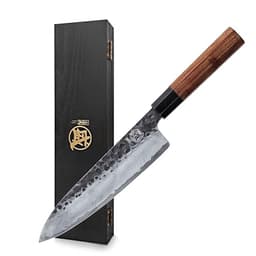
Entry — the shape without the Japanese-brand price
Mitsumoto Sakari 8-inch Gyuto (San-Mai 9Cr18MoV)
A budget three-layer gyuto with a 9Cr18MoV core — a genuinely usable stainless steel — for well under a hundred dollars. The honest catch: the maker does not publish a per-knife HRC, so you are trusting the marketing on hardness.
See all five gyutos comparedThe value line: where most people should stop
This is the tier that makes the rest of the table look expensive. A VG10 core at about 60 HRC, ground roughly 15° per side, is the same hardness band Shun publishes for VG10 and VG-MAX in its own FAQ — without the Damascus jacket that carries most of the price difference above. You give up the pattern and nothing that touches the food.
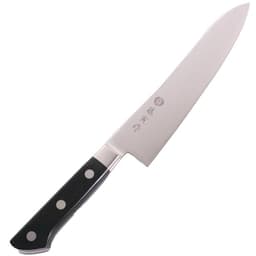
The value benchmark, and our default recommendation
Tojiro DP Gyuto 210 mm
The knife the internet has recommended to first-time gyuto buyers for a decade, and the numbers explain why: a real VG10 core at ~60 HRC for a fraction of the boutique price. Buy this before you spend three times as much.
Read the full reviewPrice as of October 20, 2026. #ad How we’re funded
Premium: what the extra money actually buys
Finish, mostly, and a slightly more acute factory grind. Shun states a 16° edge per side on the Classic; Zwilling states that the Miyabi Kaizen II is hand-honed to between 9.5° and 12°. Those are real differences you can feel on the first cut, and they are also differences a whetstone can give any knife on this page. What a stone cannot give you is 34 or 48 layers of Damascus cladding and a pakkawood D-handle, which is what you are genuinely paying for. Both are handmade in Seki, Japan, and both use a right-handed D-shaped handle.
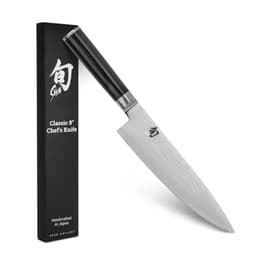
Premium — the Damascus knife everyone recognizes
Shun Classic 8-inch Chef's Knife
The knife most people picture when they think 'nice Japanese knife': a VG-MAX core at ~61 HRC under 34 layers of Damascus cladding, with a slim D-shaped handle. You pay for the finish, but the steel is genuinely hard.
Read the full reviewPrice as of October 20, 2026. #ad How we’re funded
All five, with live dated prices and the full spec table for each, are in best Japanese chef knives. If you are working out what to buy after the gyuto, the order we would buy in — gyuto, then petty, then nakiri — is set out in your first Japanese knife.
Living with a gyuto
A harder edge asks for a little discipline. Keep the knife off bones, frozen food and hard squash rinds it can wedge into and chip. Cut on wood or soft plastic, never glass, stone or ceramic, which are far harder than any knife edge. Hand-wash and dry it immediately — the dishwasher batters edges against other items and, on carbon steel, invites rust. Hone or strop lightly to keep the edge aligned between sharpenings, and when it finally dulls, sharpen it on a whetstone rather than a pull-through grinder that removes too much metal; our sharpening hub covers stones, angles and technique. Treated this way, a good gyuto stays keenly sharp for years.
Is a gyuto worth it?
For a cook who enjoys the act of cutting, yes. The thin, hard, flat blade genuinely cuts better than a chunky Western knife and holds its edge far longer between sharpenings, which is a quiet pleasure every time you cook. The trade is maintenance and care: it is less forgiving of abuse and expects hand-washing and stone sharpening. If that sounds like a fair deal, a gyuto is one of the most satisfying upgrades in a kitchen. Ready to shop? Our best Japanese chef knives roundup compares specific gyutos by steel, hardness and price.
Frequently asked questions
What is a gyuto knife used for?
A gyuto is an all-purpose chef's knife used for slicing, dicing and mincing vegetables and herbs, and cutting boneless meat and fish. Despite a name that means 'beef knife,' it handles the same broad range as a Western chef's knife, just with a thinner, harder, flatter blade that favors a push-cut. Keep it away from bones and frozen food.
What is the difference between a gyuto and a chef knife?
A gyuto is the Japanese version of a chef's knife. Compared with a German chef's knife it is flatter (better for push-cutting than rocking), thinner behind the edge, and harder (roughly 58-62 HRC versus about 56-58). That means a keener, longer-lasting edge, but a more delicate one that needs gentler use and hand-washing.
What size gyuto should I buy?
A 210mm gyuto is the best default for most home cooks. Drop to 180mm for small hands, small boards or tight kitchens; go up to 240mm if you have large hands, a big board, or do a lot of prep. Length is measured across the blade edge, not the whole knife.
Is a gyuto worth it?
If you enjoy cutting and will maintain the knife, yes. A gyuto's thin, hard blade cuts more cleanly and holds its edge far longer than a typical Western chef's knife. The trade-off is care: it can chip if used on bone or frozen food and should be hand-washed, dried and sharpened on a stone.
What is the best gyuto knife?
For most buyers the Tojiro DP 210 mm is the one to beat: a VG10 core at about 60 HRC, ground roughly 15 degrees per side, in a plain three-layer build so the money went into the blade rather than the finish. Above it, the Shun Classic (VG-MAX at 60-61 HRC, a 16-degree edge) and the Miyabi Kaizen II (an FC61 core, hand-honed to 9.5-12 degrees) buy finish and a more acute factory grind rather than a different class of knife.
How much should a gyuto cost?
Enough to get a named steel with a published hardness, and no more than that unless you want the finish. Below the value line the maker usually stops printing a Rockwell figure, which is information in itself. Prices on this site are pulled live and dated rather than written into the text, so use the buy buttons for what any of these actually costs today.
Is a gyuto a good first Japanese knife?
It is the only shape we would recommend as a first one. A santoku, nakiri, bunka or petty each gives something up — reach, a tip, or both — that a first knife cannot afford to lose. Buy the gyuto, learn what annoys you about it, and let that decide the second knife.
What is the difference between a gyuto and a santoku?
Length and the tip. A gyuto is usually 210 mm with a proper point and a little belly; a santoku is around 170 mm, flatter, and blunt at the tip. The santoku is more nimble on a small board and the gyuto is more versatile everywhere else, which is why the gyuto is the better single knife and the santoku is a good second one.
Sources
- Japanese kitchen knife — Wikipedia — Reference on gyuto/santoku/nakiri, single- vs double-bevel (kataba/ryoba) and edge angles (accessed July 21, 2026)
- Rockwell hardness test — Wikipedia — Definition of the Rockwell C (HRC) scale used to state knife-steel hardness (accessed July 21, 2026)
- Shun Knives FAQ — Shun Cutlery (Kai USA) — Shun's own answers: 'Shun hardens VG10 and VG-Max steel to 60-61 Rockwell and SG2 to 61-62', 'Shun knives, for example, are sharpened to a 16 degree angle on each side of the blade', and on rods, 'Please do not use a diamond steel for regular honing. Diamond steels are for sharpening and will remove metal from your knife before it is necessary' (accessed August 28, 2026)
- MIYABI Kaizen II 5000FCD 8-inch Chef's Knife — ZWILLING — Zwilling's published spec for the line: an 'FC61' core with fine carbide distribution at '60-62 HRC', '48 layers of stainless steel' Damascus over the core (49 total), an edge 'hand-honed using the historic Honbazuke method to an exceptionally sharp 9.5 to 12 degrees', a 'double ice-hardened FRIODUR' blade, a 'thicker and rounded bolster for increased comfort and balance', a black Pakkawood D-shaped handle, a 7.87 in blade at 0.44 lbs, handcrafted in Seki, Japan (accessed August 28, 2026)
Per-knife specs (steel, HRC, blade length, geometry) are read from each maker’s spec sheet or product listing and dated on the individual review cards above. “Not published” means the manufacturer does not state that figure — we flag it rather than guess.
Keep reading
Santoku Knife Guide
The shorter, flatter Japanese all-rounder compared.
Read the guideBest Japanese Chef Knives
Specific gyutos compared by steel, hardness and price.
See the roundupGyuto vs Chef Knife
Every difference between the Japanese and Western workhorse.
Compare themKnife Steel Guide
VG10, AUS-10, White #2, SG2 and what hardness means.
Decode the steelTojiro DP Gyuto Review
The default first gyuto, examined spec by spec.
Read the reviewGyuto vs Santoku
Reach and a tip, or a shorter flatter blade.
Compare themChef Knife Size Guide
Why 210 mm is the default, and when it is the wrong answer.
Read the guideTojiro vs Shun
Two gyutos with near-identical hardness and very different prices.
Compare themYour First Japanese Knife
What to buy after the gyuto, and in what order.
See the buying pathPetty Knife Guide
The small knife a gyuto owner reaches for most.
Read the guideBest Knife Gifts Under $150
Buying a gyuto for someone else? The picks, explained for the giver.
See the gift guide