Gyuto vs Santoku
Two Japanese knives, one decision: 210 mm of reach with a real tip, or 170 mm of flat, nimble blade. Often the same steel — genuinely different jobs.
How this is funded: we earn a commission if you buy through our links, at no extra cost to you. As an Amazon Associate we earn from qualifying purchases. It never changes which knife we recommend, and we’ll tell you when we’d skip one. Full disclosure.
Short answer: if this will be your only good knife, buy the gyuto. It is longer, it has a usable tip, and it does everything a santoku does plus several things a santoku cannot. Buy the santokuif you already own a chef’s knife you like, if your board is small, or if you chop straight down rather than rocking. They are often the same steel in the same line — this is a geometry decision, not a quality one.
| Gyuto | Santoku | |
|---|---|---|
| Typical length | 180-240 mm (210 standard) | 165-180 mm |
| Edge profile | Curved belly | Nearly flat |
| Tip | Fine, usable point | Blunt sheepsfoot |
| Best cutting motion | Rock or push | Push / straight down |
| Blade height | Moderate | Slightly taller for its length |
| Reach | Handles a cabbage or melon | Struggles with large produce |
| Point work | Trimming, scoring, boning | Very limited |
| Steel & hardness | Same within a line | Same within a line |
The tip is the real difference
Length gets all the attention and the tip matters more. A gyuto tapers to a fine point you can use: trimming silverskin off a piece of beef, scoring the skin of a fish, separating a chicken thigh at the joint, splitting a chilli lengthways, getting into the corner of a squash. A santoku’s sheepsfoot tip curves down to meet the edge and is effectively a rounded corner — safe, robust, and useless for any of those jobs.
If you cook mostly vegetables, you will barely notice. If you break down proteins even occasionally, you will notice constantly, and you will end up keeping a petty knife or a boning knife alongside the santoku — which rather undermines the argument for buying one knife.
The profile decides your cutting motion
A gyuto has a belly — the edge curves up toward the tip — so you can rock: keep the tip planted, pivot the handle, walk the blade through a pile of herbs. That is the motion most Western cooks learned, and a flat blade cannot do it.
A santoku’s edge is close to straight, which is exactly right for a push-cut: the blade comes down and slightly forward, the whole edge meets the board at once, the slice separates cleanly. There is no hinge left at the end of the cut and no wasted travel.
Neither motion is superior; using the wrong one for the knife is what feels bad. Cooks who try a santoku and dislike it are almost always trying to rock with it. Cooks who find a gyuto imprecise are often push-cutting with the curved section rather than the flatter heel. Match the motion to the blade and both feel excellent.
Length, boards and kitchens
210 mm sounds long until you halve a cabbage with it. Reach is genuinely useful for large produce, long slicing cuts, and for keeping your guiding hand clear of the edge. It needs a board to match: a gyuto on a small chopping board is awkward, and the tip hanging off the edge is how people cut themselves.
A 165–180 mm santoku fits a small board, a small kitchen and a small sink, and is easier to store on a short magnetic strip. If your kitchen is a galley and your board is the size of a laptop, that practicality outweighs a lot of theoretical versatility.
What does not differ
Within a single product line, the steel, the heat treatment, the hardness and the construction are the same across shapes. A Tojiro DP gyuto and a Tojiro DP santoku are both VG10 cores at around 60 HRC in a three-layer stainless-clad body. A Mercer Genesis chef’s knife and a Mercer Genesis santoku are both forged X50CrMoV15 at about 58 HRC.
That simplifies the decision usefully: pick the line on steel and budget, then pick the shape on how you cut. Our steel and hardness guide handles the first half, and this page handles the second. Both shapes have the same maintenance requirements too: hard Japanese steel wants a whetstone rather than a grooved rod, whatever shape it is ground into.
The honest recommendation
Most people should buy a gyuto first. It is the more capable tool and the tip matters more than the extra nimbleness. Then, if you find yourself prepping large quantities of vegetables and wishing for something shorter and flatter, add a santoku — or go one step further and add a nakiri, which takes the flat-edge idea to its conclusion.
The exception is the cook who already owns a Western chef’s knife they like. In that case a gyuto duplicates what you have and a santoku adds a genuinely different tool. Buy the shape you are missing, not the one you already own in another accent.
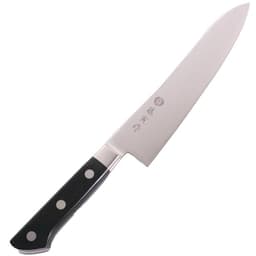
Our gyuto pick
Tojiro DP Gyuto 210 mm
The knife the internet has recommended to first-time gyuto buyers for a decade, and the numbers explain why: a real VG10 core at ~60 HRC for a fraction of the boutique price. Buy this before you spend three times as much.
Read the full reviewPrice as of October 20, 2026. #ad How we’re funded
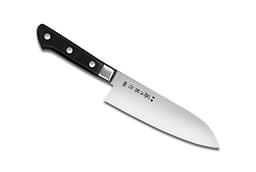
Our santoku pick — same steel, same line
Tojiro DP Santoku 170 mm
The same VG10 core and value proposition as the Tojiro DP gyuto, in the shorter, flatter santoku shape. If you push-cut and chop more than you rock, this is the format — and the best-value way into it.
See all the santokusPrice as of October 20, 2026. #ad How we’re funded
Frequently asked questions
What is the difference between a gyuto and a santoku?
Length and profile. A gyuto is the Japanese chef's knife — typically 210 mm with a curved belly and a fine, usable tip, built as an all-purpose blade. A santoku is shorter (usually 165-180 mm), flatter along the edge, and has a blunt sheepsfoot tip. The gyuto suits rocking and reach; the santoku suits push-cutting and control on a small board.
Which is better for a beginner, a gyuto or a santoku?
A santoku is slightly easier to control — it is shorter, lighter and the flat edge suits the straight-down chopping most beginners default to. But a gyuto is more versatile, and versatility matters more when you only own one knife. If it will be your only Japanese knife, buy the gyuto; if it is a second knife alongside a chef's knife you already like, the santoku adds more.
Can a santoku replace a chef's knife?
For most everyday home prep, yes — vegetables, boneless meat and fish are all well within its range. Where it falls short is anything needing reach (halving a cabbage, portioning a watermelon), anything needing a real point (trimming, scoring, boning), and any rocking motion. Plenty of cooks manage with a santoku alone and occasionally wish they had not.
Is a gyuto or santoku better for small hands?
A santoku, usually — it is shorter and lighter, so the balance point sits closer to your grip and the blade feels less like it is leading you. That said, hand size matters far less than board size and cutting style. If you have a small board, the santoku is the practical choice regardless of your hands.
Do gyutos and santokus use the same steel?
Frequently, yes. Within a single line — Tojiro DP, Shun Classic, Mercer Genesis — the gyuto and the santoku share a core steel, a heat treatment and a construction method, and differ only in shape. That is useful when comparing: if you have decided on a line, the steel question is settled and the choice is purely about geometry.
Sources
- Japanese kitchen knife — Wikipedia — Reference on gyuto/santoku/nakiri, single- vs double-bevel (kataba/ryoba) and edge angles (accessed July 21, 2026)
- Rockwell hardness test — Wikipedia — Definition of the Rockwell C (HRC) scale used to state knife-steel hardness (accessed July 21, 2026)
Per-knife specs (steel, HRC, blade length, geometry) are read from each maker’s spec sheet or product listing and dated on the individual review cards above. “Not published” means the manufacturer does not state that figure — we flag it rather than guess.
Keep reading
Gyuto Knife Guide
The shape in full — steel families, sizes, care.
Read the guideSantoku Knife Guide
The three-virtues knife, explained.
Read the guideBest Santoku Knives
Six santokus ranked on steel and grind.
See the picksChef Knife vs Nakiri
The other flat-edge decision worth settling.
Compare themSantoku vs Nakiri
The next comparison down, if the flat edge appeals.
Compare themBest Nakiri Knives
The tipless specialist, ranked on published specs.
See the nakirisTojiro DP Santoku Review
The same steel as the DP gyuto, in the shorter shape.
Read the review