Sujihiki Knife Guide
The long, thin double-bevel slicer. It does one job — separating a clean slice from a large piece of protein in a single pull — and nothing else in a knife drawer does it as well.
How this is funded: we earn a commission if you buy through our links, at no extra cost to you. As an Amazon Associate we earn from qualifying purchases. It never changes which knife we recommend, and we’ll tell you when we’d skip one. Full disclosure.
A sujihiki is a long, narrow, double-beveled Japanese slicer. Blades run from about 240 mm to 300 mm, the profile is nearly straight with a gentle rise to a fine point, and the whole knife is ground thin enough that it disappears into a piece of meat rather than pushing it around the plate.
The name is usually rendered as “muscle puller,” which is a better description of the job than “slicer” is. What the knife is optimized for is separating one clean slice from a large mass of protein in a single uninterrupted stroke — no sawing, no second pass, no torn surface.
Why length and thinness do the work
Every time you change direction mid-cut you leave a mark on the cut face. A short knife forces you to saw, so a slice off a roast ends up with a washboard surface that looks ragged and, on anything juicy, loses more moisture. A blade long enough to cross the whole cut in one draw leaves a single clean plane.
Thinness does the other half. A thick blade has to wedge the meat apart as it passes, which distorts the slice and drags. A sujihiki is ground thin from spine to edge and carries very little blade height, so there is almost no wedge. That is also why it is a poor board knife: the same absence of mass that makes it glide through a loin makes it fragile against a cutting board.
Sujihiki against the knives it competes with
Against a yanagiba. The yanagiba is the traditional single-bevel sashimi knife: ground on one face with a hollowed back, capable of a finer and more transparent slice than any double bevel, and completely handed. It also has to be sharpened with a specific single-bevel technique and left-handed versions are a special order. The sujihiki is the double-bevel answer to the same problem: 90% of the slicing performance, none of the complications.
Against a Western carving knife.A carving knife is typically thicker, softer (around 55-58 HRC) and often granton-dimpled. It is tougher, it costs less, and it will not chip if it catches a bone. The sujihiki is harder, thinner and more acute, so it cuts more cleanly and stays sharp much longer — and will punish contact with a bone. Which you want depends on whether you carve around bones or off them.
Against your gyuto. This is the comparison that actually decides the purchase. A 210 mm gyuto will carve a chicken and a small roast perfectly acceptably. Where it visibly falls behind is anything over about 15 cm across, anything you want to plate, and anything where the curve of the belly makes you lift the handle mid-stroke. If none of those describe your cooking, you do not need this knife.
What length to buy
240 mm is the default and the length most home kitchens should buy. It clears a standard roast, a turkey breast and most brisket flats in one pull, and it still fits in a normal knife block or on a magnetic strip.
270 mmmakes sense if you regularly cook large barbecue cuts — a full packer brisket, a whole pork shoulder — and have the counter space to swing it. 210 mmis sold as a sujihiki but behaves more like a narrow chef’s knife; if that is what you want, you probably want a petty or a gyuto instead. The general argument about length is in our chef knife size guide.
Steel, hardness and upkeep
Sujihiki are made almost exclusively by Japanese makers, so the steel follows the Japanese pattern: hard stainless at around 60–61 HRC on the mainstream ones, harder powder steels and carbon steels further up. Miyabi publishes 61 HRC for the Koh’s ice-hardened FC61 blade, which is at the hard end of stainless; Yoshihiro’s hammered Damascus version uses a VG10 core but publishes no hardness figure, which we note rather than fill in.
Maintenance is straightforward with one warning. A long thin blade is the easiest thing in the kitchen to chip, and chip repair on a 240 mm edge is a tedious job on a coarse stone. Keep it off bones, keep it off frozen anything, and never use it to scrape prep off a board with the edge — turn it over and use the spine. Otherwise it is a normal double-bevel knife: 15° per side, a 1000/6000 stone, a strop or a ceramic rod in between.
Who should actually buy one
Buy a sujihiki if you cook big proteins on purpose — roasts, smoked cuts, whole fish, a Sunday joint that matters — or if you have ever been annoyed by how a slice of your own cooking looked on the plate. It is a specialist, and specialists are worth owning when the specialty comes up often.
Skip it if you are still assembling a first set of knives. The order that serves most kitchens is a chef’s knife or gyuto, then a petty, then a bread knife, and only then something like this. Spending slicer money on a better main knife or on a stone to keep it sharp will change more meals.
Once you have decided the shape belongs in your kitchen, our sujihiki roundupcompares the three 240 mm slicers we track on the hardness and edge angle each maker publishes — and names the one specification none of them does.
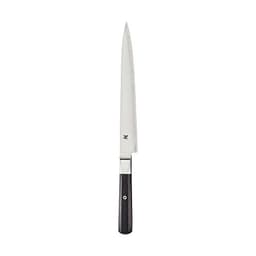
Our pick for a first sujihiki
Miyabi Koh 4000FC Sujihiki 240 mm
Miyabi's plainest line doing the slicer, and the only one at this length that puts a hardness number on the page: an ice-hardened FC61 blade at a published 61 HRC, hand-honed to 9.5-12° and left mirror-polished with no cladding and no Damascus. Buy it when you want the Seki grind and the figure, not the decoration.
Read the full reviewPrice as of October 19, 2026. #ad How we’re funded
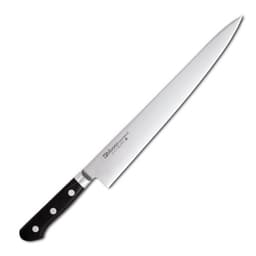
The plain mono-steel 240 mm for finding out whether you need one
Misono Molybdenum Steel Sujihiki 240 mm (No. 521)
Misono's plainest slicer: a single-layer molybdenum stainless blade from Seki with nothing clad onto it, in the 240 mm length our sujihiki guide says to buy first. Misono's own site names the steel family and the length and stops there — the hardness and weight below are the specialist retailer's figures, not the maker's.
See our picks for cutting meatPrice as of October 19, 2026. #ad How we’re funded
Frequently asked questions
What is a sujihiki used for?
Slicing cooked and raw protein: carving a roast, portioning a brisket, taking clean slices off a loin, skinning a salmon fillet, and any job where you want one long uninterrupted stroke rather than a sawing motion. The name translates roughly as 'muscle puller' — it is a knife for separating meat, not for board work.
What is the difference between a sujihiki and a yanagiba?
The bevel. A sujihiki is double-beveled and symmetrical, so anyone can use it and it sharpens like a normal knife. A yanagiba is single-beveled, handed, and ground on one face with a hollow back — it takes a finer sashimi slice and demands a specific sharpening technique. For a Western home kitchen the sujihiki is almost always the right answer.
Do I need a sujihiki if I have a chef's knife?
Only if you carve regularly. A chef's knife slices a roast adequately: it is shorter, thicker and curved, so you end up sawing, and the slices come out a little ragged. If you carve a joint once a year, live with it. If you cook large proteins often, smoke briskets, or care about how a plated slice looks, a sujihiki is a genuine upgrade rather than a luxury.
What length sujihiki should I buy?
240 mm for most home kitchens. The rule for a slicer is that the blade should clear the thing you are cutting in one pass, and 240 mm handles a standard roast, a turkey breast and most brisket flats. 270 mm is better for large barbecue cuts and worse in a small kitchen; 210 mm is really a long chef's-knife substitute rather than a slicer.
Sujihiki or a Western carving knife?
A sujihiki is thinner, harder and ground more acutely, so it takes cleaner slices and holds the edge longer — a Western carving knife at ~56 HRC will out-tough it and cost less. If you already own a carving knife and it works, there is no urgent case to replace it. If you are buying a first slicer and you already own hard Japanese knives, buy the sujihiki.
Can you use a sujihiki on vegetables?
You can, but it is the wrong tool and a slightly risky one. The blade is tall enough for very little knuckle clearance and thin enough to chip against a board with any lateral force. It also cannot rock-cut. Use it for what it is for and keep a gyuto or a nakiri on the board.
Sources
- Japanese kitchen knife — Wikipedia — Reference on gyuto/santoku/nakiri, single- vs double-bevel (kataba/ryoba) and edge angles (accessed July 21, 2026)
- Rockwell hardness test — Wikipedia — Definition of the Rockwell C (HRC) scale used to state knife-steel hardness (accessed July 21, 2026)
- 筋引 SUJIHIKI KNIFE — Misono Molybdenum series (MISONO CUTLERY CO., LTD.) — Misono's own size list for the Molybdenum-series sujihiki: 'No. 521' 240 mm, 'No. 522' 270 mm, 'No. 523' 300 mm, 'No. 524' 330 mm, 'No. 525' 360 mm. No weight, hardness, handle or bevel figure is published on the page; the company address is Seki, Gifu (accessed September 20, 2026)
- Molybdenum series — MISONO CUTLERY CO., LTD. — Misono's own description of the series: 'ハイカーボン13クロームステンレス・モリブデン使用' (high-carbon 13-chrome stainless with molybdenum), 'ハイレベルの磨き技術を用いた鋭い切れ味のステンレス刃' (a sharp stainless blade finished with high-level polishing); the English text calls it 'high-percent carbon and high-grade molybdenum-vanadium stainless steel' and 'rust resistant'. No Rockwell figure is published (accessed September 20, 2026)
- Misono Molybdenum Steel Series Sujihiki (240mm to 360mm, 5 sizes) — Japanese Chefs Knife (JCK) — The specialist retailer's spec table for the No. 521: 'AUS-8 Molybdenum Vanadium Stainless Steel', 'Rockwell Hardness (HRc): 57', 'Cutting edge length: 245mm (9.6")', 'Blade Thickness: 2.2mm (0.08")', 'Total Length: 365mm (14.3")', 'Total Weight: 157g (5.5oz)', 'Black Pakka Wood Handle with Stainless Steel Bolster', 'Full tang construction', 'Double Bevel Edge 70/30'. These are the retailer's figures, not Misono's — the product card says which is which (accessed September 20, 2026)
Per-knife specs (steel, HRC, blade length, geometry) are read from each maker’s spec sheet or product listing and dated on the individual review cards above. “Not published” means the manufacturer does not state that figure — we flag it rather than guess.
Keep reading
Miyabi Koh Sujihiki Review
Our pick for a first slicer, in full: the only 240 mm sujihiki whose maker publishes both the hardness and the edge angle.
Read the reviewBest Knives for Cutting Meat
Slicing, raw cuts and work near the bone — which shape does each job.
See the meat picksChef Knife Types Explained
Where the slicer sits among the other Japanese shapes.
See all the shapesGyuto Knife Guide
The knife a sujihiki supplements, never replaces.
Read the gyuto guideHow to Sharpen a Single-Bevel Knife
What you avoid by choosing a sujihiki over a yanagiba.
See what you're skippingChef Knife Size Guide
Why length is the spec people get wrong most often.
Read the size guideBest Sujihiki Knives
Three slicers at 240 mm, compared on published hardness and edge angle.
See the picks