How to Sharpen a Pocket Knife
Harder steel, a wider bevel and a blade too short for a kitchen stroke. Three things change when the knife lives in your pocket, and all three change what you should sharpen it on.
How this is funded: we earn a commission if you buy through our links, at no extra cost to you. As an Amazon Associate we earn from qualifying purchases. It never changes which knife we recommend, and we’ll tell you when we’d skip one. Full disclosure.
Most sharpening advice on this site assumes a kitchen knife: soft-to-medium stainless, a long blade, a thin grind, and a life spent on a wooden board. A pocket knife breaks all four of those assumptions, and people who sharpen kitchen knives competently often find their folder stubbornly refuses to come back. The technique is not the problem. The tool and the angle usually are.
Three things change, and each one has a consequence.
What is different about a pocket knife
1. The steel is harder and more wear-resistant.Folders are built for edge retention against cardboard, rope, tape and cable ties rather than for a keen push-cut through a tomato. The alloys used to get there resist abrasion by design, which is wonderful in your pocket and irritating on a stone: a soft water stone will polish such a blade for twenty minutes without meaningfully removing metal. This is the single most common reason a folder “will not sharpen.”
2. The factory angle is wider. Kitchen sharpening lives at 15 degrees per side for Japanese blades and about 20 for Western ones, as our angle guide sets out. Pocket knives sit at the wider end of that range or beyond it. Benchmade publishes the figure for its own knives: most are sharpened at 30–35 degrees inclusive, which works out at roughly 17–20 degrees per side. Tool makers reflect the same reality — Work Sharp sells 20° and 25° guides for exactly these edges. Sharpen a folder at 15 and you will spend a long session removing metal to produce an edge that chips the first time it meets a staple.
3. The blade is short.A 210 mm chef’s knife gives you a long, slow sweep in which to feel and correct your angle. A 75 mm folder gives you a fraction of that, so an error you would have caught mid-stroke on a kitchen knife simply becomes part of the bevel. Short blades also concentrate wear on one patch of a stone, which dishes soft stones fast.
Kitchen knife versus pocket knife, on the numbers
| Kitchen knife | Pocket knife | |
|---|---|---|
| Typical angle per side | 15° Japanese, 20° Western | About 17-20°, often wider |
| Steel priority | Keenness and ease of resharpening | Wear resistance and toughness |
| Best abrasive | Water stone or diamond | Diamond, or ceramic to finish |
| Blade length to control | 165-240 mm | 60-100 mm |
| Stroke | Full sweep heel to tip | Short blade worked in thirds |
| What dulls it | Boards, drying racks, dishwashers | Cardboard, rope, tape, abrasive grit |
| Guided systems | Optional | Genuinely helpful |
| Finish worth chasing | Polished, 3000-6000 | Toothy, around 600-1200 |
That last row surprises people. A mirror-polished apex slides through a tomato beautifully and is close to useless on rope, because a rope cut is a sawing action and a slightly coarse edge has micro-teeth to saw with. For a working folder, stopping at a fine diamond or a fine ceramic gives a more useful edge than grinding on to a 6000-grit polish. Our grit guide explains what each number actually leaves behind.
What to sharpen it on
A diamond plate is the default answer. Diamond is harder than any carbide in any knife steel, so it cuts wear-resistant alloys at the same speed it cuts soft ones, and a plate stays flat rather than hollowing out under a short blade. DMT publishes its grades as Coarse 325 mesh (45 µm), Fine 600 mesh (25 µm) and Extra-Fine 1200 mesh (9 µm); Fine 600 is the working grit for most maintenance, with Coarse reserved for a genuinely damaged edge. The full field is in our diamond plate roundup.
A guided clamp removes the variable that short blades punish. Clamp the blade, set an angle, and every stroke lands where the last one did. The Work Sharp Precision Adjust dials continuously from 15° to 30° in one-degree steps, which is enough range to match almost any folder; the Lansky system uses fixed guides at 17°, 20°, 25° and 30° instead, which is less flexible but faster to set and packs into its own case. Both are covered in the sharpening systems roundup.
A crossed-rod system is the fastest maintenance option. Two ceramic rods set in a base at a fixed included angle, held vertical while you draw the blade down each in turn. It cannot reprofile an edge and it will not fix real damage, but for five minutes of upkeep on an already-sharp folder it is quicker than anything else and almost impossible to do badly.
What to avoid: a carbide pull-through.The V-shaped carbide slot in a cheap pull-through scrapes metal off in shavings at whatever angle the housing dictates, which is not your knife’s angle. On a kitchen knife that is wasteful. On a folder with a hard, expensive blade it is vandalism, and it will chip the edge as often as it sharpens it.
The freehand method, in short
The full step-by-step is in the numbered walkthrough above; the short version is the same discipline as sharpening a kitchen knife, adapted for a small blade. Find the existing angle with a marker rather than guessing it. Work the edge in thirds instead of trying to sweep it. Raise a burr along the entire length on one side before you touch the other — that burr is the only proof that the two bevels have actually met — then match it. Refine, then strop it off.
The failure mode is nearly always the same one described in why your knife won’t get sharp: no burr was ever raised, so the apex was never reached, and everything after that was polishing a rounded edge. On a hard folder steel this takes longer to achieve and is therefore abandoned sooner.
Recurves, tantos and serrations
Not every folder has a plain, straight edge, and the awkward shapes need different handling.
A recurve— an edge that dips inward before sweeping up to the tip — cannot make full contact with a flat plate along its whole length. Sharpen the straight sections on the plate and the concave belly on a round or oval rod, or use a narrow slip stone that fits the curve. Trying to force a recurve flat on a bench stone grinds the curve out of it over a few sessions.
A tanto has two distinct edge segments meeting at an angular transition. Sharpen them as two separate straight edges, each at its own angle, and resist the temptation to round the corner between them — that corner is the point of the grind.
Serrations are the one case where the flat plate is entirely the wrong tool. Each scallop needs a tapered round rod worked into it from the flat back of the blade until a small burr appears on the front face, then a single light pass along the flat side to remove it. It is slow work, and the good news is that serrated edges stay functional for years, so most people need to do it very rarely.
Keeping it sharp between sessions
A charged leather strop does for a pocket knife what a honing rod does for a kitchen knife: it realigns steel that has bent out of line and polishes off the beginnings of a wire edge, without removing meaningful metal. Ten strokes per side, spine-first, once a week, and a folder that would otherwise need a plate every month can go a season. The stroke is identical to the kitchen version in how to strop a knife.
Two habits matter as much as the abrasive. Keep grit out of the pivot — pocket lint plus dust is a mild lapping compound, and it wears both the blade and the mechanism. And accept what the knife is for: if you regularly cut things that chip an edge, a slightly wider bevel that survives the week beats a keener one you have to rebuild every Sunday.
Everything else transfers directly from kitchen sharpening. If you can raise and chase a burr on a chef’s knife, you already have the skill; you mostly need a harder abrasive and a couple more degrees.
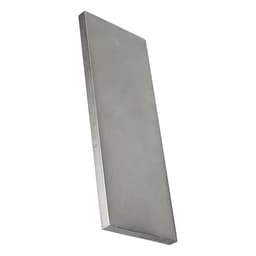
If you want to sharpen freehand
DMT D8F Dia-Sharp 8-inch Bench Stone, Fine
The single-grit, continuous-surface plate — no holes, so nothing catches a thin blade tip on the way across. Fine 600 is the grit a kitchen knife actually lives at, and this is the version to buy if you want one plate that does the job properly rather than two that do it adequately.
See the full diamond-plate fieldPrice as of October 20, 2026. #ad How we’re funded
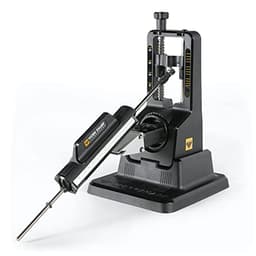
If you want the angle decided for you
Work Sharp Precision Adjust Knife Sharpener
The guided system to buy if a whetstone has beaten you. The blade clamps, the angle sets by knob anywhere from 15 to 30 degrees in one-degree steps, and a rotating handle carries coarse diamond, fine diamond and a fine ceramic. It removes the one variable beginners cannot control: holding a consistent angle.
Read the full Precision Adjust reviewPrice as of October 20, 2026. #ad How we’re funded
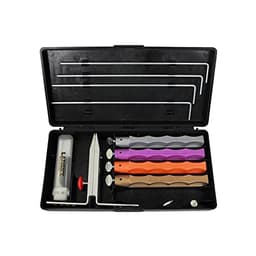
If you like fixed angles and a case
Lansky 4-Stone Deluxe Diamond System
The old-school clamp-and-guide-rod system, in its diamond version. You pick one of four fixed angles, thread the hone's rod through the matching hole, and stroke. Fixed angles are less flexible than Work Sharp's dial, but the four diamond hones cut fast and the whole thing folds into a case.
See the full sharpening-system fieldPrice as of October 20, 2026. #ad How we’re funded
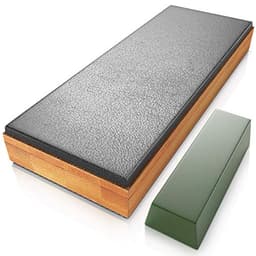
For the last thirty seconds of the job
Sharp Pebble Leather Strop for Knife Sharpening
The strop we would pair with a first whetstone. Leather mounted on a wooden paddle with polishing compound in the box, which is exactly the combination a beginner needs — a bare strop with no compound is a burnisher, not a finisher.
See the full strop fieldFrequently asked questions
What angle should I sharpen a pocket knife at?
Wider than a kitchen knife — around 20 degrees per side is the safe default, and the makers publish figures in that region. Benchmade states that most of its knives are sharpened at 30-35 degrees inclusive, which is about 17-20 degrees per side. If you do not know your knife's factory angle, color the bevel with a marker and find it rather than guessing: matching the existing grind is far quicker than regrinding the whole edge to a number you picked.
Can I use a kitchen whetstone on a pocket knife?
Yes, but it is often the wrong tool. Soft water stones cut slowly on the hard, wear-resistant steels used in modern folders, and they dish quickly when you work a short blade over the same few centimeters of stone. A diamond plate cuts those steels far faster and stays flat. If a soaking water stone is what you own, it will still work — expect it to take longer and to need flattening more often.
Why won't my pocket knife take an edge like my kitchen knife?
Usually steel, not technique. Folders are built from harder, more wear-resistant alloys than kitchen knives, which is exactly why they hold an edge through a season of cardboard and rope — and exactly why a soft stone skates over them. The other common cause is the same one that defeats kitchen sharpening: you never raised a burr along the full length, so the two bevels have not actually met at the apex yet.
Should I sharpen a pocket knife to 15 degrees like a Japanese knife?
No, unless it is a slicing-only knife you baby. A 15-degree edge is keener and more fragile, and a pocket knife's job — cardboard, cable ties, rope, the occasional thing it should not be cutting — chips and rolls a thin edge quickly. The wider bevel on a folder is a deliberate durability choice, not an oversight.
How do I sharpen a serrated pocket knife?
Not on a flat stone, which only grinds the pointed tips flat. Serrations need a tapered round rod worked into each scallop individually from the flat back of the blade, then a light pass along the flat side to knock off the burr. It is slow, and serrated edges stay usable far longer than plain ones, so most people should only do it every few years.
Do I need a guided sharpener for a pocket knife?
It helps more here than in a kitchen. A short blade gives you less time in each stroke to feel and correct the angle, so freehand errors show up faster on a folder than on a 210 mm chef's knife. A clamped guided system removes the variable entirely — the trade-off is speed and the clamp marking a soft handle scale if you overtighten it.
Sources
- Knife Care 101: A Guide To Maintaining Your Knife — Benchmade — Benchmade's published factory edge spec — 'most Benchmade knives are sharpened at 30-35° inclusive (about 17-20° per side)' — plus its coarse-to-fine grit and stropping guidance (accessed August 13, 2026)
- 20° & 25° Angle Guides for Whetstone Sharpeners — Work Sharp — Tool-maker reference for common Western (20°) vs finer (Japanese) sharpening angles (accessed July 21, 2026)
- Knife sharpening — Wikipedia — Reference on edge angle, coarse-to-fine grit progression, and honing vs sharpening (accessed July 21, 2026)
- DMT Diamond and Ceramic Color-Coded Grit Chart — Sharpening Supplies — DMT's own color codes with the mesh and micron figure for each grade (Coarse 325/45 µm, Fine 600/25 µm, Extra-Fine 1200/9 µm) (accessed August 11, 2026)
- Strop — Wikipedia — Reference on what stropping does to an edge: realigning bent steel, and light abrasion when a compound is used (accessed August 11, 2026)
Per-knife specs (steel, HRC, blade length, geometry) are read from each maker’s spec sheet or product listing and dated on the individual review cards above. “Not published” means the manufacturer does not state that figure — we flag it rather than guess.
Keep reading
Knife Sharpening Angle Guide
The kitchen numbers, and three ways to hold an angle without a jig.
Read the guideBest Diamond Sharpening Stones
Plates that cut hard steel fast and never need flattening.
See the picksBest Knife Sharpening Systems
Guided clamps and rod systems, ranked honestly.
See the picksHow to Strop a Knife
The spine-first stroke that takes the wire edge off properly.
Read the guide