How to Use a Nakiri Knife
Stop rocking it. A nakiri's dead-flat edge is the whole point of the knife, and once you cut with it the way it is built to cut, it is the fastest vegetable tool in the drawer.
How this is funded: we earn a commission if you buy through our links, at no extra cost to you. As an Amazon Associate we earn from qualifying purchases. It never changes which knife we recommend, and we’ll tell you when we’d skip one. Full disclosure.
Use a nakiri by push-cutting: set the whole edge on the food, drive it down and slightly forward until it meets the board, then lift, shift and repeat. The one thing you must not do is rock it like a chef’s knife — the edge is dead straight, so rocking lifts most of it off the food and leaves the familiar uncut hinge at the end of the stroke. Get that one change right and a nakiri is the fastest vegetable knife in the kitchen.
The nakiri is a Japanese double-bevel (ryoba) vegetable knife — tall, rectangular, flat-edged, with no point to speak of. The general reference on Japanese kitchen knives puts it alongside the gyuto and santoku as one of the modern double-bevel shapes, as distinct from the traditional single-bevel professional knives like the usuba. If you have just bought one and it feels strange, nothing is wrong with the knife: it is built around a different cutting motion than the one most Western cooks learn first.
Why the shape is the way it is
Three design decisions, each with a consequence you can feel:
- The edge is flat.It meets the board along its whole length at once, so a single downward push severs everything under the blade. There is no curve, which means there is nothing to rock on — and nothing left half-cut at the ends of the stroke.
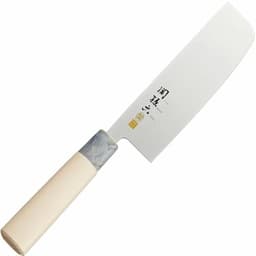
- The blade is tall. The KAI Seki Magoroku Ginju nakiri we track publishes 51 mm of blade height, which is real knuckle clearance: you can keep your guide hand curled on top of a big onion half and never touch your knuckles to the board. It also makes the blade face wide enough to use as a scoop.
- There is no tip. The front of the blade is squared or gently rounded off. That is a deliberate trade, not an omission: the shape exists for board work, and everything a point does is handled by a second knife.
The grip and the stance
Take a pinch grip — thumb and forefinger on the flats of the blade just ahead of the handle, remaining fingers around the handle. A nakiri usually has no bolster in the way and plenty of blade height, so the pinch grip is comfortable immediately. It matters more here than on a chef’s knife because you are controlling the squareness of the blade to the board, not a rolling motion, and your fingers on the blade are what tell you whether it is square.
Guide hand in a claw, knuckles forward, fingertips tucked. Because the knife is tall, the side of the blade rides against your knuckles very naturally, and the knuckles become the thickness gauge for every cut. Walk them back steadily and the slices come out even without you thinking about it.
The motion, in detail
Down and slightly forward. The downward component does the severing; the small forward push is what makes it a slice rather than a crush — a vegetable cell wall gives way far more cleanly to a blade that is moving along its own edge than to one coming straight down. Then lift the blade clear of the board, shift along, and push again. Lift, shift, push.
Two common errors. The first is rocking, which this page has already laboured, and the fix is simply to notice when the heel or the front of the blade lifts off the food during the stroke. The second is sawing — dragging the knife back and forth. A nakiri is thin and keen enough that it does not need multiple passes, and sawing on a flat edge just scrubs the apex against the board.
There is one legitimate variation: a very slight forward push-cut for soft items like a ripe tomato, where you let the edge travel further along its own length, and a straight drop for hard items like a carrot, where you want maximum downward force with the blade square. Both are still push cuts.
The four jobs it does better than anything else
| Nakiri | Chef's knife / gyuto | |
|---|---|---|
| Dicing onions and shallots | Faster — full-depth cuts, no hinge | Good, with a rocking motion |
| Slicing cabbage, chinese leaf, greens | Best in class — the tall flat edge shears it | Workable but slower |
| Planks and batons (carrot, daikon, potato) | Best in class — square blade, square cuts | Belly makes square planks harder |
| Moving prep off the board | Tall face scoops a whole board at once | Needs a bench scraper |
| Piercing, scoring, coring | Cannot — no tip | Yes |
| Protein and anything near a bone | No — wrong shape, chip risk | Yes |
| Long slicing (roast, melon, bread) | Too short at 165-180 mm | Yes |
What a nakiri cannot do, stated plainly
No piercing. No scoring fish skin. No coring a pepper from the inside. No trimming silverskin off a tenderloin. No boning, jointing, or anything that involves a twist. No bone, no frozen food, no squash shell — the edges on the better nakiris are thin and hard, and the Shun Classic nakiri, for example, is a VG-MAX core at the 60-61 Rockwell Shun publishes for that steel with a stated 16° edge per side. That combination cuts beautifully and chips if you treat it like a cleaver. Our meat-cutting page covers what to use instead.
One more honest limitation: at 165 to 180 mm a nakiri is short. A tall, flat, short blade is wonderful on a pile of vegetables and useless on a watermelon. It is a second knife — a very good one — and our first Japanese knife guide sets out the gyuto-then-petty-then-nakiri sequence for a reason.
The weight question, because it decides how it feels
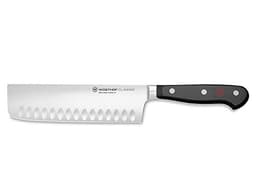
Nakiris vary enormously in mass for an identical blade length, and nobody warns you. Shun publishes 215 g for its 165 mm Classic nakiri — heavier than its own longer chef’s knife, because blade height drives weight. The KAI Ginju, the same 165 mm length in a single layer of stainless, publishes 120 g. The forged Wüsthof nakiri is heavier again, at a published 58 Rockwell in German steel.
A heavy nakiri falls through a carrot and tires your wrist on a long session; a light one needs you to push and feels nimble. Neither is wrong, but if you have used one and hated it, the weight is as likely a culprit as the shape. See our small-hands page for the same argument across other shapes.
Care, sharpening and the board you cut on
Hand-wash and dry immediately, and store it with nothing touching the edge. ZWILLING’s own care page is as blunt about this as any maker gets: no dishwasher, because of “aggressive chemical tablets,” “high temperatures” and “bumps and bangs with other objects,” and a knife needs “its very own space away from other objects, so not simply thrown in the cutlery drawer.” Our dishwasher page covers the mechanism.
Sharpening is ordinary double-bevel work on a stone — but flatness matters more here than on any other shape, in both directions. Your stone must be flat, because a dished stone grinds a convex bevel and a nakiri’s whole advantage is a straight edge that meets the board everywhere. And your strokemust not lift at the ends, because there is no tip to follow. A 1000-grit stone does the work, a 3000 or 6000 finishes it, and at 60 HRC and up you should keep the knife off a ribbed steel rod — Shun’s own FAQ even asks owners not to use a diamond steel for routine honing, because “diamond steels are for sharpening and will remove metal from your knife before it is necessary.”
Finally, the board. The edge touches it along its entire length on every cut, which makes a nakiri the knife most punished by a hard cutting surface. Wood or soft polyethylene; never glass, stone or ceramic. That single habit does more for a vegetable knife’s edge than any sharpening routine — as why knives get dull so fast explains.
If you are finding out whether you like the shape
KAI Seki Magoroku Ginju 165 mm Nakiri (AK5069)
Shun's parent company making a plain knife properly. A single-layer high-carbon molybdenum-vanadium stainless blade at 165 mm, ground in Seki and hung on a natural-wood handle — no cladding, no pattern, no pretense. The most sensible way to spend under $60 finding out whether a nakiri belongs in your kitchen.
See it against the nakiri field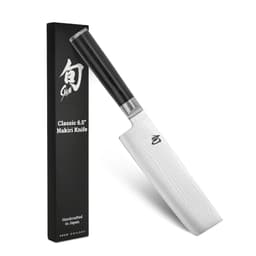
If you want the one most people end up buying
Shun Classic 6.5-inch Nakiri (DM0728)
The nakiri most people end up buying, and a fair default: VG-MAX core, Damascus cladding, and a genuinely flat 165 mm edge that meets the board along its whole length. Buy it if you want one vegetable knife and you want it to be nice.
Read the Shun Classic nakiri reviewPrice as of October 17, 2026. #ad How we’re funded
If your kitchen already runs on German knives
Wüsthof Classic 7-inch Nakiri
A nakiri built the German way: forged X50CrMoV15, full tang, a bolster and real weight in the hand. It gives up the keenness of the Japanese nakiris and gets back a blade you can maintain with a rod and cannot easily chip.
See the Wüsthof linePrice as of October 17, 2026. #ad How we’re funded
Frequently asked questions
What is a nakiri knife good for?
Vegetables, in volume, cut straight. It is the best tool in a kitchen for dicing onions, slicing cabbage and chinese leaf, cutting carrots and daikon into planks and then batons, breaking down squash flesh, and shredding greens — anything where you want clean, even, full-depth cuts. The tall flat face also works as a bench scraper to move the prep off the board.
How do you use a nakiri knife correctly?
Push cut, never rock. Take a pinch grip at the heel, lay the full edge on the food with the blade square to the board, and drive it down and slightly forward until the edge meets the board. Then lift clear, shift along by the thickness of your next cut, and repeat. The edge is straight, so rocking it the way you rock a chef's knife just lifts most of the edge off the food.
Can a nakiri replace a chef's knife?
No. It has no usable tip, so it cannot pierce, score, core, trim a chicken breast or do any fine point work, and the flat profile cannot rock. A nakiri is the best second knife in a vegetable-heavy kitchen and a poor only knife. If you want one knife, buy a 210 mm gyuto or chef's knife.
Why is my nakiri leaving the last bit of the cut attached?
Either the stroke is not reaching the board or the stone is. A nakiri's flat edge should contact the board along its whole length, so an uncut hinge usually means you are rocking the knife — lifting the heel or the tip off the food mid-stroke. The other cause is a dished sharpening stone, which grinds a convex edge that cannot lie flat; our flattening guide covers the fix.
Is a nakiri good for beginners?
Surprisingly, yes, with one caveat. The motion is simpler to learn than a rock chop, the tall blade gives generous knuckle clearance, and there is no point to stab yourself or the board with. The caveat is that it does only one job, so it should not be the first knife you buy — buy a chef's knife first, then add a nakiri if you spend most of your prep time on vegetables.
What is the difference between a nakiri and a usuba?
The grind. A nakiri is double bevel — sharpened on both sides, usable in either hand, and sharpened on an ordinary stone. A usuba is the traditional single-bevel professional version: it cuts even more cleanly and is used for techniques like rotary peeling, but it is handed, needs specific sharpening technique on the flat back as well as the bevel, and is far less forgiving.
Can you cut meat with a nakiri?
Boneless, cooked, on a flat surface — it will slice it. But it is the wrong tool: no tip for trimming or separating, no belly for a drawing cut, and a thin hard edge that chips if it meets a bone or a frozen patch. Keep it to vegetables and use a sujihiki or a chef's knife for protein.
How do you sharpen a nakiri?
On a flat stone, at the maker's angle, with extra attention to keeping the edge straight. Shun states a 16-degree edge per side for its Classic line; a 1000-grit stone sets the edge and a 3000 or 6000 finishes it. Two nakiri-specific points: check your stone is flat before you start, because a dished stone rounds the profile a nakiri depends on, and do not lift the handle at the end of the stroke — there is no tip to follow.
What cutting board should I use with a nakiri?
End-grain or edge-grain wood, or a soft polyethylene board. The edge contacts the board along its entire length on every single cut, which means a hard surface — glass, stone, granite, bamboo's hard resin seams — does more damage per hour to a nakiri than to any other knife shape in the kitchen.
Sources
- Japanese kitchen knife — Wikipedia — Reference on gyuto/santoku/nakiri, single- vs double-bevel (kataba/ryoba) and edge angles (accessed July 21, 2026)
- Classic 6.5" Nakiri — Shun Cutlery (Kai USA) — Shun's published spec for model DM0728: a '6.5 in. (165mm)' blade in '69 layer Damascus', a 'Proprietary VG-MAX cutting core [that] is wear and corrosion resistant, strong, and very fine-grained to enable a razor-sharp, long-lasting 16° edge each side', '34 layers of stainless Damascus cladding each side (68 total)', a '5.0 in (127mm)' 'Ebony color Pakkawood' handle described as 'D-shaped ebony-finished Pakkawood handles are comfortable for both left- and right-handed users', overall dimensions of '2.0 in. H x 11.9 in. L x 0.8 in. W', a weight of '7.6 oz (215 g)', 'Handcrafted in Japan' and a 'Limited Lifetime Warranty'. Listed at a Regular Price of $237.00. No Rockwell hardness figure appears anywhere on the page (accessed September 15, 2026)
- Shun Knives FAQ — Shun Cutlery (Kai USA) — Shun's own answers: 'Shun hardens VG10 and VG-Max steel to 60-61 Rockwell and SG2 to 61-62', 'Shun knives, for example, are sharpened to a 16 degree angle on each side of the blade', and on rods, 'Please do not use a diamond steel for regular honing. Diamond steels are for sharpening and will remove metal from your knife before it is necessary' (accessed August 28, 2026)
- How to Clean and Care for Your Knife — ZWILLING — ZWILLING's own care instructions: 'clean it by hand using lukewarm water, mild dish soap and a non-scratch cloth or sponge', dried with 'a plain dishtowel or microfiber cloth'; the dishwasher is ruled out for 'aggressive chemical tablets', 'high temperatures' and 'bumps and bangs with other objects'. On wooden handles: 'not dishwasher-safe and should only be washed by hand', with the wood 'regularly treating the wood with oil (e.g. linseed oil) or wax (e.g. beeswax)'. On storage, a knife needs 'its very own space away from other objects, so not simply thrown in the cutlery drawer' — a block, 'drawer organizers or protective sleeves' (accessed September 23, 2026)
- The Difference Between WÜSTHOF Forged and Stamped Kitchen Knives — WÜSTHOF — Wüsthof's own account of both processes: forged blades start as a single piece of steel heated to over 2000°F and take 'over fifty-four manufacturing steps', hardened to '58 Rockwell'; non-forged blades are 'cut from a high-quality steel sheet using a precision laser' in 'thirty-five manufacturing steps' and run 'between 55 and 57 Rockwell' (accessed August 18, 2026)
- Knife sharpening — Wikipedia — Reference on edge angle, coarse-to-fine grit progression, and honing vs sharpening (accessed July 21, 2026)
Per-knife specs (steel, HRC, blade length, geometry) are read from each maker’s spec sheet or product listing and dated on the individual review cards above. “Not published” means the manufacturer does not state that figure — we flag it rather than guess.
Keep reading
Nakiri Knife Guide
What the shape is, where it came from, and the field we track.
Read the guideBest Nakiri Knives
Six vegetable knives from about $55 to $190, compared on steel and grind.
See the picksSantoku vs Nakiri
Whether you want the tip back, and what it costs you.
Compare themBunka vs Santoku
The other short Japanese shape, and the point a nakiri does not have.
Compare themBest Knives for Cutting Vegetables
The cross-shape answer: nakiri, santoku, gyuto or cleaver.
See the picksHow to Flatten a Whetstone
The maintenance that keeps a flat edge actually flat.
Learn the method