Bunka vs Santoku
Nearly the same length, nearly the same height, nearly the same steel. One difference decides it: whether the front of the blade comes to a point you can actually use.
How this is funded: we earn a commission if you buy through our links, at no extra cost to you. As an Amazon Associate we earn from qualifying purchases. It never changes which knife we recommend, and we’ll tell you when we’d skip one. Full disclosure.
Buy the santoku unless you specifically want a point. The two shapes are the same size class, the same height class and usually the same steels — the bunka just finishes the front of the blade in an angular reverse-tanto tip instead of a rounded one. That tip is genuinely useful and genuinely fragile, and it costs money: every bunka worth buying is a premium clad knife, while the santoku field starts at around $40.
If you have been reading knife listings and cannot work out why two near-identical knives have different names, that is because the difference really is that small. Both descend from the same idea: a short, tall, flat-profiled general-purpose knife for a Japanese home kitchen, double-bevel so either hand can use it, in the 165 to 180 mm range. The general reference on Japanese kitchen knives groups them the same way, next to the nakiri and the gyuto, as double-bevel (ryoba) knives rather than traditional single-bevel ones.
The tip, which is the whole argument
A santoku’s spine curves gently down to the front of the blade and ends in a blunt, rounded nose — sometimes called a sheepsfoot. There is nothing there to pierce with and nothing there to break. A bunka’s spine runs dead straight and then drops at a sharp angle to meet the edge, producing the reverse tanto or k-tip: an actual point, set high on the blade, with the straight edge running flat beneath it.
At the board that changes four things:
- Piercing and scoring.Slashing fish skin, scoring pork fat, starting a cut into a tomato skin without crushing it, splitting a chicken breast lengthwise — the bunka does these and the santoku does not.
- Detail work near the tip. Trimming a shallot, coring a chili, prising the root end out of something. A santoku owner picks up a paring knife for this; a bunka owner does not have to.
- Lifting and moving. A point gets under a cut and a tall flat face scoops it off the board. Both shapes do the scooping; the point makes the getting-underneath easier.
- Chip risk.The k-tip is a thin, hard, unsupported angle on a blade whose steel is usually 60 HRC or harder. Lever with it, twist it in a squash, drop it tip-first into a sink and it breaks. The Enso HD bunka’s own con list on this site says exactly that, and we would say it of every bunka.
What the makers publish
This is where the comparison gets practical rather than aesthetic, because the two shapes are not sold at the same quality tier.
On the bunka side, the published numbers are good. The Enso HD line’s published spec is a “VG10 stainless steel core. 61 Rockwell.” under “37-layer Damascus with a hammered tsuchime finish,” on a triple-riveted canvas micarta handle, made in Seki, Japan. The Miyabi Kaizen II bunka carries the same FC61 core and hand-honed 9.5-12° per-side edge as the rest of its line. Both are premium knives and both publish a hardness figure, which is more than most knives on a marketplace manage.
On the santoku side, the field runs the entire length of the market. Shun publishes a complete spec for its 7-inch Classic santoku — a 178 mm blade in 69-layer Damascus, a “long-lasting 16° edge,” a 127 mm Pakkawood handle, 179 g, handcrafted in Japan, with a limited lifetime warranty and, notably, no Rockwell figure anywhere on the page (its FAQ supplies the 60-61 for VG-MAX separately). The Tojiro DP santoku is a VG10 core at around 60 HRC at a fraction of that price. The Wüsthof santoku is forged German steel at a published 58 Rockwell with hollow-edge scallops. There is a competent santoku at almost any budget.
| Bunka | Santoku | |
|---|---|---|
| Typical blade length | 165-180 mm | 165-180 mm |
| Tip | Angular reverse-tanto (k-tip) — a usable point | Rounded / sheepsfoot — no point |
| Edge profile | Flat, with a short rise at the front | Flat with a slight belly |
| Cutting motion | Push cut and chop; no rocking | Push cut and chop; slight rock possible |
| Published hardness in our registry | 61 HRC (Enso HD), ~60 HRC (Miyabi FC61) | ~60 HRC (Tojiro VG10) down to 58 HRC (Wüsthof) |
| Price range available | Premium only — no budget option exists | About $40 to $190 |
| Main weakness | The tip chips if you lever with it | Cannot pierce, score or do tip work |
| Buy it if | You want a short knife that still has a point | You want one forgiving knife for everything |
The budget argument, which usually settles it
There is no cheap bunka worth owning. Both of the bunkas we track are clad, patterned, premium knives — which makes sense, because the shape is bought by people who already know what they want. The consequence for a first-time buyer is awkward: to find out whether you like the bunka format you have to spend premium money, and if you decide you prefer a rounded tip you own an expensive knife you do not reach for.
The santoku has no such problem. Buy a VG10 santoku at the price of a takeout dinner for two, use it for a month, and you will know whether the short flat format suits how you cut. If it does and you miss having a point, the bunka upgrade makes sense and you will buy the right one. Our santoku roundup covers that field, and the under-$200 page covers where the upgrade money actually goes.
The third answer nobody asks for
Both of these shapes are compromises aimed at small kitchens and short boards. If you have 210 mm of board space and you are choosing your main knife rather than a second one, the honest recommendation is neither: buy a gyuto. It is longer, it has a point, it has enough belly to rock, and it is the shape every other Japanese knife is defined against. Read gyuto vs santoku and your first Japanese knife before you commit to a short blade.
And if you chop vegetables far more than anything else, the shape to look at is neither of these but the nakiri — taller again, dead flat, no tip at all, covered in santoku vs nakiri and how to use a nakiri.
How to maintain either one
Identically, with one caution. Both are double-bevel knives that sharpen on an ordinary water stone at the maker’s angle, and at 60 HRC and up neither belongs on a ribbed steel rod — Shun’s own FAQ even asks owners not to use a diamond steel for regular honing, because “diamond steels are for sharpening and will remove metal from your knife before it is necessary.” A 1000-grit stone sets the edge, a 3000 or 6000 finishes it, and a fine ceramic rod handles touch-ups between sessions.
The caution is for the bunka only: ease off at the tip. The k-tip has very little steel behind it, and the usual beginner mistake — lifting the handle at the end of each stroke to “get the tip” — grinds that angle into a rounded nose. Keep the pressure even and let the last centimetre of edge take the same number of passes as the rest. Our sharpening walkthrough covers the stroke, and the chipped-knife guide covers what to do when the tip loses.
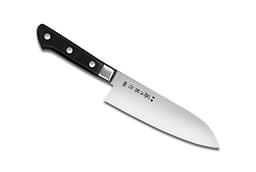
If you want the santoku
Tojiro DP Santoku 170 mm
The same VG10 core and value proposition as the Tojiro DP gyuto, in the shorter, flatter santoku shape. If you push-cut and chop more than you rock, this is the format — and the best-value way into it.
See it against the santoku fieldPrice as of October 17, 2026. #ad How we’re funded
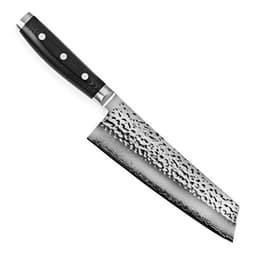
If you want the bunka
Enso HD 7-inch Bunka
The bunka that actually publishes its numbers: a VG10 core at 61 HRC under 37 hammered Damascus layers, made in Seki. The reverse-tanto tip is the whole point of the shape, and this is the cheapest way to own one from a maker that states the hardness.
Read the bunka guidePrice as of October 17, 2026. #ad How we’re funded
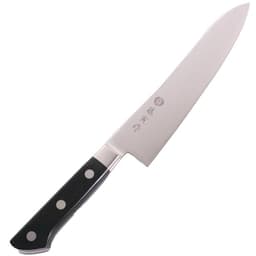
If neither shape convinces you
Tojiro DP Gyuto 210 mm
The knife the internet has recommended to first-time gyuto buyers for a decade, and the numbers explain why: a real VG10 core at ~60 HRC for a fraction of the boutique price. Buy this before you spend three times as much.
Read the gyuto reviewPrice as of October 17, 2026. #ad How we’re funded
Frequently asked questions
What is the difference between a bunka and a santoku?
The tip. Both are short, tall, flat-ish Japanese general-purpose knives in the 165 to 180 mm range, usually with the same steels and the same double-bevel grind. A santoku's spine curves down to a blunt, rounded front; a bunka's spine runs straight and then drops in a sharp angle, producing a reverse-tanto point you can pierce and detail with. Everything else about the two shapes is broadly the same.
Is a bunka better than a santoku?
It is more capable and less forgiving. The reverse-tanto point does jobs a santoku simply cannot — scoring, piercing, fine tip work, lifting a cut off the board — and it is the easiest part of any knife in a kitchen to chip, because it is a thin, hard, unsupported angle. If you want one knife to do everything and you are not careful with tips, the santoku is the safer buy.
Which is better for a beginner, a bunka or a santoku?
A santoku, for two reasons. There is nothing on it to break, and the field is enormous — you can buy a competent santoku at around $40 or spend $190, with everything in between. The bunka field is small and almost entirely premium: both bunkas we track are clad Damascus knives at premium prices, so there is no cheap way to find out whether you like the shape.
Can a bunka replace a chef's knife?
Partly. At 165 to 180 mm it is shorter than a 210 mm gyuto, so long slicing and big-volume prep are slower, and the flat profile does not rock. What it does have, which a santoku does not, is a point — so it covers more of a chef's knife's range than a santoku does. If you only want to own one knife, buy the 210 mm gyuto; if you want a second, shorter knife that still has a tip, the bunka is the one.
Is a bunka the same as a kiritsuke?
No, though they share the angular tip. A kiritsuke is a long knife — typically 210 mm and up — with a k-tip, traditionally single bevel and used as a Japanese chef's knife. A bunka is short, around 165 to 180 mm, in the santoku size class. Think of a bunka as a santoku with a k-tip and a kiritsuke as a gyuto with one.
What length bunka or santoku should I buy?
165 to 180 mm, which is effectively the whole field. Shun publishes a 178 mm blade for its 7-inch Classic santoku; the Tojiro DP santoku is 170 mm; the Enso HD bunka is 180 mm and the Miyabi Kaizen II bunka 165 mm. Within that span, length matters less than height — the taller the blade, the more knuckle clearance and the better it scoops.
Do bunkas and santokus sharpen the same way?
Yes, with one extra care point. Both are double-bevel knives that sharpen on an ordinary stone at the maker's angle — Shun states 16 degrees per side for its Classic line, ZWILLING publishes 9.5 to 12 degrees for its hand-honed Miyabi edges. On a bunka, keep the stone work off the very tip: the angular point is thin and unsupported, and over-grinding it is how people round off the feature they bought the knife for.
Why is the santoku so much more common than the bunka?
Market history rather than merit. The santoku became the standard home knife in Japan and then the standard Japanese export shape, so every maker in every price band builds one — including the German makers, who build forged versions at around 58 Rockwell. The bunka stayed a specialist's shape, which is why the knives you find in it are mostly enthusiast-grade and priced accordingly.
Sources
- Japanese kitchen knife — Wikipedia — Reference on gyuto/santoku/nakiri, single- vs double-bevel (kataba/ryoba) and edge angles (accessed July 21, 2026)
- Enso Knives — Japanese Crafted HD, Hizashi, SG2, Hachi (Cutlery and More) — Published Enso HD line spec: 'VG10 stainless steel core. 61 Rockwell.', '37-layer Damascus with a hammered tsuchime finish', a triple-riveted canvas micarta handle, made in Seki, Japan (accessed August 18, 2026)
- Classic 7" Santoku (DM0702) — Shun Cutlery (Kai USA) — Shun's published spec for model DM0702: a '7 in. (178mm)' blade, 'Blade Steel VG-MAX' described as a 'Proprietary VG-MAX cutting core', a '69 layer Damascus' blade which the same page's feature list gives as '34 layers of stainless Damascus cladding each side (68 total)', a 'long-lasting 16° edge', a '5.0 in (127mm)' 'Ebony color Pakkawood' handle on a 'Full composite tang for light weight and perfect balance', overall dimensions of '1.9 in. H x 12.5 in. L x 0.8 in. W', a weight of '6.3 oz (179 g)', 'Country of Origin Japan' / 'Handcrafted in Japan' and a 'Limited Lifetime Warranty'. Listed at a Regular Price of $237.00 against a Special Price of $189.95 on the access date. NO Rockwell hardness figure appears on the page (accessed October 13, 2026)
- Shun Knives FAQ — Shun Cutlery (Kai USA) — Shun's own answers: 'Shun hardens VG10 and VG-Max steel to 60-61 Rockwell and SG2 to 61-62', 'Shun knives, for example, are sharpened to a 16 degree angle on each side of the blade', and on rods, 'Please do not use a diamond steel for regular honing. Diamond steels are for sharpening and will remove metal from your knife before it is necessary' (accessed August 28, 2026)
- MIYABI Kaizen II 5000FCD 8-inch Chef's Knife — ZWILLING — Zwilling's published spec for the line: an 'FC61' core with fine carbide distribution at '60-62 HRC', '48 layers of stainless steel' Damascus over the core (49 total), an edge 'hand-honed using the historic Honbazuke method to an exceptionally sharp 9.5 to 12 degrees', a 'double ice-hardened FRIODUR' blade, a 'thicker and rounded bolster for increased comfort and balance', a black Pakkawood D-shaped handle, a 7.87 in blade at 0.44 lbs, handcrafted in Seki, Japan (accessed August 28, 2026)
- Rockwell hardness test — Wikipedia — Definition of the Rockwell C (HRC) scale used to state knife-steel hardness (accessed July 21, 2026)
- The Difference Between WÜSTHOF Forged and Stamped Kitchen Knives — WÜSTHOF — Wüsthof's own account of both processes: forged blades start as a single piece of steel heated to over 2000°F and take 'over fifty-four manufacturing steps', hardened to '58 Rockwell'; non-forged blades are 'cut from a high-quality steel sheet using a precision laser' in 'thirty-five manufacturing steps' and run 'between 55 and 57 Rockwell' (accessed August 18, 2026)
Per-knife specs (steel, HRC, blade length, geometry) are read from each maker’s spec sheet or product listing and dated on the individual review cards above. “Not published” means the manufacturer does not state that figure — we flag it rather than guess.
Keep reading
Bunka Knife Guide
The shape, the reverse-tanto tip and the two we track.
Read the guideSantoku Knife Guide
What a santoku is for, and what it gives up to a gyuto.
Read the guideBest Santoku Knives
Six santokus from about $40 to $180, compared on steel and grind.
See the picksGyuto vs Santoku
The length argument, which is the other half of this decision.
Compare themSantoku vs Nakiri
What happens when you remove the tip entirely.
Compare themKiritsuke vs Chef Knife
The same angular tip, on a full-length blade.
Compare them