How Thick Should a Chef's Knife Be?
Three separate measurements hide behind the word 'thickness', the decisive one is invisible on every spec sheet we have read, and the cure is to buy a construction rather than a number.
How this is funded: we earn a commission if you buy through our links, at no extra cost to you. As an Amazon Associate we earn from qualifying purchases. It never changes which knife we recommend, and we’ll tell you when we’d skip one. Full disclosure.
There is no millimetre figure to give you, and anyone who gives you one is making it up. “Thickness” is three different measurements, the one that decides how a knife cuts — the cross-section just above the edge — is published by essentially no manufacturer, and the practical answer is therefore to buy a construction: a laminated or taper-ground Japanese blade if you want thin and keen, a forged bolstered Western blade if you want mass and toughness.
This is one of the more useful questions a knife buyer can ask, and one of the hardest to get a straight answer to. Hardness is published, steel grades are published, blade length is published, edge angles are increasingly published. The geometry above the edge — which is what you actually feel going through a potato — is a blank on nearly every spec sheet in this category.
The three thicknesses, in order of how much they matter
- 1. Thickness behind the edge. The decisive one.A few millimetres above the apex, this is the wedge the food has to be pushed apart by once the edge has opened a cut. Thin here and a carrot falls into two slices; fat here and it cracks along its own grain ahead of the blade. This is the property enthusiasts mean when they say a knife “cuts well” rather than “is sharp.”
- 2. Distal taper — how the spine thins toward the tip.A well-made blade is thicker at the heel, where you need rigidity, and thinner at the tip, where you need finesse. Mercer’s own listing language for the forged Genesis is a good example of a maker naming it: a “taper ground edge” which it credits with “superior stability, easy-honing, and long-lasting sharpness.”
- 3. Spine thickness at the heel.The number people guess at by pinching a blade in a shop. It tells you about stiffness and mass — both real virtues — and surprisingly little about cutting, because a thick spine ground thin behind the edge cuts far better than a thin spine with fat shoulders.
A fourth number interacts with all of these: the edge angle at the apex, which several makers do publish. Shun states a 16° edge per side for its Classic line, ZWILLING describes its Miyabi edges as hand-honed “to an exceptionally sharp 9.5 to 12 degrees,” and current Wüsthof Classic blades are listed at about 14°. The angle decides how keen the very apex is; the thicknesses above decide what happens in the next few millimetres. Both have to be right, and our angle guide covers the apex half.
What makers actually publish — we checked
Across the knives on this site, the published record is consistent and consistently incomplete. ZWILLING’s page for the Miyabi Koh sujihiki publishes a hardness figure andan edge angle — more than most — and still gives no spine thickness and no blade height. Shun’s own pages for the Classic santoku and nakiri publish blade length, Damascus layer count, edge angle, handle length, weight, warranty and overall dimensions, and state no thickness; the “0.8 in. W” on those pages is the overall width of the product, not the spine. Miyabi’s Kaizen II listing gives a 7.87 in blade at 0.44 lbs with no thickness. Wüsthof publishes its forging process and “58 Rockwell” with no thickness.
We treat that absence as a finding rather than a gap to fill with estimates — it is the same policy that makes our product cards say “Not published” instead of carrying a plausible-looking number. The consequence for you is that thickness has to be inferred from things that arepublished.
The proxies that actually work
| Japanese laminate (clad core) | Taper-ground mono-steel | Forged Western, bolstered | |
|---|---|---|---|
| Typical construction row | VG10 / FC61 core, stainless-clad or Damascus | Single steel, taper ground | Forged, full tang, bolstered |
| What that implies about geometry | Thin behind the edge; soft cladding ground away to nothing | Thin, with stiffness from the taper rather than mass | Mass at the heel, more steel above the edge |
| Published hardness band in our registry | ~60-62 HRC | Often unpublished | 58 HRC forged, 55-57 stamped (Wüsthof's figures) |
| Behaviour on dense vegetables | Separates cleanly | Separates cleanly | More likely to wedge and crack |
| Behaviour on abuse | Chips — no bone, no twisting | Chips or bends depending on hardness | Takes it; edge rolls rather than chips |
| How to maintain it | Stone, ceramic rod for touch-ups | Stone; soft ones come back fast | Honing rod does most of the work |
Three more signals worth knowing:
- A bolster means mass.Wüsthof’s own account of forging — a single piece of steel heated past 2000°F through “over fifty-four manufacturing steps” to reach 58 Rockwell — describes a process that produces a stiff, substantial blade with a bolster and a full tang. That is a knife you can lean on, and it is not a thin knife.
- Weight, compared carefully.Only ever against a similar shape and length. Shun’s own figures make the trap obvious: its 165 mm nakiri is 215 g and its 178 mm santoku is 179 g, because blade height drives weight more than length does.
- Hollow or granton edges tell you nothing about thickness. The scallops exist to break suction so wet slices release. A hollow-edge Western santoku can still be a thick knife.
The board test, which beats every spec sheet
You can diagnose thickness in your own kitchen in two minutes, with a knife you already own:
- Carrot test. Cut 2 mm coins off a thick carrot. If the coins crack or fly apart before the blade is through, the geometry above the edge is wedging. A keener apex will not fix that.
- Potato test. Push-cut through the middle of a large potato. A thin blade glides and releases; a thick one binds halfway and needs a shove.
- Sweet potato or beet test. The hard-vegetable version, and the most unforgiving. Dense roots split along their own structure in front of a fat grind.
If a knife passes the paper-slicing test for sharpness but fails these, the edge is fine and the blade is thick. That distinction saves a great many people from sharpening a knife that did not need it — see how to test knife sharpness for the other half of the diagnosis, and why knives get dull so fast for when it really is the edge.
So how thick should yours be?
Mostly vegetables, push cutting, a wooden board. As thin as the steel safely allows: a laminated Japanese gyuto or a taper-ground mono-steel blade. This is where thinness is a daily pleasure. Our gyuto roundup is the field.
Mixed prep including protein, with other people using your knives. Medium. A forged Western knife in the 58 HRC band, kept keen with a rod, is the forgiving choice — it wedges more and survives more. See best chef knives for home cooks.
Heavy work: squash, large cuts, volume, speed. Mass helps, and thinness becomes a liability. A thicker forged blade or, for pure board volume, a tall Chinese-style blade. See what working kitchens buy and chef knife vs cleaver.
Already own a thick knife you otherwise like?You can thin it behind the edge on a coarse stone — grinding the shoulders back over several sessions until the blade releases food again. It is a genuine project, it removes real steel, and it changes the knife permanently; the general reference on Japanese kitchen knives is a good primer on why the geometry is shaped the way it is before you start reshaping it. Most people are better served by buying the geometry. Diamond plates are the usual tool if you attempt it.
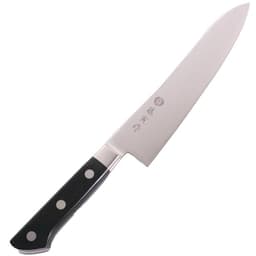
If you want a thin blade and a published core steel
Tojiro DP Gyuto 210 mm
The knife the internet has recommended to first-time gyuto buyers for a decade, and the numbers explain why: a real VG10 core at ~60 HRC for a fraction of the boutique price. Buy this before you spend three times as much.
Read the Tojiro DP gyuto reviewPrice as of October 17, 2026. #ad How we’re funded
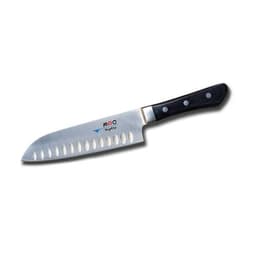
If thinness is the only thing you are buying
MAC Professional Series 6.5-inch Santoku (MSK-65)
The santoku that turns up in professional kitchens rather than gift guides. MAC grinds its molybdenum blades thinner than almost anyone, and the MSK-65 is light, fast and dimpled — a cutting tool with no decoration whatsoever.
Read the MAC Professional reviewPrice as of October 17, 2026. #ad How we’re funded
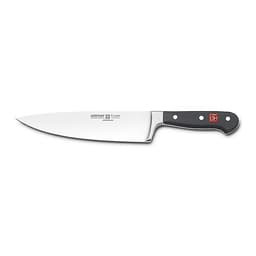
If you want mass and toughness instead
Wüsthof Classic 8-inch Chef's Knife
The benchmark forged German chef's knife: a full-tang X50CrMoV15 blade at ~58 HRC with a bolster and heft that many cooks prefer for rock-chopping. Heavier and softer than a gyuto, and built to last decades.
Read the Wüsthof Classic reviewPrice as of October 17, 2026. #ad How we’re funded
Frequently asked questions
How thick should a chef's knife be?
Thin enough that the food separates instead of splitting ahead of the edge, and thick enough that the blade does not flex or chip under the work you actually do. In practice that means a laminated or taper-ground Japanese blade if you mostly cut vegetables and push-cut, and a forged Western blade with real spine mass if you want toughness and a knife you can lean on. There is no useful single millimetre figure, partly because makers almost never publish one.
What is 'thickness behind the edge' and why does it matter more than the spine?
It is the cross-section of the blade a few millimetres above the apex — the part that has to push food apart after the edge has started the cut. A knife can have a thin spine and still wedge if the grind above the edge is fat, and a thick-spined knife that has been taper-ground thin behind the edge can cut beautifully. It is the single most important geometric property of a kitchen knife and the one nobody prints.
Why does my knife split carrots instead of slicing them?
That is wedging, and it is a thickness problem, not a sharpness problem. The apex opens a cut, then the blade's cross-section has to force the two halves apart; if the geometry is too fat the vegetable cracks along its own grain ahead of the blade. A sharper edge helps slightly. A thinner blade, or thinning the existing one behind the edge, is the actual fix.
Do makers publish blade thickness?
Almost never, and we say so on every product card rather than guessing. Across the knives we track, makers publish steel, hardness, blade length, edge angle, weight and overall dimensions — ZWILLING publishes both a hardness figure and a hand-honed edge angle for its Miyabi lines, Shun publishes blade length, weight and a 16-degree edge — and essentially none of them publish spine thickness or thickness behind the edge.
Does a hollow edge or granton edge mean a thinner knife?
No. Those scallops are there to reduce suction so wet slices do not cling to the blade face. They do not change the cross-section the food has to be pushed apart by, so a hollow-edge knife can wedge exactly as badly as a plain one. Useful feature, unrelated question.
Is a heavier knife a thicker knife?
Often, but weight also tracks blade height and handle construction, so it is a rough proxy at best. Shun publishes 215 g for its 165 mm nakiri and 179 g for its longer 178 mm santoku — the shorter knife is heavier because the blade is taller. Compare weights only between knives of similar shape and length, and treat a heavy blade in a short length as a sign of mass rather than thinness.
Can you make a thick knife cut like a thin one?
Partly, and it is real work. Lowering the edge angle helps a little; thinning the blade behind the edge — grinding the shoulders back on a coarse stone over several sessions — helps a lot and is how enthusiasts rescue fat factory grinds. It removes real steel, changes the knife permanently, and is not a beginner project. Buying the geometry you want is cheaper than grinding it in.
How thin is too thin?
When the blade flexes under the cuts you make, or when the edge chips on work you cannot avoid. A thin, hard laminated blade is superb on vegetables and fragile near a bone, a frozen edge or a lateral twist. If your prep involves squash shells, chicken bones or a lot of guests helping, buy mass and accept the wedging.
Sources
- The Difference Between WÜSTHOF Forged and Stamped Kitchen Knives — WÜSTHOF — Wüsthof's own account of both processes: forged blades start as a single piece of steel heated to over 2000°F and take 'over fifty-four manufacturing steps', hardened to '58 Rockwell'; non-forged blades are 'cut from a high-quality steel sheet using a precision laser' in 'thirty-five manufacturing steps' and run 'between 55 and 57 Rockwell' (accessed August 18, 2026)
- Mercer Culinary M21078 Genesis 8-inch Forged Chef Knife with Short Bolster — WebstaurantStore — The Genesis line's own chef-knife listing: 'Forged construction with short bolster', a 'Taper ground edge' for 'superior stability, easy-honing, and long-lasting sharpness', and 'Full tang creates better balance' — with no steel-grade designation and no Rockwell hardness figure printed anywhere on the page (accessed August 26, 2026)
- Japanese kitchen knife — Wikipedia — Reference on gyuto/santoku/nakiri, single- vs double-bevel (kataba/ryoba) and edge angles (accessed July 21, 2026)
- Classic 6.5" Nakiri — Shun Cutlery (Kai USA) — Shun's published spec for model DM0728: a '6.5 in. (165mm)' blade in '69 layer Damascus', a 'Proprietary VG-MAX cutting core [that] is wear and corrosion resistant, strong, and very fine-grained to enable a razor-sharp, long-lasting 16° edge each side', '34 layers of stainless Damascus cladding each side (68 total)', a '5.0 in (127mm)' 'Ebony color Pakkawood' handle described as 'D-shaped ebony-finished Pakkawood handles are comfortable for both left- and right-handed users', overall dimensions of '2.0 in. H x 11.9 in. L x 0.8 in. W', a weight of '7.6 oz (215 g)', 'Handcrafted in Japan' and a 'Limited Lifetime Warranty'. Listed at a Regular Price of $237.00. No Rockwell hardness figure appears anywhere on the page (accessed September 15, 2026)
- Classic 7" Santoku (DM0702) — Shun Cutlery (Kai USA) — Shun's published spec for model DM0702: a '7 in. (178mm)' blade, 'Blade Steel VG-MAX' described as a 'Proprietary VG-MAX cutting core', a '69 layer Damascus' blade which the same page's feature list gives as '34 layers of stainless Damascus cladding each side (68 total)', a 'long-lasting 16° edge', a '5.0 in (127mm)' 'Ebony color Pakkawood' handle on a 'Full composite tang for light weight and perfect balance', overall dimensions of '1.9 in. H x 12.5 in. L x 0.8 in. W', a weight of '6.3 oz (179 g)', 'Country of Origin Japan' / 'Handcrafted in Japan' and a 'Limited Lifetime Warranty'. Listed at a Regular Price of $237.00 against a Special Price of $189.95 on the access date. NO Rockwell hardness figure appears on the page (accessed October 13, 2026)
- MIYABI Kaizen II 5000FCD 8-inch Chef's Knife — ZWILLING — Zwilling's published spec for the line: an 'FC61' core with fine carbide distribution at '60-62 HRC', '48 layers of stainless steel' Damascus over the core (49 total), an edge 'hand-honed using the historic Honbazuke method to an exceptionally sharp 9.5 to 12 degrees', a 'double ice-hardened FRIODUR' blade, a 'thicker and rounded bolster for increased comfort and balance', a black Pakkawood D-shaped handle, a 7.87 in blade at 0.44 lbs, handcrafted in Seki, Japan (accessed August 28, 2026)
- MIYABI KOH 9.5-inch Pakka Wood Sujihiki, item no. 33950-243 — ZWILLING — ZWILLING's published spec for item 33950-243: a '9.45 in' blade sold as '9.5-inch', 'Advanced FC61 fine carbide stainless steel' at '61 HRC', a '9.5-12° edge angle' from a 'Hand-honed, 3-step Honbazuke blade', a 'FRIODURx2® Ice-Hardened Blade', an 'Octagon-shaped Pakkawood handle' in brown on a 'concealed tang', a weight of '0.35 lbs', 'Hand wash only', a 'lifetime warranty', and 'Handcrafted in Seki, Japan'. ZWILLING's own description of the shape: a 'sujihiki knife, also known as the Japanese filet knife, features a long, thin blade designed for cleanly slicing through both meat and fish filets'. The dimension block reads 'Length of product: 15.12 in', 'Width of product: 0.75 in', 'Height of product: 1.30 in' — figures that do not describe a blade, so spine thickness and blade height are NOT published. Listed as In Stock on the date fetched; no price is quoted here because prices on this site come only from the live daily check. ZWILLING does NOT state what alloy FC61 is (accessed September 23, 2026)
- Rockwell hardness test — Wikipedia — Definition of the Rockwell C (HRC) scale used to state knife-steel hardness (accessed July 21, 2026)
Per-knife specs (steel, HRC, blade length, geometry) are read from each maker’s spec sheet or product listing and dated on the individual review cards above. “Not published” means the manufacturer does not state that figure — we flag it rather than guess.
Keep reading
Knife Anatomy
Spine, bolster, tang, heel and the words the rest of this site uses.
Read the guideChef Knife Size Guide
The length question, which is the other half of blade geometry.
Read the guideForged vs Stamped Knives
Wüsthof's own figures for both processes, and what each buys.
Compare themJapanese vs German Knives
Thin and hard against thick and tough, argued on published numbers.
Compare themKnife Steel & Hardness Guide
Why hardness decides how thin a blade can safely be ground.
Read the guideBest Knives for Cutting Vegetables
Where thinness pays off most, shape by shape.
See the picks