Chef Knife vs Cleaver
Two completely different tools share the word 'cleaver'. Which one you actually mean decides whether it can replace your chef's knife or should never touch a vegetable.
How this is funded: we earn a commission if you buy through our links, at no extra cost to you. As an Amazon Associate we earn from qualifying purchases. It never changes which knife we recommend, and we’ll tell you when we’d skip one. Full disclosure.
Short answer:the question has two completely different answers, because “cleaver” describes two unrelated tools.
- A Chinese chef’s knife (caidao, sometimes called a vegetable cleaver) is thin, light and ground for slicing. It can replace a chef’s knife for most prep, and in millions of kitchens it does.
- A Western meat cleaver is thick, heavy and deliberately obtuse-edged so it survives hitting bone. It cannot replace anything and should never be your general knife.
They look similar in a product photo, which is the entire source of the confusion. Work out which one you actually want before you buy either.
| Chef's knife | Chinese chef's knife | Meat cleaver | |
|---|---|---|---|
| Blade thickness | Moderate | Thin | Very thick |
| Weight | 180-250 g | Light for its size | Heavy by design |
| Edge angle | ~14-20° per side | ~15-20° per side | ~25-30° per side |
| Blade height | ~45 mm | ~75-85 mm | Tall and thick |
| Tip | Fine point | None | None |
| Bone | Avoid | Never | Yes — its only job |
| Vegetables | Very good | Excellent | No |
| Board scoop | Poor | Best in class | Yes, but heavy |
The Chinese chef’s knife, properly understood
A caidao is roughly 200 mm long and 75–85 mm tall, and typically thinner behind the edge than a Western chef’s knife. It weighs about what a forged German knife weighs, spread over a much larger blade — which is why picking one up is surprising: it looks like it should be a sledgehammer and it feels like a big, light slicer.
What it does exceptionally well:
- Straight-down chopping. Flat edge, so the whole length lands together and nothing stays hinged. Same principle as a nakiri, with far more blade.
- Volume prep. The height means enormous knuckle clearance, so you can work fast with the blade fully vertical.
- Moving food. The broad face carries a whole board of diced vegetables to the pan in one pass. Nothing else comes close.
- Crushing.Lay the flat over a garlic clove or a piece of ginger, thump once. A chef’s knife does this too; the cleaver does it better and more safely.
What it cannot do is anything that needs a point — trimming, scoring, boning — and it will not rock-chop. So it fills the same role as a nakiri scaled up: outstanding at the one motion, incapable of several others.
The meat cleaver, and when you actually need one
A true meat cleaver is a wedge. It is thick at the spine, ground to an obtuse edge of roughly 25–30° per side, and heavy enough that gravity does most of the work. Every one of those choices is about surviving impact: a fine edge would chip on the first rib, and a light blade would bounce.
You need one if you break down whole birds through the bone, split pork ribs, or portion bone-in cuts at home. You do not need one for anything else, and using it as a general knife is unpleasant — it is too heavy for repetitive work and too obtuse to slice anything cleanly.
Note what this means for your chef’s knife: if you own a cleaver, your chef’s knife never has to meet bone, which removes the single most common way people chip a good blade. That is a genuine argument for owning one even if you use it twice a year.
Sharpening: the difference matters
A Chinese chef’s knife sharpens exactly like any other kitchen knife — a whetstone at roughly 15–20° per side depending on the steel. The only wrinkle is the height: with a taller blade it is slightly harder to feel when the bevel is flat on the stone, so beginners tend to lift the spine too much. Color the bevel with a marker and take a few passes to check.
Carbon-steel Chinese knives — and many of the classic ones are carbon, not stainless — also need drying immediately and will develop a patina. That is normal and largely protective, but it means a dishwasher or a wet sink will rust them within a day.
A meat cleaver should be sharpened deliberately blunt by kitchen-knife standards: around 25–30° per side. Putting a fine edge on one is a mistake that lasts exactly one rib. Our angle guide explains the durability-versus-keenness trade in detail.
So which should you buy?
Buy a chef’s knife if you own neither. It is the most versatile single tool in a kitchen and nothing here changes that.
Add a Chinese chef’s knife if you prep vegetables in volume, cook a lot of stir-fries, or simply like the idea of a big flat blade. It is one of the cheapest genuinely good knives available and it changes how a vegetable-heavy session feels.
Add a meat cleaveronly if you actually cut through bone. If you do not, it will live in a drawer — and your money is better spent on a whetstone.
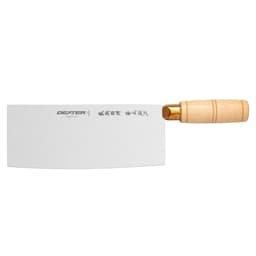
Our Chinese chef's knife pick
Dexter-Russell Traditional 8-inch Chinese Chef's Knife (5178)
The workhorse Chinese cook's knife — a thin, light, 8 x 3-1/4 inch rectangle of high-carbon steel on a hardwood handle. Not a bone cleaver: it is a slicing and chopping blade whose tall face doubles as a scoop, and it is the cheapest genuinely good knife on this site.
See where it fits among the shapesPrice as of October 19, 2026. #ad How we’re funded
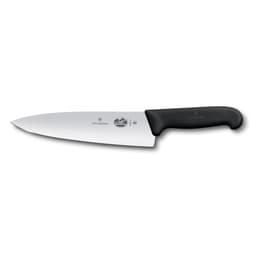
The chef's knife to own first
Victorinox Fibrox Pro 8-inch Chef's Knife
The knife that wins nearly every budget test, and the one to buy if you buy only one. A soft, stamped X50CrMoV15 blade at ~55-56 HRC and a grippy, non-slip handle — it dulls sooner than a hard Japanese knife but takes an edge back in seconds.
Read the full reviewPrice as of October 19, 2026. #ad How we’re funded
Frequently asked questions
What is the difference between a chef knife and a cleaver?
It depends which cleaver. A Chinese chef's knife (caidao) looks like a cleaver but is thin, light and ground for slicing — it can genuinely replace a chef's knife for most prep. A Western meat cleaver is thick, heavy and ground obtusely to survive impact with bone, and it is useless for fine work. The rectangular shape is the only thing the two share.
Can a cleaver replace a chef's knife?
A Chinese cook's knife can, and in a great many kitchens it does — it slices, dices, minces, crushes garlic with the flat, and scoops the board with its tall face. What it lacks is a point, so trimming and boning need a second knife. A heavy Western meat cleaver cannot replace a chef's knife under any circumstances.
Is a Chinese cleaver good for vegetables?
Very. The tall, flat blade lands along its whole length on a straight-down chop, so slices separate cleanly, and the height gives excellent knuckle clearance. In that respect it works like a large nakiri. The broad face is also the best board-scoop of any knife shape.
Can you cut bone with a chef's knife?
Small, soft bones like a chicken rib cage, carefully, with a soft-steel Western knife. Never with a hard Japanese knife — at 60+ HRC the thin edge chips rather than deforms. For pork ribs, chicken backs or anything with real density, you want a heavy meat cleaver, a bone saw, or a butcher.
How do you sharpen a Chinese cleaver?
Exactly like a chef's knife: a whetstone at roughly 15-20 degrees per side, depending on the steel. The only practical difference is that the blade is tall, so you need to be deliberate about keeping the angle consistent across a wider face. A heavy bone cleaver is different — it wants a much more obtuse edge, around 25-30 degrees, because durability matters more than keenness.
Sources
- Japanese kitchen knife — Wikipedia — Reference on gyuto/santoku/nakiri, single- vs double-bevel (kataba/ryoba) and edge angles (accessed July 21, 2026)
- Rockwell hardness test — Wikipedia — Definition of the Rockwell C (HRC) scale used to state knife-steel hardness (accessed July 21, 2026)
- Knife sharpening — Wikipedia — Reference on edge angle, coarse-to-fine grit progression, and honing vs sharpening (accessed July 21, 2026)
Per-knife specs (steel, HRC, blade length, geometry) are read from each maker’s spec sheet or product listing and dated on the individual review cards above. “Not published” means the manufacturer does not state that figure — we flag it rather than guess.
Keep reading
Best Knives for Cutting Meat
Where the Chinese chef's knife fits among slicers and forged chef's knives.
See the meat picksChef Knife Types Explained
Every shape in one scannable reference.
See all the shapesNakiri Knife Guide
The Japanese take on a tall, flat vegetable blade.
Read the guideBest Chef Knives
The all-rounders, ranked on steel and geometry.
See the picksKnife Sharpening Angle Guide
Why a bone cleaver wants a blunter edge than a slicer.
Read the angle guideBest Nakiri Knives
The tall vegetable knife that is not a cleaver.
See the nakirisKnife Anatomy
Why blade height changes how a knife handles.
Read the guide