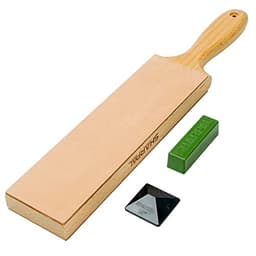
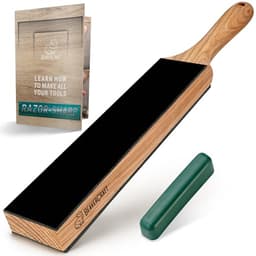
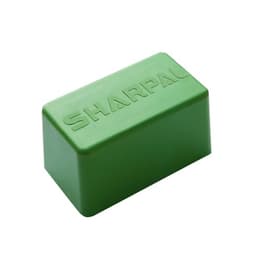
We recommend this strop on two roundups, and we should be clear about why, because it is not that the leather is special. It is that a strop is a two-part tool — leather and abrasive compound — and this one arrives with both. The single most common stropping mistake is not technique; it is buying a bare strip of leather, drawing a knife across it, and wondering why nothing happened. Sharp Pebble ships the compound in the box. That alone makes it the strop we pair with a first whetstone. This review checks everything else about it against what the maker actually publishes, and finds one thing the maker does not.
What Sharp Pebble actually publishes
Sharp Pebble’s own store lists exactly one strop: the “Premium Knife Sharpening Leather Strop Kit.” Its product page states the surface is “premium quality genuine cowhide leather,” mounted on a “Classic Bamboo Base” with a “Non-Slip rubber base,” and gives the size as “8 x 3 x 1 inches” and the weight as “1.7 pounds.” A green compound is included. The page also carries three rules of use that are worth more than most stropping videos: “Never cut into a strop, always pull backwards,” “Work your blade from heel to tip,” and “Do it slowly, with nice and steady hands.”
That is a respectable amount of published detail for a budget strop. Two things are absent. The leather thickness is not stated — which matters, because thin, soft leather compresses under the blade and rounds the apex, and thick firm leather does not. And the compound has no grit or micron figure anywhere on the maker’s site. Sharp Pebble’s own article on compound explains what the stuff is — “a mixture of several abrasive chemical substances processed to be very fine such as aluminum oxide, chromium oxide, and diamonds” — and how to apply it (“rub the bar on the strop until you achieve a consistent coating”), but it never puts a number on any color. The maker’s own claim for the effect is modest, too: compound produces “a slight difference in the sharpness of the blade.” That is an honest sentence, and it is why the next section exists.
The listing and the maker’s page are not obviously the same object
The strop we link is the Amazon listing titled “Sharp Pebble Leather Strop for Knife Sharpening | Double Sided Knife Strop with Premium Stropping Compound for Kitchen, Hunting & Pocket Knives, Tools & Chisels.” Sharp Pebble’s own page describes a bamboo-base kit and does not say whether it is double-sided. The listing was live and in stock on the Amazon Creators API on the day this review was written, under that exact title. Whether the listing and the maker’s kit are one product with two descriptions, or two products, we cannot settle from the title alone, so we do not. The registry card keeps the listing’s dimensions as Not published; the figures in the section above are the maker’s, for the maker’s kit, and are attributed that way. If the two are the same unit, you are getting 8 inches of cowhide on bamboo with a rubber foot. If they are not, the maker’s numbers are still the best published guide to what Sharp Pebble sells as a strop.
What a strop does, and what it does not
A strop does not sharpen. It finishes. Drawn edge-trailing across leather, an edge that has just come off a stone has its last microscopic burr pulled off and its apex aligned; with a compound loaded into the leather, a whisker of steel is also abraded, which is what puts the polish on the bevel. The reference on the subject describes exactly those two effects — realignment, and light abrasion when a compound is used — and nothing more. A dull knife stropped for ten minutes is a dull knife with a shiny bevel. The order is stone, then strop; the stropping how-to covers the strokes, and the sharpening how-to covers what has to happen first.
This is also why “compound in the box” is the feature that decides the recommendation. Bare leather realigns; leather with compound realigns and polishes. A beginner who buys a bare strop and no compound gets the smaller of the two effects and often concludes stropping does not work. Sharp Pebble removes that failure mode by default.
Length: the number that decides who should buy it
The maker publishes 8 inches. That is about 203 mm of leather, and the rule for a strop is the same as the rule for a honing rod: the working surface should be at least as long as the blade, so the whole edge crosses it in one unbroken stroke. Break the stroke halfway and the place you lift and re-set is where the apex gets rounded. Eight inches covers a 165–170 mm santoku, a 150 mm petty and a 165 mm nakiri with room to spare. It covers an 8-inch (203 mm) chef’s knife with no room at all. It does not cover a 210 mm gyuto or a 240 mm slicer.
So the honest recommendation splits by knife. If your main knife is a santoku, a nakiri or a petty — which describes a lot of the people buying their first stone — this is the strop. If it is a 210 mm gyuto, the SHARPAL 205H at 13.2 inches takes the edge in one pass and the Sharp Pebble does not. If you own a 240 mm sujihiki, the BeaverCraft 15.2-inch kit is the only strop we list that fits. The strop roundup ranks all of them on exactly this axis.
How it compares
Three strops with compound in the box, on the figures each listing or maker publishes. Note that none of the three publishes a micron grade for its compound — that is a category-wide gap, not a Sharp Pebble one.
The Sharp Pebble strop against the two longer double-sided strops on this site| | Sharp Pebble | SHARPAL 205H | BeaverCraft LS6P1 |
|---|
| Working length | 8 in. (maker's kit page); listing: Not published | 13.2 in. | 14 in. |
|---|
| Sides | Listing says double-sided; maker's page does not state | Two | Two |
|---|
| Backing | Bamboo base with non-slip rubber foot (maker's kit) | Rigid backing | Hardwood block |
|---|
| Leather | Genuine cowhide; thickness Not published | Leather; thickness Not published | Thick leather; thickness Not published |
|---|
| Compound included | Yes — green; grit Not published | Yes — kit; grit Not published | Yes; grit Not published |
|---|
| Weight | 1.7 lb (maker's kit) | Not published | Not published |
|---|
| Takes a 210 mm gyuto in one stroke | No | Yes | Yes |
|---|
| Best for | Santoku, nakiri, petty; a first strop | Gyutos and 8-inch chef's knives | Kitchen knives and carving tools |
|---|
Who should buy it
Someone buying their first whetstone, whose longest knife is 200 mm or under, who wants the strop and the compound in one purchase and does not want to think about it. That is a large group, and this is the right strop for it. It pairs naturally with the same brand’s 1000/6000 stone kit, which is the stone most of that group ends up with.
Who should not: anyone whose main knife is a 210 mm gyuto or longer, who should buy length instead; anyone who wants to know the compound’s micron grade, because no budget strop maker we list publishes one and this one is no exception; and anyone who expects a strop to rescue a dull knife, which no strop will.
How we reviewed this
We do not own this strop and have not used it. This review reads Sharp Pebble’s own product page for its strop kit and its own article on compound against the Amazon listing we link, the general reference on what stropping does to an edge, and the figures already compiled for the other strops we list. Where the maker publishes nothing — the leather thickness, the compound grit — we say so. Where the listing and the maker’s page describe the product differently, we print both rather than pick one. The listing’s ASIN was re-verified live via the Amazon Creators API on the review date. No price appears in this text: prices on this site come only from the live daily check and carry the date they were pulled. Our methodology sets out the rules in full.