Gyuto Club

SHARPAL 202H Review

The guided system whose angle range starts below every other clamp on this site. Reviewed on SHARPAL's own published figures — including the capability it does not have.

By Stephen V.Last updated How we pick

How this is funded: we earn a commission if you buy through our links, at no extra cost to you. As an Amazon Associate we earn from qualifying purchases. It never changes which knife we recommend, and we’ll tell you when we’d skip one. Full disclosure.

Buy the 202H if your knives are Japanese and you want a clamp, or if you repair edges rather than merely refresh them. Buy the cheaper Work Sharp Precision Adjust if you own a normal drawer of kitchen knives and keep them maintained. The 202H earns its price on two published figures and loses a capability on a third, and all three are checkable rather than vague.

SHARPAL states the specification plainly. “Sharpening Angle: 10°–35° per side.” “Abrasives Included: Diamond 220 grit, Diamond 325 grit, Diamond 600 grit, Diamond 1000 grit, Ceramic plate, 6000 grit whetstone, Smooth leather strop.” “Blade Type: Straight-edge knives.” “Main Materials: Stainless steel and aircraft-grade aluminum alloy.” “Product Dimensions & Weight: 9.25 x 6.22 x 5.31 in… 9 lb / 4.1 kg.” Its key features add a “Flip design keeps sharpening angle consistent” and “Heavy-duty metal construction”, under a site-wide three-year warranty.

We have not sharpened a hundred knives on one — we do not own it, and our methodology page says what we do instead. What follows is that published specification read against the clamps we already rate, and against what a Japanese kitchen edge actually needs.

The 10 degree floor is the reason to care

Every clamped system sets an angle. The question is which angles it can reach, and this is where the field separates. The Work Sharp Precision Adjust dials from 15° to 30°. The Lansky Deluxe Diamond gives four fixed guides whose lowest is 17°. Both are perfectly matched to Western kitchen knives and to the Japanese knives ground around 15 or 16 degrees — Shun publishes a 16° edge per side on the Classic line — and both stop exactly where the category’s finest edges begin. ZWILLING publishes a 9.5° to 12° hand-honed edge on its Miyabi Koh knives. A 15° floor cannot restore that edge; it can only thicken it.

SHARPAL’s 10° floor is the first on a clamp we rate that reaches it. That is a real, narrow advantage rather than a broad one: most readers own knives at 15 or 16 degrees and will never dial below it. But if you own one knife ground finer than that, this is the only guided kit here that will not quietly re-profile it, and our angle guide gives the number per knife type.

One honest limit on that number, published by SHARPAL rather than discovered by us: “For wide blades, the usable angle range may be slightly more limited depending on the blade width and clamping position.” The system also runs two scales for exactly this reason — the A scale when the clamp-to-edge distance is 12.7 mm, the B scale when it is 50.8 mm — so a tall nakiri and a petty are not read off the same markings.

Seven abrasives is a full ladder, not a longer list

The grits matter less for how fine they finish than for how evenly they step. 220, 325, 600 and 1000 in diamond, then a ceramic plate SHARPAL describes as a 3000-grit equivalent, then a 6000 whetstone, then leather. Each stage only has to remove the scratches the previous one left, which is what makes a long ladder produce a cleaner apex than a short one — not the headline number at the top.

SHARPAL is unusually direct about not using all of it. Its own FAQ says to “Use 220 grit only for severely dull, damaged, or chipped edges”, 325 “for edge restoration or heavier sharpening”, and “For regular sharpening and maintenance, start with 600 grit or 1000 grit.” That is the correct advice and it is worth repeating here, because 220 grit diamond on a 60-plus HRC edge removes steel fast, and hard thin steel does not grow back. Shun’s own FAQ makes the same point about diamond in a different context: it warns against a diamond steel for routine honing because it “will remove metal from your knife before it is necessary”.

The three abrasive types also want three different routines, which is the kit’s main day-to-day nuisance: diamonds dry, the ceramic dry or with a little water, the 6000 stone kept wet, and the strop on a clean dry blade, spine-leading only. None of that is difficult. It does mean the full ladder is a project rather than a five-minute job, and most sessions should be two plates and a strop.

SHARPAL 202H against the two clamps we already rate, on published figures
 SHARPAL 202HWork Sharp Precision AdjustLansky Deluxe Diamond
Angle control10°–35° per side, continuously adjustable15°–30°, 1° incrementsFour fixed guides: 17°, 20°, 25°, 30°
Abrasives supplied220/325/600/1000 diamond, ceramic plate, 6000 whetstone, leather strop320 and 600 diamond, fine ceramicFour diamond hones, coarse to fine
Serrated capabilityNo — published for straight edges onlyNot statedNot stated
Blade capacityTo 7 mm thick, 560 mm long, 7.5 mm or widerAbout 10 inches without repositioningSmall hones — long blades need several clamp positions
Build and weightStainless and aircraft-grade aluminium, 9 lbNot publishedFolds into its own case
Warranty stated by maker3 yearsNot stated on our sourceNot stated on our source
Running costNamed refill plates, sold per pair by the makerReplaceable abrasivesReplaceable hones

What it will not do

Serrations. SHARPAL publishes the blade type as straight-edge knives and the kit contains nothing shaped to enter a gullet. This is a genuine regression from the Work Sharp Precision Adjust Elite that previously held this slot on our roundup, which shipped a ceramic rod for serrated edges. If a bread knife is part of why you are buying a system, it is not part of what this one solves — our serrated roundup covers the tools built for that job.

Single-bevel knives. A yanagiba, deba or usuba is ground on one side with a hollow back, and no symmetric clamped system belongs near one; our single-bevel guide explains why.

Living in a drawer. Nine pounds and a 9.25-inch base is a bench tool. That mass is the reason the angle stays where you put it, so it is a feature rather than a flaw — but a kit you have to haul out and set up is a kit you use less often than a stone you can wet in ten seconds.

Teaching you anything. Nothing clamped will teach you to feel a burr, which is the skill that eventually makes a stone faster than any jig. Between real sharpenings a smooth ceramic rod remains the correct maintenance tool, and sharpening vs honing covers the distinction.

Who should buy which

Buy the 202H if you own a Japanese knife ground finer than 15 degrees; if you are the person who sharpens everyone else’s knives; or if your drawer contains genuinely damaged edges that need resetting rather than refreshing and you want the whole repair-to-polish ladder in one case.

Buy the Work Sharp Precision Adjust if you own a normal kitchen set at 15 to 20 degrees, keep it roughly maintained, and want repeatable results for appreciably less money. It reaches the angles your knives actually have, and the edge it leaves on a kitchen knife is one most people could not distinguish in use. Our review of that kit makes the case in full, and Precision Adjust vs Lansky sets it against the fixed-guide alternative.

Buy a stone instead if your knives are Japanese, you have the patience for a weekend of practice, and you would rather own a skill than a fixture. A 1000/6000 combination stone costs a fraction of this, is gentler on hard thin steel, and handles every shape a clamp refuses — including the serrations this kit will not touch. Our combination whetstone roundup is where to start, and how to sharpen a knife teaches the motion.

The verdict

The 202H is a specification-led product rather than a marketing tier: the angle range, the seven named abrasives, the materials, the mass and the blade capacity are all published and all checkable, and the one capability it lacks is published too rather than left for you to discover. That is a better standard than most of this category manages. What SHARPAL does not claim, and we will not either, is that a longer grit ladder makes a sharper kitchen knife than a shorter one in ordinary use. It makes a wider range of repairs possible on more knives, and it reaches a geometry the cheaper clamps cannot. Price that against the knives you actually own.
#1Reviewed here

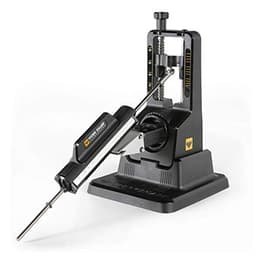
SHARPAL 202H Precision Knife Sharpening System

The clamped system that goes lower than the rest. SHARPAL publishes a 10° to 35° per-side range, where the Work Sharp dial stops at 15° — so this is the guided kit that can match the most acute Japanese factory edges rather than thickening them. Seven abrasives run from 220 diamond to a 6000 whetstone and a leather strop, which is a full repair-to-polish ladder in one case.

Strengths

  • 10°-35° per side — the only guided kit here that reaches below 15°
  • Seven abrasives: 220/325/600/1000 diamond, a 3000-equivalent ceramic plate, a 6000 whetstone and a leather strop
  • Stainless and aircraft-grade aluminium at 9 lb, with dual sliding clamps and a flip mechanism that keeps both sides on the same angle

Trade-offs

  • SHARPAL publishes it for straight edges only — there is no serration tool in the kit
  • 9 lb and 9.25 inches of base: this lives on a bench, not in a drawer
  • Three abrasive types, three different routines — diamonds dry, the 6000 stone wet, the strop edge-trailing only
TypeManual clamped guided system, bench-mounted
AbrasivesDiamond 220 / 325 / 600 / 1000, ceramic plate (3000 grit equivalent), 6000 whetstone, leather strop
Abrasive materialDiamond plates, ceramic, whetstone and leather
Angle control10°-35° per side, adjustable
Dimensions9.25 x 6.22 x 5.31 in, 9 lb

Specs read from the manufacturer listing, on October 28, 2026. “Not published” means the maker does not state that figure.

Work Sharp Precision Adjust Knife Sharpener

The cheaper clamp most kitchens should buy

Work Sharp Precision Adjust Knife Sharpener

The guided system to buy if a whetstone has beaten you. The blade clamps, the angle sets by knob anywhere from 15 to 30 degrees in one-degree steps, and a rotating handle carries coarse diamond, fine diamond and a fine ceramic. It removes the one variable beginners cannot control: holding a consistent angle.

Read the Precision Adjust review
$101.78 · View on Amazon

Price as of October 29, 2026. #ad How we’re funded

King (Matsunaga) KW-65 1000/6000 Combination Whetstone

If you would rather learn the stone

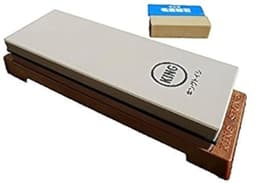
King (Matsunaga) KW-65 1000/6000 Combination Whetstone

The stone that has taught more people to sharpen than any other. One side 1000-grit to set an edge, one side 6000-grit to polish it, made in Japan, for the price of a takeout dinner. Start here.

Read the King KW-65 review
$37.99 · View on Amazon

$43.9514% off

Price as of October 29, 2026. #ad How we’re funded

Frequently asked questions

What angles does the SHARPAL 202H sharpen at?

SHARPAL publishes '10°–35° per side', adjusted continuously rather than by fixed holes. The 10 degree floor is the number that distinguishes it: the Work Sharp Precision Adjust stops at 15 and the Lansky's lowest fixed guide is 17, so this is the only clamped system we rate that can match a factory edge ground finer than 15 degrees instead of thickening it. SHARPAL adds one caveat of its own: 'For wide blades, the usable angle range may be slightly more limited depending on the blade width and clamping position.'

What abrasives come with the SHARPAL 202H?

Seven, and SHARPAL lists them precisely: 'Diamond 220 grit, Diamond 325 grit, Diamond 600 grit, Diamond 1000 grit, Ceramic plate, 6000 grit whetstone, Smooth leather strop.' The ceramic is described elsewhere on the same page as a 3000-grit equivalent rather than a measured grit. That is a full ladder from edge repair to a polished finish in one case, which is unusual at this price.

Can the SHARPAL 202H sharpen serrated knives?

No. SHARPAL publishes the blade type as 'Straight-edge knives', and nothing in the kit is shaped to enter a serration gullet. This is the one place it is a step backwards from the Work Sharp Precision Adjust Elite it replaces in our roundup, which shipped a ceramic rod for serrations. A bread knife needs a tapered diamond rod instead.

Can the SHARPAL 202H sharpen Japanese knives?

It is the clamped system best suited to them, because the bottom of its range reaches below the geometry most Japanese makers grind. Shun publishes a 16 degree edge per side on its Classic line and ZWILLING publishes a 9.5 to 12 degree hand-honed edge on Miyabi Koh, so a 10 degree floor covers the category rather than stopping just short of it. Two cautions still apply: clamp pressure on a thin hard blade needs to be gentle, and SHARPAL's own guidance is to 'Use 220 grit only for severely dull, damaged, or chipped edges' and to start maintenance at 600 or 1000.

How big is the SHARPAL 202H?

Bigger than people expect from the photographs. SHARPAL publishes '9.25 x 6.22 x 5.31 in / 23.5 x 15.8 x 13.5 cm; 9 lb / 4.1 kg' for the unit itself, in 'Stainless steel and aircraft-grade aluminum alloy'. That mass is the point — a clamped system is only as accurate as its base is still — but it is a bench tool, not something that lives in a drawer between uses.

What size blades will it hold?

SHARPAL's own FAQ publishes the capacity: blades 'up to 0.28 in / 7 mm thick, up to 22 in / 560 mm long, and 0.30 in / 7.5 mm or wider.' Twenty-two inches covers every kitchen knife and most slicers without repositioning, which is a genuine advantage over clamps that top out near 10 inches. For short or narrow blades SHARPAL says one clamp is enough provided the blade is held firmly, and that off-centre clamping does not affect the sharpening angle.

Do the abrasives need soaking?

Each type is used differently, which is the kit's main nuisance. SHARPAL publishes it per abrasive: 'Diamond plates: Use dry; Ceramic plate: Use dry or with a small amount of water; Whetstones: Keep wet and add water as needed; Leather strop: Use on a clean, dry blade. spine-leading, edge-trailing only.' No soaking is required for any of them.

Why do the diamond plates feel so aggressive at first?

SHARPAL says to expect it: 'New diamond abrasives have a break-in period and may feel very aggressive during the first several uses. As the surface breaks in, it becomes smoother and more consistent.' On a 60-plus HRC Japanese edge that break-in period is the worst possible time to reach for the 220 plate. Break the new plates in on a cheap knife before you put a good one in the clamp.

Sources

  • 202H Knife Sharpening Kit With Accurate Angle Adjustment — SHARPAL — SHARPAL's own page for the 202H, and the source of every figure we print for it. Its specification table gives 'Sharpening Angle: 10°–35° per side'; 'Abrasives Included: Diamond 220 grit, Diamond 325 grit, Diamond 600 grit, Diamond 1000 grit, Ceramic plate, 6000 grit whetstone, Smooth leather strop'; 'Blade Type: Straight-edge knives'; 'Use Method: Diamond plates: Use dry; Ceramic plate: Use dry or with a small amount of water; Whetstones: Keep wet and add water as needed; Leather strop: Use on a clean, dry blade. spine-leading, edge-trailing only'; 'Main Materials: Stainless steel and aircraft-grade aluminum alloy'; and 'Product Dimensions & Weight: 9.25 x 6.22 x 5.31 in / 23.5 x 15.8 x 13.5 cm; 9 lb / 4.1 kg'. Its key features are 'Complete 7-stage sharpening system', 'Adjustable angle from 10°–35°', 'From edge repair to mirror polish', 'Flip design keeps sharpening angle consistent' and 'Heavy-duty metal construction', under a site-wide '3-Year Warranty'. Its FAQ publishes the capacity — blades 'up to 0.28 in / 7 mm thick, up to 22 in / 560 mm long, and 0.30 in / 7.5 mm or wider' — the A/B scale rule ('Use the A scale for standard knives when the distance from the clamp end to the cutting edge is 1/2 in / 12.7 mm. Use the B scale for wide knives when the distance … is 2 in / 50.8 mm'), the grit guidance ('Use 220 grit only for severely dull, damaged, or chipped edges… For regular sharpening and maintenance, start with 600 grit or 1000 grit'), and the warning that new diamond abrasives 'may feel very aggressive during the first several uses'. SHARPAL publishes NO serrated capability for this model and NO grit figure for the ceramic plate beyond '3000 grit equivalent'. Its own store price on the access date was $179.99 (accessed October 28, 2026)
  • 20° & 25° Angle Guides for Whetstone Sharpeners — Work Sharp — Tool-maker reference for common Western (20°) vs finer (Japanese) sharpening angles (accessed July 21, 2026)
  • Shun Knives FAQ — Shun Cutlery (Kai USA) — Shun's own answers: 'Shun hardens VG10 and VG-Max steel to 60-61 Rockwell and SG2 to 61-62', 'Shun knives, for example, are sharpened to a 16 degree angle on each side of the blade', and on rods, 'Please do not use a diamond steel for regular honing. Diamond steels are for sharpening and will remove metal from your knife before it is necessary' (accessed August 28, 2026)
  • How to Clean and Care for Your Knife — ZWILLING — ZWILLING's own care instructions: 'clean it by hand using lukewarm water, mild dish soap and a non-scratch cloth or sponge', dried with 'a plain dishtowel or microfiber cloth'; the dishwasher is ruled out for 'aggressive chemical tablets', 'high temperatures' and 'bumps and bangs with other objects'. On wooden handles: 'not dishwasher-safe and should only be washed by hand', with the wood 'regularly treating the wood with oil (e.g. linseed oil) or wax (e.g. beeswax)'. On storage, a knife needs 'its very own space away from other objects, so not simply thrown in the cutlery drawer' — a block, 'drawer organizers or protective sleeves' (accessed September 23, 2026)
  • DMT Diamond and Ceramic Color-Coded Grit Chart — Sharpening Supplies — DMT's own color codes with the mesh and micron figure for each grade (Coarse 325/45 µm, Fine 600/25 µm, Extra-Fine 1200/9 µm) (accessed August 11, 2026)
  • Knife sharpening — Wikipedia — Reference on edge angle, coarse-to-fine grit progression, and honing vs sharpening (accessed July 21, 2026)

Per-knife specs (steel, HRC, blade length, geometry) are read from each maker’s spec sheet or product listing and dated on the individual review cards above. “Not published” means the manufacturer does not state that figure — we flag it rather than guess.

Keep reading