Work Sharp Precision Adjust vs Lansky Deluxe Diamond
Two clamped guided systems that solve the same beginner problem. The difference is one number: whether the angle is a dial or a set of holes.
How this is funded: we earn a commission if you buy through our links, at no extra cost to you. As an Amazon Associate we earn from qualifying purchases. It never changes which knife we recommend, and we’ll tell you when we’d skip one. Full disclosure.
Buy the Work Sharp Precision Adjust if any of your knives are Japanese; buy the Lansky Deluxe Diamond if they are all Western kitchen or outdoor knives and you want something that folds into a case. That is the whole decision, and it rests on one specification: the Work Sharp sets any angle from 15° to 30° in one-degree increments, while the Lansky gives you four fixed guides at 17°, 20°, 25° and 30°.
Both of these are clamped guided systems, which means they solve the same problem in the same way. You clamp the blade, the jig fixes the angle between the abrasive and the edge, and you stroke. The reason this format exists is that holding a consistent angle freehand is the single skill that defeats most beginners on a stone — and a wandering angle is why a knife can come off twenty minutes of sharpening no sharper than it went on. Our troubleshooting page goes through the other causes.
The decision table
| Work Sharp Precision Adjust | Lansky Deluxe Diamond | |
|---|---|---|
| Angle setting | Dial, 15°-30° in 1° steps | Fixed guides: 17° / 20° / 25° / 30° |
| Lowest angle | 15° per side | 17° per side |
| Abrasives | 320 coarse diamond, 600 fine diamond, fine ceramic | Four diamond hones, coarse to fine |
| Mechanism | Clamp + rotating abrasive handle | Clamp + guide rods through holes |
| Max blade length | ~10 in without repositioning | Small hones; long blades need repositioning |
| Matches a 16° Shun edge | Yes | No — nearest guide is 17° |
| Portability | Bench unit | Folds into its own case |
| Best for | Mixed Japanese and Western kitchens | Western kitchen and outdoor knives |
Why the angle range decides this
Japanese kitchen knives are ground more acutely than Western ones, and the gap is not subtle. EdgeCraft, which builds machines around exactly this distinction, puts Euro/American knives at “sturdy 20 degree facets (40 degree total angle)” and Asian knives at “the more delicate 15 degree facets (30 degree total angle).” Shun publishes 16° per side for the Classic line; our registry has the Tojiro DP at roughly 15° per side.
A fixed 17° guide cannot reproduce a 15° edge. What it does instead is grind a new, slightly more obtuse bevel — a one-time re-profile that takes a while on hard steel and leaves you with a knife that is sharp but no longer the geometry its maker ground. For a soft German blade at 20°, that is irrelevant; Lansky’s 20° guide is exactly right. For a 60 HRC Japanese core it is the difference between maintaining an edge and changing it.
The flip side: the Lansky’s 25° and 30° guides go further the other way than the Work Sharp needs to, and that suits outdoor and heavy-use knives. Benchmade, for instance, publishes a factory spec of “30-35° inclusive (about 17-20° per side)” for most of its knives — squarely in Lansky territory. If your collection is pocket knives and a hunting blade rather than a gyuto, the fixed holes are not a limitation at all.
What the grit numbers mean here
Both kits are diamond-led, which is the right choice for a guided system: diamond cuts hard steel quickly and the plates stay flat, where a water stone used on a jig would dish unevenly. DMT’s published color-coded grades are the useful reference for what these numbers buy — Coarse at 325 mesh / 45 micron, Fine at 600 mesh / 25 micron, Extra-Fine at 1200 mesh / 9 micron.
The Work Sharp’s 320 coarse and 600 fine diamond plates land on the first two of those, and its fine ceramic is the finishing step that takes the edge beyond what the diamond leaves. The Lansky’s four hones span a similar range with more intermediate steps, which genuinely helps on a badly damaged edge. What neither kit does is take you to a polished finish in the 3000–8000 grit range; for that you want a stone, and our grit guide explains why the extra polish matters less than most people assume for kitchen work.
The practical annoyances, both sides
The clamp marks things. Both systems grip the blade, and both will mark a soft handle or a polished bolster if you overtighten. Tighten just enough that the blade cannot shift, and use a strip of tape over a finish you care about.
Tall blades are awkward. A nakiri or a tall santoku forces the clamp to grip high above the edge, which changes the effective angle slightly across the blade. Neither jig is good at this; a stone is.
Long blades are slow.The Work Sharp handles about 10 inches without repositioning. The Lansky’s small hones mean a 240 mm sujihiki is several clamp positions and a lot of passes.
Both are slower than a competent freehand session. This is the honest long-term note: people who learn to sharpen on a stone generally stop using their jig, because a stone is faster, handles every shape, and does not care how tall the blade is. A guided system is the best way to get sharp knives today and a poor way to avoid learning. If you would rather skip the jig entirely, start with how to sharpen a knife on a whetstone.
Which to buy
Mixed kitchen, any Japanese knives, or you are not sure: the Work Sharp Precision Adjust. The dial is the feature, and it is the one that stops you unintentionally re-profiling a knife you paid for.
All-Western kitchen, pocket knives, outdoor knives, or you want it to travel: the Lansky Deluxe Diamond. Its fixed angles match what those knives already are, its hones cut quickly, and it folds into a case.
You sharpen for a whole household, or you repair chipped edges regularly:the Precision Adjust Elite, which keeps the same 15°–30° dial and adds a wider abrasive set and a heavier base. For one or two knives it is close to twice the price for an edge most people cannot tell apart.
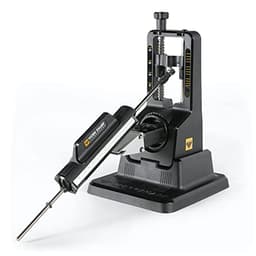
Our pick for most kitchens
Work Sharp Precision Adjust Knife Sharpener
The guided system to buy if a whetstone has beaten you. The blade clamps, the angle sets by knob anywhere from 15 to 30 degrees in one-degree steps, and a rotating handle carries coarse diamond, fine diamond and a fine ceramic. It removes the one variable beginners cannot control: holding a consistent angle.
Read the full Work Sharp reviewPrice as of October 6, 2026. #ad How we’re funded
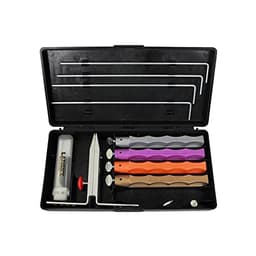
The fixed-angle alternative
Lansky 4-Stone Deluxe Diamond System
The old-school clamp-and-guide-rod system, in its diamond version. You pick one of four fixed angles, thread the hone's rod through the matching hole, and stroke. Fixed angles are less flexible than Work Sharp's dial, but the four diamond hones cut fast and the whole thing folds into a case.
See it in the systems roundupPrice as of October 6, 2026. #ad How we’re funded
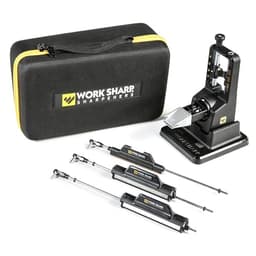
If you sharpen a whole household's knives
Work Sharp Precision Adjust Elite Knife Sharpener
The same clamp-and-dial idea as the standard Precision Adjust, with a wider abrasive selection and a sturdier build. Worth the step up only if you sharpen a lot of knives, or knives in genuinely bad shape — otherwise the cheaper kit reaches the same edge.
Compare it with the standard kitPrice as of October 6, 2026. #ad How we’re funded
Frequently asked questions
Which is better, the Work Sharp Precision Adjust or the Lansky Deluxe Diamond?
The Work Sharp, if your knives include Japanese kitchen blades. It sets any angle from 15 to 30 degrees in one-degree increments, so you can match an existing 15 or 16 degree edge exactly. The Lansky gives you four fixed guides — 17, 20, 25 and 30 degrees — which cover Western kitchen and outdoor knives well and cannot match a 15 degree Japanese edge without re-profiling it.
Can the Lansky sharpen Japanese knives at 15 degrees?
Not at 15 degrees. Its lowest fixed guide is 17 degrees, so sharpening a 15 or 16 degree Japanese edge on it means grinding the edge to a slightly more obtuse angle. That is a one-time re-profile and the knife still gets sharp — it is just no longer the geometry the maker ground. If you own a Shun at 16 degrees per side or a Tojiro DP at around 15, the Work Sharp's dial is the reason to choose it.
Are guided systems better than a whetstone?
They are better at being consistent and worse at everything else. A guided system removes the one variable beginners cannot control — holding a steady angle — which is why it is the right first purchase for a lot of people. A stone is faster once you can use one, handles any blade shape or length, and costs less. Most people who learn stones stop using the clamp.
Do the clamps damage knife handles?
They can mark soft handles and bolsters if you overtighten, which is the most common complaint about both systems. Tighten only enough that the blade does not move, and put a strip of tape or thin card between the clamp jaws and a polished bolster if you care about the finish.
What grits do you get in each kit?
The Work Sharp Precision Adjust carries three abrasives on a rotating handle: 320 coarse diamond, 600 fine diamond and a fine ceramic. The Lansky Deluxe Diamond is four diamond hones, coarse to fine. For context on what those numbers mean, DMT publishes its own color-coded grades at Coarse 325 mesh / 45 micron, Fine 600 mesh / 25 micron and Extra-Fine 1200 mesh / 9 micron.
Will either one sharpen long kitchen knives?
Both will, with a caveat on each. The Work Sharp handles blades to roughly 10 inches without repositioning. The Lansky's hones are small, so a long chef's knife becomes a many-pass job in two or three clamp positions. Neither is pleasant on a very tall blade like a nakiri, where the clamp has to grip well above the edge.
Sources
- 20° & 25° Angle Guides for Whetstone Sharpeners — Work Sharp — Tool-maker reference for common Western (20°) vs finer (Japanese) sharpening angles (accessed July 21, 2026)
- Knife sharpening — Wikipedia — Reference on edge angle, coarse-to-fine grit progression, and honing vs sharpening (accessed July 21, 2026)
- DMT Diamond and Ceramic Color-Coded Grit Chart — Sharpening Supplies — DMT's own color codes with the mesh and micron figure for each grade (Coarse 325/45 µm, Fine 600/25 µm, Extra-Fine 1200/9 µm) (accessed August 11, 2026)
- Understanding Euro/American and Asian Style Knives - Chef's Choice by EdgeCraft — EdgeCraft's own figures: Euro/American knives are 'sharpened with sturdy 20 degree facets (40 degree total angle)' while Asian knives use 'the more delicate 15 degree facets (30 degree total angle)'; its 15° sharpeners create 'the 15 degree edge with a multi-bevel gothic arch geometry which provides more metal support for the edge, therefore making it more durable'; traditional single-bevel Japanese knives have a primary blade bevel 'ground, commonly at about 10-11 degrees' under 'a very small single cutting edge facet of about 15 degree', and 'Always sharpen this style knife at 15 degree (Asian style)'. The Trizor XV Model 15 is the model it names for converting a 20° edge to 15° (accessed August 28, 2026)
- Knife Care 101: A Guide To Maintaining Your Knife — Benchmade — Benchmade's published factory edge spec — 'most Benchmade knives are sharpened at 30-35° inclusive (about 17-20° per side)' — plus its coarse-to-fine grit and stropping guidance (accessed August 13, 2026)
- Sharpening stone — Wikipedia — Reference on water, oil and diamond stones: Japanese water-stone grit ranges, why stones dish in the middle with use, and why a diamond plate retains its flatness (accessed August 13, 2026)
Per-knife specs (steel, HRC, blade length, geometry) are read from each maker’s spec sheet or product listing and dated on the individual review cards above. “Not published” means the manufacturer does not state that figure — we flag it rather than guess.
Keep reading
Work Sharp Precision Adjust Review
The guided clamp in full, including what the dial does and does not fix.
Read the reviewBest Knife Sharpening Systems
Guided, electric and pull-through, ranked against each other.
See the fieldKnife Sharpening Angle Guide
Why 15 degrees and 20 degrees are the two numbers that matter.
Read the guideBest Sharpeners for Japanese Knives
What can actually hold a 15-degree edge, stones included.
See the picksWhetstone vs Electric Sharpener
The other side of this decision, if a clamp is not the answer.
Compare themBest Whetstones for Beginners
If you would rather learn the stone than buy a jig.
See the stones