Whetstone vs Electric Sharpener
One gives a better edge and costs less; the other works in a minute with no skill at all. The right answer depends on a question about yourself, not about the tools.
How this is funded: we earn a commission if you buy through our links, at no extra cost to you. As an Amazon Associate we earn from qualifying purchases. It never changes which knife we recommend, and we’ll tell you when we’d skip one. Full disclosure.
Most comparisons of these two tools are really arguments about identity — whether you are the kind of person who sharpens knives properly. That is not a useful basis for a purchase, so here is the practical version.
A whetstone produces a better edge, costs less, and removes an amount of metal you would struggle to measure. An electric sharpener produces an adequate edge in about a minute, requires no skill whatsoever, and takes a real bite out of the blade every time. The genuine question is not which tool is better. It is whether you will actually use the harder one, because a knife sharpened badly by a machine cuts considerably better than a knife not sharpened at all by a stone in a drawer.
The decision table
| Whetstone | Guided clamp | Electric | |
|---|---|---|---|
| Edge quality | Best | Very good | Adequate |
| Steel removed | Least | Low | Most |
| Skill needed | Real practice | Almost none | None |
| Time per knife | 5-10 min once learned | 10-20 min | About 1 min |
| Angle control | Any angle, by hand | Dialed, exact | One or two presets |
| Fixes chips and reprofiles | Yes | Yes | Partly |
| Works on single-bevel knives | Yes | No | No |
| Mess | Water and slurry | Dry | Dry |
| Cost of entry | Lowest | Middle | Highest |
What a whetstone gives you that nothing else does
Control over the angle.A stone will sharpen at any angle you can hold, which means you can match an edge exactly rather than forcing it to whatever a jig was built for. That matters most with Japanese knives, where the factory geometry is the thing you paid for — a Miyabi ground at 10° per side becomes an ordinary knife the moment a 20° machine touches it.
Repairs.A chipped tip, a rolled section, a bevel that needs re-establishing after years of bad sharpening — a coarse stone handles all of it. Machines mostly cannot.
Feedback. A stone tells you what is happening. You feel the burr form, hear the sound change as the bevel seats flat, see the slurry turn gray. That information is what turns procedure into skill, and it is completely absent from a motorized machine.
The whole method, in order, is in how to sharpen a knife on a whetstone, and the stones we would buy are in best whetstones.
What an electric sharpener gives you
It happens. That is the entire argument, and it is stronger than stone advocates admit. A machine on the counter gets used; a stone that requires soaking, a flat surface, ten minutes and a technique you are unsure of does not. Most household knives in the world are dull, and they are dull because sharpening them was slightly too much effort.
Consistency. Every knife comes out the same, because a jig does not have a bad day. For a household where several people cook and nobody wants to become a sharpening enthusiast, that reliability has real value.
The cost is steel, and it is not trivial. Machines are also inflexible about angle and hostile to a few specific knives. Our electric sharpener roundup goes through which machines are gentle and which are not.
The option in the middle
If your objection to a stone is specifically “I cannot hold the angle” — which it usually is, because that is the only genuinely hard part — a guided clamp system solves exactly that problem and nothing else. The knife clamps, a dial sets the angle, and you push an abrasive back and forth by hand. No skill, no motor, and a fraction of the metal loss.
It is slower than either alternative, which is the honest catch: fifteen minutes a knife, and it does not get faster with practice. But for somebody with three or four good knives who wants them properly sharpened twice a year without learning freehand technique, it is very often the right answer and almost nobody considers it. See the sharpening systems roundup and our Work Sharp Precision Adjust review. If you have already decided on a motor, the machine most people end up with is assessed in full in our Chef’sChoice Trizor XV 15XV review.
The verdict
Buy a whetstone if you own knives worth maintaining, you are willing to spend three or four evenings getting the angle right, or you own hard Japanese knives whose geometry you want to preserve. It is the cheapest option and the best one, in that order.
Buy a guided system if you have tried a stone and could not hold the angle, or if you want repeatable results on a mixed drawer of Japanese and German knives without forcing them all to one geometry.
Buy an electric sharpenerif you know yourself well enough to admit that neither of the above will ever happen, and your knives are currently blunt. That is not a failure — it is a correct read of your own habits, and a machine on the counter beats a stone in a cupboard every single time. If you want the full range of stone-free options ranked, including the improvised ones that actually work, sharpening without a whetstone is the page.
Whichever you choose, buy a honing rod or a strop as well. Ten seconds of maintenance a week does more for a knife than any sharpening method, and it is what stretches sharpening from monthly to twice a year — which matters most of all if you went electric.
If the answer is whetstone
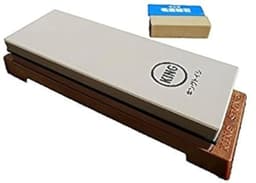
King (Matsunaga) KW-65 1000/6000 Combination Whetstone
The stone that has taught more people to sharpen than any other. One side 1000-grit to set an edge, one side 6000-grit to polish it, made in Japan, for the price of a takeout dinner. Start here.
See all six whetstones compared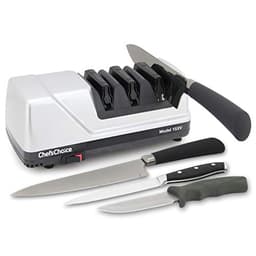
If the answer is electric
Chef'sChoice 15XV EdgeSelect Electric Sharpener
The electric sharpener people who hate sharpening actually keep using. Three stages, diamond abrasives in the first two, and a jig that converts a 20-degree Western edge to a 15-degree one. It is fast and consistent — and it eats far more steel than a stone ever would.
See all five machines comparedPrice as of October 19, 2026. #ad How we’re funded
Frequently asked questions
Is a whetstone better than an electric sharpener?
It produces a better edge, costs far less and removes almost no metal — but only after you have learned to hold a consistent angle, which takes real practice. An electric sharpener gives a repeatable working edge in about a minute with no skill at all, at the cost of significant steel removal each time. Whetstone if you will practice; electric if you honestly will not.
Do electric sharpeners ruin knives?
They remove far more steel per sharpening than a stone does, so a knife run through one weekly will visibly narrow over a few years. Used two or three times a year with honing in between, the metal loss is minor. The genuine damage cases are repeated 'just to be sure' passes, single-bevel Japanese knives, and machines that force a 15-degree angle onto a 20-degree German knife.
How long does it take to learn to use a whetstone?
Most people produce a knife that cuts paper on their first or second attempt, and a genuinely sharp knife within about five sessions. The skill being learned is holding one angle for the length of a stroke; everything else is procedure you can follow from a page. Practice on a cheap soft-steel knife, not on your best one.
What is a guided sharpening system?
A middle option: the knife clamps into a jig and a guide rod holds the abrasive at a set angle, so the machine solves the angle problem but you supply the motion. That means a consistent edge without freehand skill, and a fraction of the metal removal an electric machine causes. It is slower than both alternatives.
Can you use an electric sharpener on Japanese knives?
Double-bevel Japanese knives — gyuto, santoku, nakiri — can go through a machine set to 15 degrees, though a belt-driven sharpener treats them far more kindly than fixed abrasive slots. Single-bevel knives such as yanagiba and deba must never go in one: every machine assumes two symmetrical bevels and will grind the hollow back flat.
Which is cheaper overall?
The whetstone, by a wide margin. A good combination stone costs less than the cheapest decent electric machine and lasts for years of home use with occasional flattening. The electric sharpener also has a hidden cost: it consumes your knives faster, so the blades themselves need replacing sooner.
Sources
- Knife sharpening — Wikipedia — Reference on edge angle, coarse-to-fine grit progression, and honing vs sharpening (accessed July 21, 2026)
- 20° & 25° Angle Guides for Whetstone Sharpeners — Work Sharp — Tool-maker reference for common Western (20°) vs finer (Japanese) sharpening angles (accessed July 21, 2026)
- How to Sharpen a Knife With a Whetstone — Montana Knife Company — Master-bladesmith walkthrough of whetstone angle, grit progression and deburring (accessed July 21, 2026)
Per-knife specs (steel, HRC, blade length, geometry) are read from each maker’s spec sheet or product listing and dated on the individual review cards above. “Not published” means the manufacturer does not state that figure — we flag it rather than guess.
Keep reading
Best Whetstones
Six stones compared on grit, material and prep.
See the stonesBest Electric Knife Sharpeners
Five machines compared, including which knives to keep away.
See the machinesBest Sharpening Systems
The guided-clamp middle ground.
See the systemsHow to Sharpen a Knife
The whetstone method, if you decide to learn.
Read the walkthrough