How to Strop a Knife
Sixty seconds on leather is the difference between sharp and unpleasantly sharp. The stroke, the angle, the count — and the one direction rule that decides whether it works at all.
How this is funded: we earn a commission if you buy through our links, at no extra cost to you. As an Amazon Associate we earn from qualifying purchases. It never changes which knife we recommend, and we’ll tell you when we’d skip one. Full disclosure.
Stropping is the least understood step in sharpening and the easiest one to get right. It takes under a minute, it costs about twenty dollars to set up, and on a knife that is already sharp it produces a noticeable jump in keenness that no amount of extra time on a stone will match.
It is also the step where a small mistake actively makes things worse — strop in the wrong direction or with the spine lifted and you will dull the knife you just spent twenty minutes sharpening. So it is worth reading the stroke description properly before the first attempt.
What stropping does
Two mechanisms, and only one of them needs compound.
Realignment.The last few microns of a knife edge are extremely thin, and thin steel bends. Normal use rolls sections of the apex over to one side, and a rolled apex presents a flat surface to the food instead of a point — which is what “gone dull” usually means on a knife that has not been abused. Drawing the edge backwards across firm leather pushes that bent steel back into line. The reference literature puts it simply: stropping “re-aligns parts of the blade edge that have been bent out of alignment”. This is the same job a honing rod does, done more gently.
Polishing.If the leather is charged with compound — usually green chromium oxide — the strop also abrades, very lightly. That removes the last remnants of the burr left by sharpening and polishes the bevel behind the apex, which is where the extra keenness comes from. It is the finest abrasive step in the whole process, finer than any kitchen water stone.
The mistakes that make a knife worse
Stropping edge-first. The one unforgivable error. Push the knife forward with the edge leading and you will slice into the leather, which ruins the strop, and force the apex to fold, which ruins the edge. Everything about stropping is backwards compared with sharpening.
Lifting the spine.The instinct is to raise the handle slightly for “better contact”. It is the opposite: raising the spine concentrates the abrasive on the very apex and rounds it over. Lay the bevel flat and keep it there.
Pressing hard.Leather compresses. Push down and it bulges up around the edge, wrapping the apex in abrasive from both sides and convexing it. Light pressure — the weight of the blade — is the whole technique.
Using a hanging strap.The barber’s hanging strop works for a straight razor held with almost no pressure by somebody who does it daily. On a kitchen knife it is loose enough to belly upward and roll the edge. Use a strop bonded to a rigid paddle or block.
Where stropping fits
Think of edge maintenance as three jobs with different frequencies. You sharpen on a stone two or three times a year, and that is the only step that removes real metal. You hone or strop weekly, which realigns the edge and removes essentially nothing. And you finish every sharpening session with a strop, because that is when the burr needs taking off.
For hard Japanese knives the strop is not merely an alternative to a rod — it is the correct tool. A grooved steel rod at 60 HRC is a genuine chipping risk, whereas leather cannot damage anything. If you own a VG10 gyuto and a honing rod, the strop should replace the rod. The schedule is laid out in how often to sharpen a knife, and if stropping is not producing a result, the problem is almost always upstream — why your knife won’t get sharp works through the causes in order.
Keeping the strop working
A strop needs almost nothing, but two habits kill one. Do not wash it — water swells leather and then dries it hard, and the compound is meant to accumulate. And do not let it glaze: when the surface goes shiny and black, the leather is saturated with steel particles and has stopped cutting. Scrape it lightly with the spine of a knife or a stiff brush, recharge with fresh compound, and it works like new. Kept that way, a strop outlasts most of the knives you use it on.
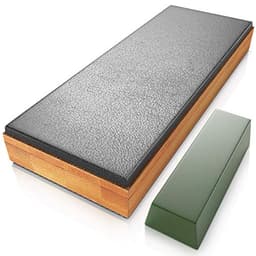
The strop we'd start with
Sharp Pebble Leather Strop for Knife Sharpening
The strop we would pair with a first whetstone. Leather mounted on a wooden paddle with polishing compound in the box, which is exactly the combination a beginner needs — a bare strop with no compound is a burnisher, not a finisher.
See all five strops comparedFrequently asked questions
Which direction do you strop a knife?
Spine-first, always — the edge trails behind the direction of travel, so you are dragging the back of the knife across the leather and the edge follows. Pushing edge-first slices into the strop and rolls the apex over. This is the single rule that decides whether stropping helps or hurts.
How many times should you strop a knife?
Ten to fifteen strokes per side after sharpening on a finishing stone; about five per side for a mid-week touch-up on a knife that is still sharp. More is not better — past the point where the burr is gone, extra strokes start to convex the edge and take the keenness back off.
What angle do you strop at?
The same angle you sharpened at, which for most kitchen knives means about 15 degrees per side for a Japanese blade and 20 for a German one. The practical method is to lay the bevel flat on the leather rather than trying to measure: lower the spine until the whole bevel makes contact, then hold that.
Can you strop a knife without compound?
Yes, and it still does something — bare leather realigns steel that has bent out of line, which is most of what a honing rod does. But the extra keenness people associate with stropping comes from the abrasive: a charged strop polishes the bevel and removes the last of the burr. For a kitchen knife, use compound.
How often should you strop a kitchen knife?
Whenever the edge starts feeling slightly less crisp — for a home cook, that is roughly once a week, and it takes under a minute. Stropping is maintenance, not sharpening: it keeps a sharp knife sharp for far longer between whetstone sessions, and on hard Japanese steel it is the correct alternative to a grooved honing rod.
Will stropping fix a dull knife?
No. A strop removes an almost immeasurable amount of metal, so it cannot create a new bevel, fix a chip or bring back an edge that has genuinely worn round. If the knife will not already slice paper, it needs a whetstone first — then strop at the end of that session.
Sources
- Strop — Wikipedia — Reference on what stropping does to an edge: realigning bent steel, and light abrasion when a compound is used (accessed August 11, 2026)
- Knife sharpening — Wikipedia — Reference on edge angle, coarse-to-fine grit progression, and honing vs sharpening (accessed July 21, 2026)
- How to Sharpen a Knife With a Whetstone — Montana Knife Company — Master-bladesmith walkthrough of whetstone angle, grit progression and deburring (accessed July 21, 2026)
Per-knife specs (steel, HRC, blade length, geometry) are read from each maker’s spec sheet or product listing and dated on the individual review cards above. “Not published” means the manufacturer does not state that figure — we flag it rather than guess.
Keep reading
Sharp Pebble Leather Strop Review
The strop with compound in the box, checked against what Sharp Pebble publishes.
Read the reviewBest Strops
Five leather strops compared on length, backing and kit.
See the stropsHow to Sharpen a Knife
The whetstone session that stropping finishes.
Read the walkthroughSharpening vs Honing
Three different jobs that keep getting confused.
Read the explainerHow Often to Sharpen a Knife
Where stropping fits in a maintenance schedule.
Read the guideHow to Test Knife Sharpness
How to tell whether the burr actually came off.
Learn the tests