How Often Should You Sharpen a Knife?
Two or three times a year, if you hone weekly. Here is the schedule by steel and by kitchen — and the three tests that answer the question better than any calendar.
How this is funded: we earn a commission if you buy through our links, at no extra cost to you. As an Amazon Associate we earn from qualifying purchases. It never changes which knife we recommend, and we’ll tell you when we’d skip one. Full disclosure.
The honest answer to “how often should I sharpen my knife” is that the question is slightly wrong, because it collapses three different jobs into one word. You sharpen a knife a couple of times a year. You hone or strop it weekly. And the reason most people think their knives need constant sharpening is that they are skipping the second thing entirely.
A knife that is realigned weekly and sharpened twice a year will spend almost all of its life feeling sharp, and will still be full-width in twenty years. A knife that is never honed and run through an electric sharpener whenever it annoys somebody will spend most of its life feeling mediocre and will be visibly narrower within five. Same knife, same cook.
The schedule
These are starting points, not rules. Adjust them by what the tests below tell you.
| Cook a few times a week | Cook every day | Professional kitchen | |
|---|---|---|---|
| Hone or strop | Weekly | Before most sessions | Several times a shift |
| Sharpen — soft steel (55-58 HRC) | 2-3× a year | Every 2-3 months | Weekly to fortnightly |
| Sharpen — hard steel (~60 HRC) | 1-2× a year | Every 4-6 months | Fortnightly to monthly |
| Maintenance tool | Rod or strop | Rod (soft) / strop (hard) | Rod at the pass |
Two things move these numbers more than anything else. The first is hardness: a VG10 gyuto at ~60 HRC genuinely holds an edge through several times as much cutting as a German knife at 57, which is exactly what you are buying when you pay for hard steel. Our steel and hardness guide explains the mechanism. The second is what you cut on, which we come back to below and which most people underestimate badly.
Three tests that beat any calendar
Do not sharpen on a schedule. Sharpen when the knife fails a test.
The paper test. Hold a sheet of printer paper by one corner and slice down through it. A sharp knife bites in immediately and cuts a clean line. A knife that needs honing will catch and tear. A knife that skates off the edge of the paper without biting needs a stone.
The tomato test. Rest the edge on a tomato skin and draw it back once, with no downward pressure at all. Sharp cuts in on its own weight. Dull slides across the skin and then bursts through. This is the most honest kitchen test there is, because tomato skin is exactly the material a rolled apex fails on.
The light test. Hold the knife edge-up under a lamp and look straight down at it. A truly sharp apex is too fine to reflect anything and is effectively invisible. Any bright line running along the edge is a flat, and a flat means dull. Bright spots in an otherwise dark edge are chips or rolls in specific places.
The order of operations is: run a test, hone, run the test again. If honing fixed it, the edge was rolled and nothing else was wrong. If it did not, the steel has worn and you need abrasive.
What actually determines how fast a knife dulls
Not the brand, and not really the price. Four things, roughly in order of impact:
1. The board.Glass, stone, granite, ceramic plates and steel counters destroy edges on contact — a single pass across a glass board can undo a whole sharpening session. End-grain wood is gentlest, edge-grain wood and soft polyethylene are fine. This single variable swamps everything else.
2. Honing frequency. Covered above, and it is the difference between sharpening twice a year and every two months.
3. Steel hardness. Real, and smaller than the board effect. Hard steel buys you edge retention; it does not buy you immunity from a granite worktop.
4. Washing and storage. A dishwasher batters edges against racks and etches steel with detergent; loose knives in a drawer knock into each other. Both are pure avoidable damage, and both are covered in knife care and storage.
The cost of sharpening too often
Every sharpening removes metal, and metal does not come back. That matters less than the internet sometimes suggests — a whetstone session on a kitchen knife removes an amount you would struggle to measure — but it compounds, and the tool changes the arithmetic enormously. A stone takes off very little. A guided system takes off a little more. An electric machine takes off a great deal, which is why running one weekly will visibly narrow a knife within a few years while a stone used twice a year will not.
So the rule that keeps knives alive is: maintain constantly, sharpen rarely. Weekly honing or stropping costs nothing in steel and does most of the work. Save the abrasive for when the tests say the edge is genuinely worn.
When to break the schedule
Sharpen immediately, regardless of when you last did, if the knife has a visible chip, if it has been dropped on a hard floor, if somebody has run it through a dishwasher, or if it has been used on a frozen item or a bone. Those are damage events, not wear, and honing will not touch them. Everything else can wait for the tomato.
And if the honest answer to “how often” in your kitchen is “far more often than this page says,” the schedule is not the problem. Why knives get dull so fast works through the six causes — the board, the drawer, the dishwasher, an unremoved burr, a rolled edge nobody honed, and last of all the steel itself.
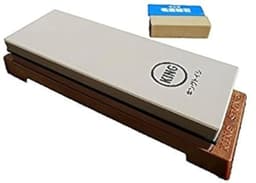
The stone for two sessions a year
King (Matsunaga) KW-65 1000/6000 Combination Whetstone
The stone that has taught more people to sharpen than any other. One side 1000-grit to set an edge, one side 6000-grit to polish it, made in Japan, for the price of a takeout dinner. Start here.
See all six whetstones comparedFrequently asked questions
How often should you sharpen a kitchen knife?
For a home cook who hones or strops weekly, two or three full sharpenings a year is enough. Cook every day and hone rarely, and it becomes every two or three months. A professional line cook sharpens weekly or fortnightly. The variable that matters most is not how much you cook — it is whether you maintain the edge in between.
How often should you hone a knife?
Soft German or American knives: before most cooking sessions, or at least weekly. It takes ten seconds and undoes the edge rolling that normal cutting causes. Hard Japanese knives at 60 HRC: less often, and with a fine ceramic rod or a leather strop rather than a grooved steel rod, which can micro-chip a brittle apex.
How do I know when my knife needs sharpening?
Three tests. The paper test: a sharp knife bites into a hanging sheet of paper and slices cleanly; a dull one skates or tears. The tomato test: it should break the skin on its own weight with no sawing. The light test: hold the edge up to a lamp — a dull edge reflects light back as a thin bright line, a sharp one is invisible. If honing does not fix a failure, it needs a stone.
Can you sharpen a knife too often?
Yes. Every sharpening removes metal, and a knife has a finite amount. Sharpening a kitchen knife weekly on a coarse stone or an electric machine will visibly narrow the blade over a few years. The correct pattern is to sharpen rarely and maintain constantly — hone or strop weekly, and go to the stone only when the edge no longer responds.
Do Japanese knives need sharpening more often?
Less often. Hard steel around 60 HRC holds a keen edge through far more cutting than soft steel at 56-58 HRC — that is the whole point of the hardness. The trade-off is that when a Japanese knife does need work it wants a whetstone rather than a rod, and it is less tolerant of a rushed job.
Does cutting on a wooden board make a knife stay sharp longer?
Yes, and the effect is large. End-grain wood and soft plastic let an edge sink in briefly rather than stopping it dead; glass, stone, ceramic and steel surfaces roll or chip an apex almost instantly. Board choice, along with washing habits and storage, changes sharpening frequency more than the brand of knife does.
Sources
- Knife sharpening — Wikipedia — Reference on edge angle, coarse-to-fine grit progression, and honing vs sharpening (accessed July 21, 2026)
- Rockwell hardness test — Wikipedia — Definition of the Rockwell C (HRC) scale used to state knife-steel hardness (accessed July 21, 2026)
- How to Sharpen a Knife With a Whetstone — Montana Knife Company — Master-bladesmith walkthrough of whetstone angle, grit progression and deburring (accessed July 21, 2026)
Per-knife specs (steel, HRC, blade length, geometry) are read from each maker’s spec sheet or product listing and dated on the individual review cards above. “Not published” means the manufacturer does not state that figure — we flag it rather than guess.
Keep reading
How to Sharpen a Knife
The whetstone session, start to finish.
Read the walkthroughHow to Hone a Knife
The ten-second habit that stretches the schedule.
Read the how-toKnife Care & Storage
The habits that dull knives fastest, and how to stop.
Read the guideWhy Your Knife Won't Get Sharp
When sharpening happens and nothing improves.
Diagnose itHow to Test Knife Sharpness
Five tests that beat any calendar, in the order to use them.
Learn the tests