Petty Knife Guide
The small Japanese knife that solves the problem every cook eventually notices: a gyuto is clumsy on a shallot and a paring knife cannot slice a tomato.
How this is funded: we earn a commission if you buy through our links, at no extra cost to you. As an Amazon Associate we earn from qualifying purchases. It never changes which knife we recommend, and we’ll tell you when we’d skip one. Full disclosure.
Petty is a Japanese loanword from the French petit, and it describes exactly what it sounds like: a small knife. In practice it means a pointed blade of roughly 120–150 mm, shaped like a gyuto that has been scaled down — a gentle curve to the belly, a fine usable tip, a flat-ish section near the heel, and a grind thin enough that it slips into food rather than wedging it apart.
It exists because of a gap that becomes obvious about a month into owning a good chef’s knife. A 210 mm gyuto is superb at everything on a board and genuinely clumsy on a shallot, a garlic clove, a strawberry or a lime. A 90 mm paring knife handles those and cannot slice a tomato without the tip running out of blade. The petty covers the middle, and in most kitchens it ends up being the second-most-used knife in the house.
The shape, and what it is for
A petty is a general-purpose blade in miniature, which is why it is more useful than a specialist knife of the same size. The point is the most important feature: it lets you start a cut in the middle of something, core a pepper, score fat, remove an eye from a potato, or work around a joint on a chicken breast. Any small knife with a rounded or sheepsfoot tip has given that away and is a much narrower tool.
The curve matters second. Enough belly to rock a little for herbs, but flat enough near the heel for clean push cuts. And the grind matters third: Japanese pettys are ground noticeably thinner than Western utility knives, which is why they feel dramatically better on a ripe tomato and why they are less tolerant of being twisted.
The one thing a petty is not is a boning knife. It has no flex and the wrong profile for following a bone, and using it that way is how people break tips off small Japanese knives.
Which size
Length is the whole decision, and the two ends of the range are genuinely different tools.
| 110-125 mm | 135-150 mm | 150-180 mm | |
|---|---|---|---|
| Used mainly | In the hand | Board and hand | On the board |
| Best at | Peeling, coring, trimming | Shallots, herbs, citrus, tomatoes | Small board prep, portioning |
| Replaces a paring knife | Yes | Mostly | No |
| Buy it if you own | A santoku or nakiri already | Just a chef's knife | Nothing between 100 and 200 mm |
| Watch out for | Too short for board slicing | Nothing — the default | Overlaps a santoku |
If you are not sure, take something in the 135–150 mm band. It is the size that does the most jobs adequately, and the one nearly every Japanese maker builds as its standard petty. Go shorter only if you specifically want an in-hand knife, and longer only if you own nothing between a paring knife and a chef’s knife — at which point you might be better served by a santoku.
Hard steel or soft?
This is the one category on the site where we would not push you toward hard steel. Edge retention is a function of how many cuts you make between sharpenings, and a petty makes a handful of cuts at a time — a shallot, a lemon, some parsley — rather than the hundreds a chef’s knife makes in a session. A soft German utility knife at ~58 HRC will feel sharp for perfectly long enough, and it costs a fifth of what a VG10 petty does.
The argument for the hard one is different and still real: a thin, hard blade cuts better while it is sharp, and if you already own a hard-steel gyuto then matching the petty means one stone session covers both knives at the same angle. If you own a Tojiro DP, buy the DP petty; if you own a Wüsthof, buy the Wüsthof. Consistency is worth more here than an upgrade would be. The trade-offs behind the hardness numbers are in our steel and hardness guide.
The five we track, side by side
The word “petty” covers a wider range of knives than most categories, so the specs matter more than usual here — a 114 mm forged German utility knife and a 152 mm Damascus-clad Japanese one are barely the same tool. These are the five in our registry, on the figures their makers publish. An empty cell is a finding, not a gap in our research: it means the maker does not state that number.
| Tojiro DP | Mercer 5-inch | MAC 5-inch | Shun 6-inch | Wüsthof 4.5-inch | |
|---|---|---|---|---|---|
| Blade length | 150 mm | 127 mm | 125 mm | 152 mm | 114 mm |
| Steel | VG10 | X50CrMoV15 | Molybdenum-vanadium | VG-MAX | X50CrMoV15 |
| Published hardness | ~60 HRC | ~58 HRC | Not published | Not published | ~58 HRC |
| Factory edge | ~15° per side | Double bevel | Thin ground | ~16° per side | ~14° per side (PEtec) |
| Construction | VG10 core, 3-layer clad | Forged, full tang, bolstered | Single steel, taper-ground | VG-MAX core, 34-layer Damascus | Forged, full tang, bolstered |
| Really for | Matching a hard Japanese gyuto | Doing the job cheaply | The best cutting feel here | Matching a Shun Classic | In-hand peeling and trimming |
Two patterns are worth reading out of that table. The first is that length is the real variable, not steel: 114 mm and 152 mm are different tools with the same name, and choosing between them is the size decision above rather than a quality decision. The second is that hardness is the spec makers hide behind. MAC and Shun publish no Rockwell figure for these knives at all, and we print “Not published” rather than borrowing one from a sibling model. Even the Tojiro figure is not Tojiro’s: the maker’s own page for the F-802 omits hardness, and the 60 +/-1 HRC comes from the specialist retailer’s spec sheet — a distinction the Tojiro DP petty review takes apart in full.
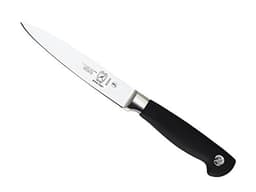
If your kitchen already runs on German knives, or you simply want the gap covered without spending much, the forged budget option is the sensible answer and the page would be dishonest to pretend otherwise:
The cheapest petty worth owning
Mercer Culinary Genesis 5-inch Utility Knife (M20405)
A forged, full-tang, bolstered utility knife for about the price of a takeaway. Nothing here is exciting and nothing is wrong: soft German steel, a grippy handle, and a 127 mm blade that does the small jobs a chef's knife is clumsy at.
See all five comparedWhere it fits in a knife set
The classic three-knife kitchen is a chef’s knife or gyuto for everything on a board, a serrated bread knife for anything with a crust or a skin that resists, and a petty for small work. Almost nobody needs a fourth knife, and everything past that — nakiri, cleaver, slicer, boning knife — is a specialist bought to solve a problem you have actually encountered.
This is also the argument against block sets. A fifteen-slot block contains perhaps three knives you will use and twelve that exist to fill holes, and the money is spread across all fifteen. Buying the three separately gets you far better steel for the same outlay, which we set out in best chef knife sets.
The order matters as much as the list. A gyuto first, this knife second, and a nakiri only if you prep vegetables in volume — that sequence, and what each stage adds, is set out in your first Japanese knife.
If you are weighing this knife against simply using the big one for everything, the head-to-head is in chef knife vs utility knife — including why the second knife most people buy is the wrong one, and why the gap between the two blade lengths is the thing that makes the pair work.
Looking after one
Small knives are easy to sharpen and easy to over-sharpen. The edge is short, so two or three passes per side on a 1000-grit stone covers the whole thing — and it is very easy to spend as long as you would on a chef’s knife and remove metal you will miss in a decade. Sharpen briefly, deburr, stop.
The two habits that break pettys are prying and twisting. A thin 130 mm blade has very little steel resisting a lateral force, so levering an avocado stone or twisting through a hard squash is how tips snap. And the hard Japanese ones want a stone or a strop rather than a grooved rod — the technique is identical to a big knife, and the walkthrough is in how to sharpen a knife on a whetstone.
One naming point worth settling before you buy: petty and utility describe the same size class, so the word on the box tells you nothing. Petty vs utility knifecovers what actually differs between them — hardness, edge angle and thinness behind the edge.
Our pick for a first petty
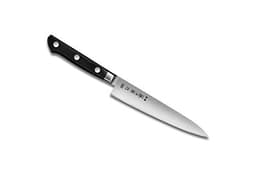
Tojiro DP Petty 150 mm (F-802)
The DP gyuto's little brother, and the petty we would buy. Same VG10 core, same stainless cladding, same ~60 HRC — shrunk to the size where a big knife stops being useful. If you already own a Tojiro gyuto, this is the knife that fills the gap under it.
See all five pettys comparedPrice as of October 20, 2026. #ad How we’re funded
Frequently asked questions
What is a petty knife?
A small, pointed Japanese kitchen knife of roughly 120-150 mm, shaped like a scaled-down gyuto. The name comes from the French 'petit'. It handles everything a chef's knife is too big for and a paring knife is too small for: shallots, garlic, herbs, one tomato, citrus segments, trimming fat and coring peppers.
What is the difference between a petty knife and a paring knife?
Size and where you use it. A paring knife is 80-100 mm and is essentially an in-hand tool — you hold the food up and work on it. A petty is 120-150 mm, long enough to use on a board for slicing and dicing while still being controllable in the hand. Most people find a short petty replaces a paring knife entirely.
Is a petty knife the same as a utility knife?
Functionally yes — 'petty' is the Japanese name and 'utility knife' the Western one for the same 120-150 mm pointed blade. The consistent difference is construction: Japanese pettys are ground thinner and are usually harder, while Western utility knives are often built like miniature chef's knives with a bolster and softer steel.
What size petty knife should I get?
150 mm if it will do small board work — slicing tomatoes, breaking down peppers, portioning a chicken breast. 120 mm or shorter if you want a knife to work in your hand for peeling, coring and trimming. If you already own a 165-180 mm santoku, take the shorter petty, because the longer one duplicates reach you have.
Do I need a petty knife?
Not to cook, but it is the purchase most cooks notice most after their first good chef's knife. Most home prep is small — garlic, shallots, herbs, a lemon — and doing that with 210 mm of blade is awkward. Buy it third, after a chef's knife and a serrated bread knife, and never as a first knife.
Can a petty knife replace a chef's knife?
No. A petty has neither the length nor the weight to break down a cabbage, portion a squash or work through a pile of onions efficiently, and its short edge means far more strokes for the same job. It is explicitly a second knife. If you can only own one, buy a 200-210 mm chef's knife or gyuto.
What is the best petty knife?
It depends on what your big knife is. If you own a hard Japanese gyuto, buy a matching hard petty — the Tojiro DP petty runs the same VG10 core at about 60 HRC, so one stone session covers both knives at one angle. If your kitchen runs on soft German steel, or you simply want the job done cheaply, a forged utility knife at about 58 HRC does everything a petty needs to do for a fraction of the price.
What is a petty knife used for?
Small board and in-hand work: shallots, garlic, chiles, herbs, one tomato, citrus segments, coring peppers, trimming fat and silverskin, hulling strawberries, and taking the eyes out of a potato. It is not a boning knife — it has no flex and the wrong profile for following a bone, and using it that way is how tips get snapped off.
Petty or santoku as a second knife?
A petty, in almost every case. A santoku duplicates most of what your chef's knife already does at a slightly smaller size, while a petty covers the jobs the big knife is genuinely bad at. Buy the santoku third, if at all — the exception is a very small board, where a 170 mm santoku can end up being the knife you use most.
Sources
- Japanese kitchen knife — Wikipedia — Reference on gyuto/santoku/nakiri, single- vs double-bevel (kataba/ryoba) and edge angles (accessed July 21, 2026)
- Rockwell hardness test — Wikipedia — Definition of the Rockwell C (HRC) scale used to state knife-steel hardness (accessed July 21, 2026)
Per-knife specs (steel, HRC, blade length, geometry) are read from each maker’s spec sheet or product listing and dated on the individual review cards above. “Not published” means the manufacturer does not state that figure — we flag it rather than guess.
Keep reading
Best Chef Knives for Small Hands
Where the 80 g Tojiro petty ranks as a main knife for a smaller hand.
See the picksBest Petty & Utility Knives
Five compared on steel, grind and length, with live prices.
See the picksChef Knife Types Explained
Where the petty sits among gyuto, santoku and nakiri.
See the shapesGyuto Knife Guide
The big knife a petty is designed to work alongside.
Read the guideChef Knife Size Guide
How blade length changes the way any knife handles.
Read the guideYour First Japanese Knife
Where the petty sits in the buying order, and what comes after it.
See the buying pathChef Knife vs Utility Knife
Why the gap between the two lengths is what makes the pair work.
Read the comparisonPetty vs Utility Knife
The Japanese petty against the Western utility knife, on published figures.
Compare them