Petty vs Utility Knife
The two words describe the same size class, so the name tells you almost nothing. What separates them is steel hardness, how acutely the edge is ground, and how thin the blade is behind it.
How this is funded: we earn a commission if you buy through our links, at no extra cost to you. As an Amazon Associate we earn from qualifying purchases. It never changes which knife we recommend, and we’ll tell you when we’d skip one. Full disclosure.
Petty and utility are two words for the same size class. Buy a petty if you will hand wash and sharpen it, because you get a harder, thinner, more acutely ground edge; buy a Western utility knife if the knife has to tolerate being treated as a tool. Do not buy one of each — that is the same knife twice.
Petty is the Japanese adoption of the French petit, and it names a knife in roughly the 120 to 150 mm bracket. A Western catalogue calls a knife in the same bracket a utility knife, or sometimes a sandwich knife. There is no shape difference you could pick out blindfolded, no standard that separates them, and makers use both words loosely — the registry we draw on has knives listed as “Paring/Utility” by their own maker. So the words are not the comparison. The build is.
The three differences that are real
1. Hardness.This is the biggest one and it is published on both sides. A Japanese petty with a VG10 core sits near 60 HRC — Takefu, which makes VG10, publishes a hardness of “HRC60≤” for the steel, and the specialist retailer’s spec table for Tojiro’s F-802 states “Rockwell C scale : 60 ±1.” A Western utility knife in X50CrMoV15 sits near 58; Wüsthof’s own account puts its forged German blades at 58 Rockwell and its non-forged ones between 55 and 57. Two points of Rockwell sounds trivial and is not: it is the difference between an edge that holds for weeks of light work and one that needs a rod every few days. Our hardness chart puts the bands in context.
2. Edge angle.Western makers have moved towards finer edges than they used to grind — Wüsthof’s Classic utility knife is ground at roughly 14 degrees per side — but the Japanese convention is still finer and, more importantly, it is finer on harder steel, which is what makes it hold. The practical consequence is in what you can do with the knife: a more acute edge on hard steel slices cleanly through a tomato skin and chips if you lever it against a seed.
3. Thinness behind the edge.Nobody publishes this and it is the thing you actually feel. A thin blade parts food; a thick blade wedges it apart. On a small knife this shows up when you slice a radish or a cold sausage: the thin knife gives you a disc, the thick one gives you a disc with a crack in it. Japanese pettys are generally ground thinner, and where a Western maker grinds thin — MAC’s Professional paring/utility knife is the example in our registry — the knife feels Japanese in the hand regardless of the word on the box.
Where the handle matters more than the blade
This is a size class you use in the air as much as on a board, which makes the handle unusually important. A smooth rounded Western handle with a bolster suits a pinch grip on a board. A grippy textured handle — Santoprene on the Mercer Genesis, POM on the Wüsthof Classic — suits wet hands and in-hand work. A Japanese wa handle is light and neutral and very good for delicate work.
The one specification worth looking for is a closed blade-to-handle joint. Tojiro’s own description of the metal bolster on its DP line is a hygiene argument: it “is very hygienic and prevents stain and dirt from being accumulated between blade and handle.” On a knife that spends its life trimming raw protein and being rinsed, that is not a styling note.
| Tojiro DP Petty 150 mm | Wusthof Classic Utility 4.5 in. | Mercer Genesis Utility 5 in. | |
|---|---|---|---|
| Category name used by maker | Petty / utility | Utility | Utility |
| Blade length | 150 mm | 114 mm | 127 mm |
| Steel | VG10 core, 13-chrome stainless cladding | X50CrMoV15 | X50CrMoV15 (German stainless) |
| Published hardness | Not published by Tojiro; 60 ±1 HRC per specialist retailer | ~58 HRC (maker's figure for forged blades) | ~58 HRC |
| Edge | Double bevel | Double bevel, ~14° per side | Double bevel |
| Weight | 80 g | Not published | Not published |
| Handle | Reinforced laminate, full tang, metal bolster | POM, triple-riveted | Santoprene, non-slip |
| Best at | Clean slicing; board and in-hand | In-hand trimming, peeling, coring | Everything, cheaply |
| Dishwasher | No | No — maker excludes it from warranty cover | No |
Which one to buy
Buy the pettyif your chef’s knife is already Japanese, if you hand wash, and if you own or intend to own a stone. You get the cleanest cut available in this size, and in the Tojiro’s case you get published dimensions (150 mm blade, 260 mm overall, 80 g) which is more than most makers in this class will tell you.
Buy the Western utility knifeif the knife needs to be unprecious. Softer steel rolls instead of chipping, comes back on a rod in seconds, and tolerates the household treating it as a general-purpose tool. Note that “unprecious” still does not mean dishwasher-safe: Wüsthof excludes dishwasher damage from its own warranty cover, and every maker in this class says the same.
Buy neither yetif you do not already own a good chef’s knife. This is a second or third knife. Our chef’s knife roundup is where the first purchase belongs, and the full field in this size class is in best petty knives.
How we compared these
Every figure in the table above is the maker’s own published specification, except the Tojiro hardness, which Tojiro does not publish and which is labeled as the specialist retailer’s figure instead. Where a maker publishes nothing — weight, in two of three cases — the table says so rather than estimating. We own none of these knives and claim no test results; our methodology page explains what we do instead. Prices come only from our live price layer, with the date each was read.
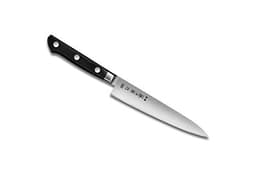
The petty: hard, thin, VG10-cored
Tojiro DP Petty 150 mm (F-802)
The DP gyuto's little brother, and the petty we would buy. Same VG10 core, same stainless cladding, same ~60 HRC — shrunk to the size where a big knife stops being useful. If you already own a Tojiro gyuto, this is the knife that fills the gap under it.
Read the full Tojiro DP petty reviewPrice as of October 16, 2026. #ad How we’re funded
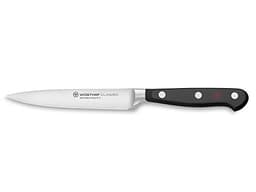
The utility knife: softer, sturdier, in-hand
Wüsthof Classic 4.5-inch Utility Knife
The forged German answer to the petty question. At 114 mm it is the shortest knife here — closer to a big paring knife than a small chef's knife — and it is built like the full-size Classic, bolster and all.
See it against the fieldPrice as of October 16, 2026. #ad How we’re funded
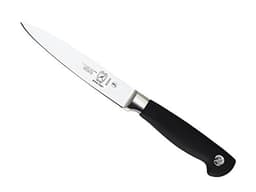
The cheapest one worth owning
Mercer Culinary Genesis 5-inch Utility Knife (M20405)
A forged, full-tang, bolstered utility knife for about the price of a takeaway. Nothing here is exciting and nothing is wrong: soft German steel, a grippy handle, and a 127 mm blade that does the small jobs a chef's knife is clumsy at.
See it against the fieldFrequently asked questions
What is the difference between a petty knife and a utility knife?
The name is regional, not functional: petty is the Japanese term for the same size class a Western maker calls a utility knife, from the French 'petit'. What actually differs is what Japanese versus Western construction always differs in — a petty is typically harder (around 60 HRC against 58), thinner behind the edge and ground more acutely, while a Western utility knife is a little sturdier and more forgiving.
Is a petty knife the same as a paring knife?
No, though the ranges overlap. A paring knife is usually 80 to 100 mm and designed to be used in your hand, in the air. A petty is usually 120 to 150 mm, which is long enough to still work on a board. At 120 mm the two categories genuinely blur, and several makers list the same blade under both words at different lengths.
What size petty knife should I buy?
150 mm if it is your second knife after a chef's knife, because it is the only length in this class that works both on a board and in your hand. 120 to 127 mm if you want a dedicated in-hand knife and already own something for board work. Below about 110 mm you are buying a paring knife, which is a different tool.
Is a petty knife worth it over a cheap utility knife?
If you will hand wash it and sharpen it on a stone, yes — the hard thin edge holds longer and cuts more cleanly. If the knife will go in a dishwasher, get used on frozen food, or never be sharpened, a soft German utility knife at around 58 HRC is genuinely the better buy and not a compromise.
Can a petty knife replace a paring knife?
For most people, yes. A 150 mm petty does everything a paring knife does slightly less comfortably, and a lot of things a paring knife cannot — slicing a shallot on a board, portioning a block of cheese, cutting a sandwich. The exception is close in-hand work like hulling strawberries or turning vegetables, where a short blade is genuinely easier to control.
Do I need both a petty and a utility knife?
No. They are the same size class, so owning one of each is the clearest case of drawer overlap there is. Own one knife in this bracket and spend the saved money on a whetstone or on a better chef's knife — the chef's knife does most of your work and the stone keeps all of it sharp.
Is a utility knife the same as a boning knife?
No. A boning knife is narrow and usually flexible, designed to follow bone and separate joints; a utility knife is stiff and straight. Using a stiff utility knife to bone out a chicken is the quickest way to twist and chip it, and that is especially true of the harder Japanese petty blades.
What is the best petty knife?
The Tojiro DP at 150 mm is the one we would buy first: a VG10 core clad in 13-chrome stainless, with Tojiro publishing 150 mm, 260 mm total length and 80 g for the F-802. If you want soft steel and a tougher edge, the Wusthof Classic 4.5-inch is the Western answer, with a published X50CrMoV15 blade at around 58 HRC and roughly a 14 degree edge per side.
Sources
- TOJIRO CLASSIC Petty Knife 150mm — TOJIRO JAPAN — Tojiro's own product page for the F-802: blade length 150 mm, total length 260 mm, weight 80 g, core 'VG10', outer layers '13 Chrome Stainless Steel', handle 'Reinforced Laminated Material (3Studs, Full-Tang)', edging 'Double Bevel', and a metal bolster that 'is very hygienic and prevents stain and dirt from being accumulated between blade and handle'. The series is described as 'An extremely durable and rust-resistant knife made to professional specifications' that 'has achieved both professional sharpness and easy maintenance'. NO Rockwell hardness figure is published on this page (accessed September 9, 2026)
- Tojiro (FUJITORA) DP 3Layered VG10 Petty Knife (Utility) 150mm — Hocho-Knife — The Japanese-knife specialist's spec table for the same F-802: blade material 'VG-10(Core), Cobalt Alloy Steel by 3-Layers Stainless Steel', hardness 'Rockwell C scale : 60 +/-1', blade length '150mm (5.9in.)', total length '260mm (10.2in.)', weight '80g', handle 'Composite Wood with Metal Tsuba(bolster)', edge 'Double edged (available for both left and right-handed)', 'Made in JAPAN'. This — not Tojiro's own page — is where the DP line's published hardness figure comes from (accessed September 9, 2026)
- The Difference Between WÜSTHOF Forged and Stamped Kitchen Knives — WÜSTHOF — Wüsthof's own account of both processes: forged blades start as a single piece of steel heated to over 2000°F and take 'over fifty-four manufacturing steps', hardened to '58 Rockwell'; non-forged blades are 'cut from a high-quality steel sheet using a precision laser' in 'thirty-five manufacturing steps' and run 'between 55 and 57 Rockwell' (accessed August 18, 2026)
- Limited Lifetime Warranty Policy Details — WÜSTHOF — Wüsthof's published warranty terms: cover for the initial purchaser or gift recipient, and the exclusions (bent tips, chipped blades, honing steels, customary wear, commercial or educational use) (accessed August 13, 2026)
- VG10 — TAKEFU SPECIAL STEEL CO., LTD. — The steel maker's own published composition for VG10: 'C: 1.00, Cr: 15.00, Mo: 1.00, V: 0.25, Co: 1.55' (percent), a hardness of 'HRC60≦' (60 HRC and above), and the maker's own explanation that '15% chromium (Cr), 1% molybdenum (Mo), and 1.5% cobalt (Co) which all strengthen the matrix, yielding high hardness, in addition to maintaining a long-lasting sharp edge'. Intended uses listed as kitchen knives, general-purpose knives and machine blades (accessed September 18, 2026)
- Japanese kitchen knife — Wikipedia — Reference on gyuto/santoku/nakiri, single- vs double-bevel (kataba/ryoba) and edge angles (accessed July 21, 2026)
- Rockwell hardness test — Wikipedia — Definition of the Rockwell C (HRC) scale used to state knife-steel hardness (accessed July 21, 2026)
Per-knife specs (steel, HRC, blade length, geometry) are read from each maker’s spec sheet or product listing and dated on the individual review cards above. “Not published” means the manufacturer does not state that figure — we flag it rather than guess.
Keep reading
Best Petty Knives
The whole field in this size class, compared on published figures.
See the picksChef Knife vs Utility Knife
The other half of the question: board work against in-hand work.
Compare themWhat Is a Petty Knife?
The shape, the name and where it came from.
Read the explainerTojiro DP Petty Review
The 150 mm F-802 in full, with the figures Tojiro publishes.
Read the reviewYour First Japanese Knife
Where a petty belongs in the gyuto, petty, nakiri sequence.
Read the pathChef Knife Size Guide
How the length bands work across every shape.
Read the guide