What forging actually buys
A bolster.The thick collar between blade and handle is the signature of a forged Western knife — it is the part of the billet that was not hammered thin. It adds weight behind the hand, it gives a pinch grip something to rest against, and on a full-bolster design (the Zwilling) it is a finger guard. It also, on a full bolster, stops you sharpening the last centimeter of the heel, which is why Wüsthof and Mercer use a half bolster and why the Wüsthof vs Zwilling page spends so long on it.
A full tang. The steel of the blade continues through the handle as a full-width slab, riveted between the scales. Every knife on this page has one. It is a durability feature more than a performance one: handles on full-tang knives do not loosen, and the knife balances further back.
A few points of hardness.This is the one people miss. Wüsthof publishes 58 HRC for its forged line against 55–57 for its stamped one — a modest but real gap, and it shows up as an edge that holds a little longer between honings. It does not make a forged German knife hard in the Japanese sense: 58 HRC is still soft enough to roll rather than chip, and a honing rod is still the right maintenance tool. The hardness chart puts the bands side by side.
What it does not buy.A better steel. The Wüsthof, the Mercer and the stamped Victorinox Fibrox all use X50CrMoV15; forging changes the shape and the heat treatment, not the alloy. And it does not buy a thinner grind — forged knives tend to be ground thicker, which is why a thin stamped or clad knife often cuts more cleanly than a forged one of twice the price. Forging is a trade: weight, bolster and durability for some cutting feel.
Why the Japanese knives are not on this page
Several of the Japanese knives we cover are forged in the plain sense of the word — a clad blade is made by forge-welding a hard core between softer layers. But they do not have the things a buyer searching “forged chef knife” is looking for: there is no integral bolster hammered from the billet, the tang is often concealed or partial, and the makers describe the construction as “VG10 core, stainless-clad” or “Damascus cladding” rather than “forged.” We list construction as the maker states it, so they do not appear here. That is not a demerit. A Tojiro DP gyuto at ~60 HRC will hold an edge longer than any knife on this page; it just answers a different question, and the Japanese vs German page is where that question lives.
Forged sets: read the whole box
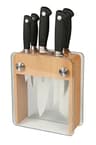
“Forged knife set” is where the word does the most work and deserves the most suspicion, because a set can be sold as forged when only the chef’s knife is. The two sets here are chosen because the maker states forged construction across every blade. The Wüsthof two-piece is the cleanest version of the idea: the 8-inch chef’s knife and a paring knife, both forged X50CrMoV15 at ~58 HRC, no block, no filler. The Mercer Genesis six-piece is the block version done honestly: the distributor listing describes forged, full-tang, bolstered German stainless blades across all five knives, in a beech-and-glass block. Its one weakness is disclosure — neither the set listing nor the Genesis chef knife’s own listing prints a steel grade or a Rockwell figure, so its hardness cell reads Not published, and that is why the Wüsthof pair ranks above it despite offering fewer knives. The full review goes through every piece.
Fifteen-piece blocks are not on this page for a reason: the ones in our registry are stamped throughout, and a big block that is genuinely forged all the way through costs far more than most buyers searching this term intend to spend. Our knife sets roundup covers the stamped blocks and says which are worth it.
The forged santoku
A santoku built the German way is a slightly odd object — the shape was designed to be light and thin, and forging makes it neither — but for a cook who wants the flat profile and shorter length with Western weight and toughness, the Wüsthof Classic 7-inch is the one to buy: fully forged, full tang, bolster, hollow-ground scallops, ~58 HRC. It is heavy for a 170 mm blade and it will not hold an edge like a VG10 santoku, and the registry card says both. If you want the santoku shape done the Japanese way instead, the santoku roundup is the page.
How we ranked these
We do not own these knives. Eligibility was the maker’s own construction description containing “forged”; ranking within the eligible set was on published hardness (a stated ~58 HRC beats an unstated one), bolster design, and for the sets, whether every blade is forged and whether the box contains filler. Price was not a ranking criterion, but the live figure on every card is the one to check before you decide between the Wüsthof and the Mercer, which share a steel, a hardness and a construction.