Wüsthof vs Zwilling
Forged in the same German town, in the same steel class, at almost the same price. The differences are small, real, and mostly about what happens on a whetstone five years from now.
How this is funded: we earn a commission if you buy through our links, at no extra cost to you. As an Amazon Associate we earn from qualifying purchases. It never changes which knife we recommend, and we’ll tell you when we’d skip one. Full disclosure.
Solingen has been making cutlery since the Middle Ages, and these two companies are the reason most people outside Germany have heard of it. Both forge their premium chef’s knives from German stainless, both run them in the 57-58 HRC band, both fit full tangs and triple-riveted synthetic handles, and both charge broadly similar money.
That similarity is not a coincidence and it is not laziness — it is what a mature tradition converging on a good answer looks like. It also means the comparison comes down to a small number of genuine differences, which is more useful than it sounds, because you can actually decide on them.
The decision table
| Wüsthof Classic | Zwilling Pro | |
|---|---|---|
| Steel | X50CrMoV15 | Zwilling special-formula stainless |
| Hardness | ~58 HRC | ~57 HRC |
| Construction | Forged, full tang | Forged, ice-hardened, full tang |
| Bolster | Half bolster | Curved — heel fully reachable |
| Factory edge | ~14° per side | German-standard grind |
| Blade length | 203 mm | 203 mm |
| Handle | POM, triple-riveted | Polymer, triple-riveted |
| Profile | Moderate belly | Slightly more curved belly |
| Price tier | Premium | Mid |
The bolster is the real difference
On any forged Western knife, the bolster is the collar of steel where the blade meets the handle. It stops your fingers sliding onto the edge, it adds weight behind your grip, and it creates a problem that nobody mentions at the point of sale: a full bolster stands proud of the cutting edge, so when the blade lies on a whetstone the last stretch near the handle never touches abrasive.
Sharpen a knife for a few years and the result is visible — the rest of the edge has receded, the heel has not, and there is a step you cannot remove without grinding the bolster back. A half bolster (Wüsthof Classic) is cut away below the spine, which mostly solves it. A curved bolster (Zwilling Pro) tapers away before the heel entirely, which solves it completely.
If you sharpen your own knives and intend to keep one for twenty years, that is a more consequential feature than a single Rockwell point in either direction. If you send knives out to be professionally sharpened, it matters much less — a service will grind the bolster if it needs it.
One Rockwell point, and what it is worth
Wüsthof publishes ~58 HRC for its forged knives and Zwilling ~57 for the Pro line. That is close to the smallest difference worth stating. In practice the Wüsthof will hold an edge slightly longer and the Zwilling will be a shade more forgiving of abuse — both effects small enough to be swamped by whether you hone regularly.
Zwilling’s “ice-hardening” is a genuine cryogenic step in heat treatment rather than marketing invention: cooling the steel well below freezing after quenching converts more retained austenite to martensite, making hardness more consistent through the blade. It is real metallurgy that ends up expressed as the same HRC figure everyone else quotes, so read the number rather than the process name. The hardness chart puts both firmly in the same band.
The factory edge
Wüsthof grinds the Classic to roughly 14° per side, which is unusually acute for a German knife and is a big part of why a new one feels keener than its hardness would suggest. Zwilling uses a more conventional German grind on the Pro.
This difference is real out of the box and evaporates the first time you sharpen either knife yourself — at that point you choose the angle. It matters most to buyers who will never own a stone, which is a large share of the market and precisely who a keen factory edge is aimed at.
In the hand
Both are heavy in the way forged German knives are, with the balance near the grip and enough momentum that the blade helps you through a dense carrot. The Zwilling Pro carries a slightly more generous belly, which suits a rocking motion; the Wüsthof is marginally flatter, which suits a push cut a little better.
Both handles are symmetrical triple-riveted synthetics: durable, dishwasher-proof in principle (do not), and less grippy when wet than the Santoprene on a Mercer or the Fibrox on a Victorinox. Neither is handed, which makes both a better bet than a D-handled Japanese knife for a left-handed cook.
Warranty and where you buy
Both carry long warranties and both are counterfeited. Wüsthof’s published terms are specific about what is notcovered: bent tips, chipped blades, honing steels, customary wear, and commercial or educational use. That is worth reading before assuming a lifetime warranty covers a knife that met a tile floor. Buy from an authorized dealer and keep the receipt — the channels are compared in where to buy a Japanese chef knife, and the same logic applies to German brands.
Which one to buy
Buy the Wüsthof Classic if you want the keener edge from day one, you like a slightly flatter profile, and you are buying a knife to keep for decades from the most established name in the category. It is the more refined of the two and it is priced accordingly.
Buy the Zwilling Pro if you sharpen your own knives and want the heel accessible for the life of the blade, if you rock-chop and want the extra belly, or if you want a forged Solingen knife at a lower price. The curved bolster is a genuinely thoughtful piece of design and the reason this knife deserves more attention than it gets.
Buy neither ifwhat you actually want is a keener, harder, lighter knife — in which case the choice is not between these two but between German and Japanese entirely, which is argued out in Japanese vs German knives and Shun vs Wüsthof.
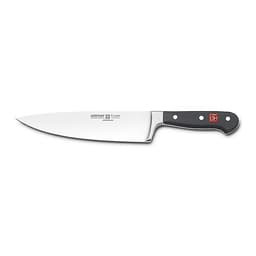
If the answer is Wüsthof
Wüsthof Classic 8-inch Chef's Knife
The benchmark forged German chef's knife: a full-tang X50CrMoV15 blade at ~58 HRC with a bolster and heft that many cooks prefer for rock-chopping. Heavier and softer than a gyuto, and built to last decades.
Read the full reviewPrice as of October 20, 2026. #ad How we’re funded
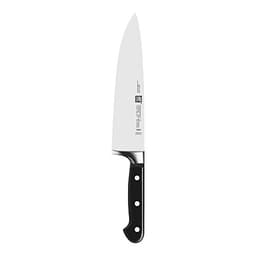
If the answer is Zwilling
Zwilling Professional S 8-inch Chef's Knife
The other great forged German knife. Zwilling's special-formula stainless at ~57 HRC, a full bolster and their ice-hardening process make this a durable, slightly heavier alternative to the Wüsthof Classic.
Read the full reviewFrequently asked questions
Is Wüsthof or Zwilling better?
They are close enough that hand feel should decide it. Wüsthof's Classic runs slightly harder at ~58 HRC with a keener factory grind and a half bolster; Zwilling's Pro runs ~57 HRC with a curved bolster that leaves the heel fully reachable on a stone. Buy the Wüsthof for the edge out of the box, the Zwilling if you sharpen your own knives and want the whole edge accessible.
Are Wüsthof and Zwilling the same company?
No. They are separate, long-established companies that both make knives in Solingen, Germany, and both forge their premium lines from German stainless in the same hardness band. The overlap in materials and method is why the comparison is so close; the ownership is entirely separate.
What is the difference between the Wüsthof Classic and the Zwilling Pro?
The bolster is the headline. The Classic has a half bolster; the Pro has a curved one that tapers away before the heel, so a whetstone reaches the entire edge. Beyond that: the Classic is a Rockwell point harder with a finer factory grind, the Pro carries a slightly more curved belly that favors rocking, and both use symmetrical triple-riveted handles.
Does the bolster really matter?
Over a long life, yes. A full bolster sits proud of the edge at the heel and blocks a stone, so after years of sharpening you develop an unsharpened step near the handle that only a coarse grind on the bolster will fix. A half or curved bolster avoids that. If you send your knives out for sharpening, the point is much less pressing.
Which is easier to sharpen?
The Zwilling Pro, marginally and for one specific reason: the curved bolster lets the whole edge lie flat on a stone. Otherwise the two are equally forgiving — both are German stainless in the 57-58 HRC band, which raises a burr quickly and tolerates a slightly inconsistent angle. Both are good knives to learn stone technique on.
Should I buy German or Japanese instead?
If the choice above feels like splitting hairs, that is a signal. Both of these are tough, heavy, forgiving knives that need honing often and hold an edge for weeks. A Japanese knife at ~60 HRC cuts more keenly and holds it for months, and asks you to be careful and own a whetstone. That is the bigger fork in the road.
Sources
- The Difference Between WÜSTHOF Forged and Stamped Kitchen Knives — WÜSTHOF — Wüsthof's own account of both processes: forged blades start as a single piece of steel heated to over 2000°F and take 'over fifty-four manufacturing steps', hardened to '58 Rockwell'; non-forged blades are 'cut from a high-quality steel sheet using a precision laser' in 'thirty-five manufacturing steps' and run 'between 55 and 57 Rockwell' (accessed August 18, 2026)
- Rockwell hardness test — Wikipedia — Definition of the Rockwell C (HRC) scale used to state knife-steel hardness (accessed July 21, 2026)
- Limited Lifetime Warranty Policy Details — WÜSTHOF — Wüsthof's published warranty terms: cover for the initial purchaser or gift recipient, and the exclusions (bent tips, chipped blades, honing steels, customary wear, commercial or educational use) (accessed August 13, 2026)
Per-knife specs (steel, HRC, blade length, geometry) are read from each maker’s spec sheet or product listing and dated on the individual review cards above. “Not published” means the manufacturer does not state that figure — we flag it rather than guess.
Keep reading
Wüsthof Classic 8-inch Review
The forged German benchmark, in full.
Read the reviewZwilling Pro 8-inch Review
The curved-bolster alternative, in full.
Read the reviewForged vs Stamped Knives
What forging buys, in the maker's own published figures.
Read the comparisonKitchen Knife Brands Explained
Who makes what, and the house steel each brand builds on.
See the brands