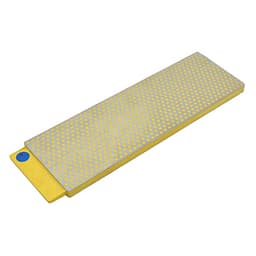
Buy the D8F if you sharpen thin, pointed Japanese knives and want a plate that will still be dead flat in a decade. Buy the two-grit DuoSharp instead if you need one tool to cover both edge repair and routine sharpening. That is the whole decision between DMT’s two 8-inch bench plates, and it comes down to a single physical difference: this one has no holes in it.
DMT’s own page for SKU D8F describes a “precisely engineered Dia-Sharp Bench Stone with continuous diamond surface” that “assures consistent, even sharpening every time,” and leads with a claim no water stone can make: “Guaranteed not to hollow or groove.” The grade is published plainly as “fine diamond (25 micron / 600 mesh) for honing a razor sharp edge,” on a “micronized monocrystalline diamond surface,” with “non-skid rubber feet with the diamond grit clearly marked on side of stone,” and it is “Made in the USA.” The Amazon listing we link adds the dimensions: 8 x 3 x 0.38 inches.
We have not worn this plate out over years — we do not own one, and our methodology page says what we do instead. What follows is DMT’s published specification, read against the rest of the field and against what a Japanese kitchen edge actually needs.
The continuous surface is the product
DMT sells two bench formats and the difference is not cosmetic. The DuoSharp line uses what DMT calls interrupted surface technology — the familiar polka-dot face, which DMT describes as “slightly recessed” so swarf falls away instead of loading the abrasive. Dia-Sharp is unbroken diamond from edge to edge, and DMT itself points that surface at “small and pointed tools.”
On a kitchen knife that distinction shows up in one specific place: the tip. Draw the last 20 mm of a thin gyuto across an interrupted plate and the point repeatedly crosses a void and lands on the far rim of it. On a soft German blade nothing happens. On a 60–61 HRC Japanese edge, that is exactly the kind of point loading that takes a small chip out, and the tip is the thinnest, least supported steel on the knife. The continuous face removes the mechanism entirely.
The second thing you are buying is flatness you do not have to maintain. A water stone dishes in the middle with use — that is normal, and the fix is a flattening plate and the pencil-grid routine in our flattening guide. A dished stone grinds a convex bevel, which is a real and under-discussed reason edges come off a stone less sharp than they went on. DMT’s plate does not dish, and DMT puts that in writing. It will also flatten other things for you: DMT’s page names “flattening plane soles, irons and chisel backs,” and in a kitchen context a diamond plate is the standard tool for lapping a water stone back to true.
What 25 micron / 600 mesh actually does
Fine is the grit a kitchen knife lives at, and it is worth being precise about what it is not. DMT’s published color-coded table runs Coarse at 325 mesh / 45 micron, Fine at 600 mesh / 25 micron, and Extra-Fine at 1200 mesh / 9 micron. This plate is the middle one, in one grade only.
DMT D8F against its two-grit sibling and a typical water stone, on published figures| | DMT D8F Dia-Sharp | DMT DuoSharp W8FCNB | 1000/6000 water stone |
|---|
| Grits | Fine only — 600 mesh / 25 µm | Coarse 325/45 µm + Fine 600/25 µm | 1000 + 6000 |
|---|
| Surface | Continuous diamond | Interrupted (recessed dots) | Continuous, bonded abrasive |
|---|
| Plate size | 8 x 3 x 0.38 in. | 8 x 2.63 x 0.38 in. | Varies, typically ~180 x 60 mm |
|---|
| Stays flat | Guaranteed not to hollow or groove | Yes — diamond plate | No — dishes with use |
|---|
| Prep | Dry or water, no soaking | Dry or water, no soaking | Soak or splash, depending on stone |
|---|
| Base / feet | Non-skid rubber feet | None (NB = no base) | Usually a holder in the box |
|---|
| Finishes an edge | No — working grit | No — working grit | Yes, at 6000 |
|---|
| Best for | Thin, pointed Japanese blades | One plate for repair + sharpening | A polished finish, cheapest route |
|---|
So: this is a maintenance and sharpening plate, not a finishing one. If you want a polished edge you add a fine water stone or a strop after it — our grit guide explains why that extra polish matters less for kitchen work than most people assume, and how to strop a knife covers the cheap version of the same effect.
The advice on DMT’s own site that we tell you to ignore
DMT’s FAQ recommends “sharpening at a 20-degree angle,” and adds that “sharpening at the proper angle is not as important as sharpening at a constant angle.” The second clause is among the best sentences any maker has written about sharpening. The first is wrong for the knives this site is about.
Twenty degrees per side is Western and outdoor geometry. Shun publishes a 16° edge per side for the Classic line; the VG10 gyutos in our registry sit around 15°. Sharpen one of those at 20° and you are not maintaining the edge, you are grinding a thicker one and throwing away the geometry you paid for. Use the plate at the angle your knife already has — our angle guide covers how to find and hold it.
One more piece of DMT guidance worth carrying over, because it applies to every hard Japanese knife: Shun’s own FAQ warns “please do not use a diamond steel for regular honing. Diamond steels are for sharpening and will remove metal from your knife before it is necessary.” A diamond plate is a sharpening tool, used when the edge needs steel removed. The ten-second daily habit is a ceramic rod, not this.
Living with it
Break-in is real and DMT says so.“The diamond surface will seem aggressive in nature; the diamond sharpener will smooth after initial sharpening with no impact to long term performance. Your first few sharpenings are the break-in period.” Do those sessions on a cheap knife.
Water, then dry it.DMT’s care instruction is to “clean after each use with water and wipe dry,” and after several sharpenings to “use a mild kitchen abrasive cleanser and a nylon scrub brush.” A loaded plate feels finer than it is and cuts worse.
It will not last forever.DMT states that its sharpeners “do not last forever, but they last for several years,” while guaranteeing replacement for defects “regardless of age.” That is a more honest pair of claims than most of this category manages.
Who should buy something else
- You have a chipped or badly neglected edge.600 mesh will get there eventually and you will be at it a long time. Start with a coarse plate or a coarse stone — see how to fix a chipped knife.
- You want one tool to do everything. The two-grit DuoSharp is the better single purchase, and the holes are a non-issue on Western knives.
- You want a mirror finish. Buy a water stone. Diamond cuts; it does not polish.
- You are buying your first sharpening tool ever. A 1000/6000 combination stone costs less and teaches more. Our beginner stones page is the starting point.
The verdict
This is the plate to own if your knives are thin, hard and pointed — the continuous surface removes a real chipping mechanism that nobody selling polka-dot plates mentions, and “guaranteed not to hollow or groove” is a claim with teeth. It is a narrow tool: one working grit, no finishing grade, and no answer for a damaged edge. Within that range it does the job better than anything else we cover, and it is one of the few sharpening products whose maker publishes everything you would want to check. Worth noting for anyone cross-shopping: DMT’s own store was listing this plate well above what the Amazon listing has been running at on the date we checked, so compare both before you buy — the live price on the card above is read fresh and dated.