Gyuto Club

The Best HENCKELS Knives

One company, two brands, and a spec sheet that only exists on one of them. What ZWILLING publishes, what HENCKELS does not, and which of the four is worth your money.

By Stephen V.Last updated How we pick

Buy the ZWILLING Professional S 8-inch if you want the best knife this company makes for under $100 — forged in ZWILLING’s own German factory, ice-hardened, a published ~57 HRC, with a full bolster that doubles as a finger guard. It is for the cook who wants one proper German knife and will keep it for twenty years. The budget pick is the HENCKELS Solution 8-inch chef’s knife at roughly a sixth of the price: a stamped German-stainless blade with a real brand behind it, for a first kitchen or a second knife you will not baby.

Now the thing that actually makes this page worth reading, because it is the question behind almost every HENCKELS search. ZWILLING and HENCKELS are two tiers of the same company, and only one tier publishes its numbers. The two-figure logo (ZWILLING) is the forged, ice-hardened, Solingen-made line, and ZWILLING prints a hardness figure, a care regime and a US warranty for it. The one-figure logo (HENCKELS, formerly J.A. Henckels International) is the stamped value line — and for the Solution and Statement ranges there is no published Rockwell figure at all. Both are legitimate; they are simply not the same purchase, and the price gap tells you which one you are holding. Prices below come from our live price layer as of November 22, 2026.

We rank four items, which is the whole HENCKELS-family field in our registry, and we would rather say that than pad the list with knives we have not verified. We own none of them and claim no testing; every figure is the maker’s or the listing’s, read on a dated visit, and where nobody publishes one we say “Not published” — see our methodology.

How this is funded: we earn a commission if you buy through our links, at no extra cost to you. As an Amazon Associate we earn from qualifying purchases. It never changes which knife we recommend, and we’ll tell you when we’d skip one. Full disclosure.

Quick picks

Ranked on steel, hardness, geometry and buyer fit. Select a row to jump to the full write-up. We have not cut with every one of these — here is exactly how we compared them instead.

#KnifeBest forPrice
1
Zwilling Professional S 8-inch Chef's Knife

Zwilling Professional S 8-inch Chef's Knife

The other great forged German knife. Zwilling's special-formula stainless at ~57 HRC, a full bolster and their ice-hardening process make this a durable, slightly heavier alternative to the Wüsthof Classic.

Best overall — the forged one
$92.62 · View on Amazon

$169.9946% off

Price as of November 22, 2026. #ad How we’re funded

2
HENCKELS Solution 8-inch Chef's Knife

HENCKELS Solution 8-inch Chef's Knife

About the cheapest way to get a German-stamped chef's knife with a name behind it. HENCKELS (the Zwilling sister brand) doesn't publish the hardness on this entry line, so treat it as a solid starter blade, not a keeper.

Budget pick — cheapest knife worth owning
$15.22 · View on Amazon

Price as of November 22, 2026. #ad How we’re funded

3
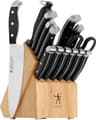
HENCKELS Statement 15-Piece Knife Block Set

HENCKELS Statement 15-Piece Knife Block Set

If you specifically want a full block that fills every slot — chef, santoku, bread, steak knives, shears — from a real German maker, this is the sane pick. Stamped rather than forged, which is exactly how it's affordable.

Best full block if you want every slot filled
$118.73 · View on Amazon

$149.9921% off

Price as of November 22, 2026. #ad How we’re funded

4
HENCKELS Fine-Edge Sharpening Steel

HENCKELS Fine-Edge Sharpening Steel

The cheapest honing rod from a real cutlery brand. There is nothing clever about it — a fine-cut steel rod that realigns a soft German edge in ten seconds — but it costs about as much as a takeaway and it removes the last excuse for cooking with a rolled edge.

Best accessory — the rod these knives need
$11.99 · View on Amazon

$19.9940% off

Price as of November 22, 2026. #ad How we’re funded

The picks in full

#1Best overall — the forged one

Zwilling Professional S 8-inch Chef's Knife

The other great forged German knife. Zwilling's special-formula stainless at ~57 HRC, a full bolster and their ice-hardening process make this a durable, slightly heavier alternative to the Wüsthof Classic.

Strengths

  • Forged, ice-hardened (FRIODUR) blade for edge stability
  • Full bolster acts as a finger guard for new cooks
  • Made in Zwilling's own German factory

Trade-offs

  • Full bolster makes it harder to sharpen the heel and adds weight
  • ~57 HRC steel is durable but not as edge-retentive as Japanese steel
Blade steelZwilling special-formula stainless
Hardness~57 HRC
Blade length203 mm
WeightNot published
Edge geometryDouble bevel, ~15° per side
HandlePolymer, triple-riveted
ConstructionForged, ice-hardened, full bolster

Specs read from the manufacturer listing, on July 21, 2026. “Not published” means the maker does not state that figure.

#2Budget pick — cheapest knife worth owning

HENCKELS Solution 8-inch Chef's Knife

About the cheapest way to get a German-stamped chef's knife with a name behind it. HENCKELS (the Zwilling sister brand) doesn't publish the hardness on this entry line, so treat it as a solid starter blade, not a keeper.

Strengths

  • German stainless from an established maker at a rock-bottom price
  • Satin-finished stamped blade, light and easy to handle
  • Dishwasher-tolerant (though hand-washing still helps any knife last)

Trade-offs

  • Hardness is not published for this line — expect entry-level edge holding
  • Stamped, not forged; no bolster heft
Blade steelGerman stainless (X50CrMoV15-type)
HardnessNot published
Blade length203 mm
WeightNot published
Edge geometryDouble bevel
HandleRiveted polymer
ConstructionStamped, single steel

Specs read from the manufacturer listing, on July 21, 2026. “Not published” means the maker does not state that figure.

#3Best full block if you want every slot filled

HENCKELS Statement 15-Piece Knife Block Set

If you specifically want a full block that fills every slot — chef, santoku, bread, steak knives, shears — from a real German maker, this is the sane pick. Stamped rather than forged, which is exactly how it's affordable.

Strengths

  • Complete set: chef, santoku, bread, utility, paring, steak knives, shears, block
  • German-engineered stamped stainless from an established brand
  • Built-in block keeps everything organized on the counter

Trade-offs

  • Stamped blades — lighter and less refined than forged lines
  • You are paying partly for the steak knives and block, not just the chef's knife
Blade steelGerman stainless (stamped)
HardnessNot published
Blade lengthNot published
WeightNot published
Edge geometryNot published
HandleRiveted polymer
ConstructionStamped, full set

Specs read from the manufacturer listing, on July 21, 2026. “Not published” means the maker does not state that figure.

#4Best accessory — the rod these knives need

HENCKELS Fine-Edge Sharpening Steel

The cheapest honing rod from a real cutlery brand. There is nothing clever about it — a fine-cut steel rod that realigns a soft German edge in ten seconds — but it costs about as much as a takeaway and it removes the last excuse for cooking with a rolled edge.

Strengths

  • Costs less than almost any other name-brand rod
  • Fine cut, so it is not the crude coarse rod that damages edges
  • Does the one job a rod should do, on the knives it suits

Trade-offs

  • HENCKELS does not state the rod length on this listing
  • Wrong tool for hard Japanese steel — use a ceramic rod or a stone instead
TypeDry honing rod (realigns, does not abrade)
MaterialFine-cut hardened steel rod
LengthNot published

Specs read from the manufacturer listing, on August 10, 2026. “Not published” means the maker does not state that figure.

The two logos, and how to tell what you are buying before you pay

The simplest reliable test is the price, and the second is the word on the blade. A knife marked ZWILLING— the two-figure trademark — is from the forged line: the blade is hot-drop forged from a single billet, ice-hardened in ZWILLING’s FRIODUR process, and finished with a bolster and a full tang. A knife marked HENCKELSalone is from the value line: the blade is laser-cut from rolled sheet, which is why a HENCKELS chef’s knife costs less than a restaurant lunch and a ZWILLING one costs what it costs.

Neither is a counterfeit and neither is a trick. What is genuinely frustrating is the documentation gap. ZWILLING publishes care instructions, a US warranty with its exclusions spelled out, and its Honbazuke three-step edge process for its Japanese-made lines. For the stamped Solution and Statement ranges, the hardness figure simply is not published anywhere we can find, which is why those entries read “Not published” in our spec tables rather than carrying a number we guessed. For an entry-level stamped German blade, expect edge holding in the low-to-mid 50s HRC range in practice — but that is our reading of the category, not a figure the maker stands behind.

Why the Professional S is the pick, bolster included

The Professional S is the knife in this family a cook would still be using in 2050. Forging plus ice-hardening is not marketing: a hot-drop forged blade has a thicker spine tapering to the edge and a bolster that puts the balance point at your index finger, and the cryogenic step stabilises the martensite so the edge takes less damage in use. At ~57 HRC it is slightly harder than most of the German field and noticeably tougher than any 60+ HRC Japanese blade.

The full bolster is the one real argument against it, and we will not soften it. ZWILLING runs the bolster all the way down to the heel, which means the last centimetre of edge never touches a flat stone. Sharpen this knife for ten years and you will develop a recurve at the heel unless you deliberately work that section on the corner of a stone. Wüsthof’s Classic uses a half bolster and does not have this problem — that trade-off is the whole of our Wüsthof vs ZWILLING comparison. If you have never sharpened a knife and want a guard between your hand and the blade, the full bolster is a feature. If you own stones, it is a tax.

Where the Solution 8-inch actually belongs

It belongs in a first apartment, a holiday rental, a student kitchen, or a drawer beside a better knife as the one you lend out. At this price you are buying German stainless of the X50CrMoV15 family with a brand that has to care about returns, and that is genuinely worth more than an unbranded Amazon knife at the same money. The listing even tolerates the dishwasher, which no knife we would call a keeper does.

What you are not buying is edge retention or a hand you will enjoy in ten years. There is no bolster heft, no published hardness, and the riveted polymer handle is functional rather than nice. Treat it as a consumable: hone it often, sharpen it on anything, and replace it when it annoys you. If your budget is genuinely under $50 and you want the best knife in that band rather than the cheapest, our under-$50 roundup has the forged Mercer Genesis instead.

The 15-piece block: who it is honestly for

We are usually hard on filled blocks, because piece count and blade count are different numbers and the gap between them is where sets hide their margin. The Statement 15-piece earns its place on one specific condition: you are furnishing an empty kitchen from nothing, you want the counter to look finished, and you would rather spend once than assemble a kit over two years. Chef, santoku, bread, utility and paring knives, a set of steak knives, shears and the block, from a maker with a service address, for roughly what a single mid-range Japanese chef’s knife costs.

The honest accounting: the blades are stamped, the steak knives are the part you will use least, and a large share of the price is wood and shears. If what you actually want is good knives rather than a full block, two or three good blades beat fifteen mediocre ones every time — the argument we make at length in our knife-set roundup.

The rod is not an upsell

Every knife on this page is soft enough that a honing rod is the correct maintenance tool, and the HENCKELS Fine-Edge steel is about the cheapest name-brand rod in existence. A rod does not sharpen — it realigns an edge that has rolled over sideways, which is exactly what happens to German stainless after a few sessions on a board. Ten seconds before you cook and these knives feel new for months longer.

Two caveats. HENCKELS does not state the rod length on this listing, which matters because a rod should be longer than the blade you are honing; if you are mostly honing a 10-inch knife, buy a longer rod. And never use a ribbed steel rod on a hard Japanese edge — at 60+ HRC the apex breaks instead of bending. Our honing versus sharpening explainer covers which tool does what, and our rod roundup ranks the alternatives if you want a longer one.

How we picked

These four are every HENCKELS-family product in our registry with a verified live listing, so this is the field rather than a selection from it. Ranking is editorial and argued above: the forged knife wins because forging, ice-hardening and a published hardness figure are real differences you can read off the maker’s own pages, not because we scored anything. Prices are read live and stamped with a date on every row; if a listing loses its offer the row shows “Check price” rather than a stale number.

Frequently asked questions

What is the difference between HENCKELS and ZWILLING?

They are two tiers of the same Solingen company. ZWILLING (the two-figure logo) is the forged, ice-hardened premium line, and ZWILLING publishes a hardness figure, care guidance and a US warranty for it. HENCKELS (the one-figure logo, formerly J.A. Henckels International) is the stamped value line, and for ranges like Solution and Statement no Rockwell figure is published at all. Same parent, different manufacturing, very different price.

Is HENCKELS or ZWILLING better?

ZWILLING, if you measure by construction and documentation — forged, bolstered, ice-hardened, with a published ~57 HRC. HENCKELS is better value in the narrow sense that a Solution chef's knife costs about a sixth as much and still cuts. Buy ZWILLING if this is the knife you want to keep; buy HENCKELS if you need a serviceable knife today for very little money.

What is the best HENCKELS chef's knife?

Within the HENCKELS value line, the Solution 8-inch: a stamped German-stainless blade at the lowest price any established cutlery brand charges. If you will stretch past $90, the ZWILLING Professional S 8-inch is a materially different knife — forged, full tang, full bolster, ice-hardened, with a published hardness figure.

Are HENCKELS knives dishwasher safe?

The Solution listing tolerates it, but ZWILLING's own care guidance rules the dishwasher out for its knives — it names aggressive detergent tablets, high temperatures and knocks against other items as the three problems, and says to hand wash in lukewarm water with mild soap and dry with a cloth. Wooden-handled knives are hand-wash only. Our advice is the maker's: wash by hand even when the listing says you need not.

Where are HENCKELS knives made?

It depends on the line, and the listings are not always explicit. The ZWILLING forged ranges are made in the company's own German factory, which is the claim the Professional S carries. The stamped HENCKELS value ranges are produced across multiple facilities and the listings we link do not consistently state a country, so we do not assert one for the Solution or the Statement set.

What hardness are HENCKELS knives?

Not published for the Solution or Statement lines, which is why our spec tables read 'Not published' rather than giving a number. ZWILLING publishes ~57 HRC for the Professional S. For reference, the German forged field generally sits at 55-58 HRC, and entry-level stamped blades sit lower — but we are not going to attach a figure to a model its maker does not stand behind.

Is the Statement 15-piece set worth it?

If you are filling an empty kitchen and want every slot covered in one purchase, yes — it is a complete, brand-backed set for roughly the price of one mid-range Japanese chef's knife. If you already own a decent chef's knife, no: you would be paying mostly for steak knives, shears and a block. Fifteen stamped pieces are not an upgrade on three good blades.

Do I need a honing rod for these knives?

Yes, and it is the highest-value accessory on this page. German stainless at 55-58 HRC rolls over at the apex rather than wearing away, and a rod puts it back in seconds. Hone before cooking, sharpen on a stone a few times a year, and these knives will feel sharp for years. Do not use a ribbed steel rod on hard Japanese knives.

Sources

  • How to Clean and Care for Your Knife — ZWILLING — ZWILLING's own care instructions: 'clean it by hand using lukewarm water, mild dish soap and a non-scratch cloth or sponge', dried with 'a plain dishtowel or microfiber cloth'; the dishwasher is ruled out for 'aggressive chemical tablets', 'high temperatures' and 'bumps and bangs with other objects'. On wooden handles: 'not dishwasher-safe and should only be washed by hand', with the wood 'regularly treating the wood with oil (e.g. linseed oil) or wax (e.g. beeswax)'. On storage, a knife needs 'its very own space away from other objects, so not simply thrown in the cutlery drawer' — a block, 'drawer organizers or protective sleeves' (accessed September 23, 2026)
  • Warranty USA — Zwilling J.A. Henckels — ZWILLING's US warranty terms, which govern a Miyabi purchase: products 'will be free of defects in material and workmanship from the date of purchase for as long as said purchaser owns the product'; it 'does not cover defects resulting from normal wear and tear, misuse, abuse, alteration, negligence, or use of the product other than its intended purpose'; 'the original purchaser must provide valid proof of purchase'; and it applies only to products 'purchased in the United States from Zwilling or a Zwilling authorized seller located in the United States', with ZWILLING reserving 'the right to reject warranty claims for products purchased from unauthorized sellers' (accessed September 23, 2026)
  • Japanese Knives - Some Nuggets of Information — ZWILLING — ZWILLING's own account of the three Honbazuke steps, which it translates as 'true cutting edge': 'The knife is initially ground on a coarse vertical rotating sharpening stone', then 'finely honed on a horizontal rotating sharpening stone', and finally 'a vertical rotating leather stropping block is used to polish the grind/cutting edge'. The page does not give an edge angle, a hardness figure, or any guidance on honing rods (accessed September 23, 2026)
  • The Difference Between WÜSTHOF Forged and Stamped Kitchen Knives — WÜSTHOF — Wüsthof's own account of both processes: forged blades start as a single piece of steel heated to over 2000°F and take 'over fifty-four manufacturing steps', hardened to '58 Rockwell'; non-forged blades are 'cut from a high-quality steel sheet using a precision laser' in 'thirty-five manufacturing steps' and run 'between 55 and 57 Rockwell' (accessed August 18, 2026)
  • Honing steel — Wikipedia — Reference on rod types and what they do: 'The steel and ceramic honing steels may have longitudinal ridges, whereas the diamond-coated steels are smooth but embedded with abrasive diamond particles'; 'Non-abrasive honing rods such as smooth ceramic or ribbed steel are able to remove small amounts of metal via adhesive wear'; 'It is often recommended that steeling be performed immediately before or after using a knife and can be done daily'; and, on hard blades, 'In East Asia, notably Japan, harder knives are preferred, so there is little need for steeling intra-day, as the edge does not deform as much. Instead, the blade is honed as needed on a waterstone' (accessed September 1, 2026)
  • Using a Steel — WÜSTHOF Australia — Wüsthof's own how-to: 'Tilt the knife so that there is a 14 degree angle between the knife and the steel', 'A fairly sharp knife may only need 2-3 repetitions, while a dull knife will need more', 'Honing re-aligns the microscopic teeth in the blade', a honing steel 'should be used regularly' and even 'after each use', and the sizing rule — 'You want to make sure the steel is at least as long as the blade you are either honing or sharpening' (accessed September 1, 2026)

Per-knife specs (steel, HRC, blade length, geometry) are read from each maker’s spec sheet or product listing and dated on the individual review cards above. “Not published” means the manufacturer does not state that figure — we flag it rather than guess.

Keep reading