Whetstone Brands Explained
Eight names cover almost everything worth buying. What each one actually makes, what it is known for, and the one question that separates them more than the badge does.
How this is funded: we earn a commission if you buy through our links, at no extra cost to you. As an Amazon Associate we earn from qualifying purchases. It never changes which knife we recommend, and we’ll tell you when we’d skip one. Full disclosure.
Sharpening stones are a small market with a lot of names on it, and most of those names are resellers rather than makers. The list below covers the houses that actually make something distinctive, plus the marketplace brands you will meet first because they dominate the search results.
Before any of it, though: the brand is the least important variable in your purchase.Grit pairing decides what the stone does. Soak-or-splash decides whether you will actually use it. Whether it comes with a base decides whether it slides around the counter. The badge decides how consistent the stone is between units — genuinely worth something, and worth less than the other three.
The brands, at a glance
| Brand | Makes | Known for | Buy it for |
|---|---|---|---|
| King | Soaking water stones, resin-bonded | The KW-65 1000/6000 — the stone that taught a generation to sharpen | Your first stone, on a budget |
| Shapton | Ceramic stones, splash-and-go | GlassStone: a thin ceramic layer on a glass plate, dead flat, fast on hard steel | Hard Japanese steel, and hating soak times |
| Naniwa | Magnesia- and resin-bonded ceramic water stones | A wide range where some lines soak and some splash — read the line, not the brand | A 1000/3000 finish, and consistent quality |
| Suehiro | Japanese water stones across the grit range | Long-established maker; the Cerax and Debado lines are the familiar ones | When you have outgrown a combination stone |
| DMT | Monocrystalline diamond plates | Color-coded grades with published mesh and micron figures for each | Repairs, hard steel, and flattening water stones |
| Atoma | Diamond sheets on aluminum bodies | Replaceable diamond sheets; the #140 is the standard stone-flattening plate | Flattening, and heavy repair work |
| Sharpal | Electroplated diamond plates and strops | Value diamond plates with published grit and micron figures | A first diamond plate without the specialist price |
| Sharp Pebble | Marketplace water stones and kits | Complete beginner kits: stone, bamboo base, angle guide, flattening stone | Starting from nothing in one purchase |
The Japanese water-stone houses
Kingis where most people start, and deservedly. The KW-65 1000/6000 combination is inexpensive, cuts smoothly, and has been the default recommendation for beginners for decades. It is a soaking stone with a relatively soft binder, which means it cuts quickly and dishes quickly — both of those are the same property viewed from different sides, and flattening is part of owning one.
Shapton took the opposite approach. The GlassStone is a thin ceramic abrasive layer bonded to a glass plate: splash-and-go, extremely flat, and fast on hard steel because ceramic abrasive cuts hard carbides well. It costs more and there is less abrasive to wear through, which is a fair trade for anyone who finds a ten-minute soak enough friction to stop sharpening.
Naniwais the one to read carefully, because the brand spans both behaviors. Some of its lines are soakers described as needing several minutes submerged; others — the Chocera Pro and S-series among them — are splash-and-go. Buying “a Naniwa” tells you nothing about preparation; buying a specific Naniwa line does. Soaking a whetstone goes through how to tell.
Suehirois the fourth name you will meet once you go past combination stones — a long-established maker with a wide grit range, typically bought as separate single-grit stones rather than as a first purchase.
The diamond-plate makers
DMT is the reference brand and, for our purposes, the most honest documenter in the category: it publishes a mesh number and a micron figure for every grade, so Coarse is stated as 325 mesh / 45 µm, Fine as 600 mesh / 25 µm and Extra-Fine as 1200 mesh / 9 µm. That is exactly the kind of published specification this site exists to reward.
Atoma makes diamond sheets bonded to aluminum bodies, with the sheet replaceable when it wears out. The #140 is effectively the industry standard for flattening water stones. Sharpal occupies the value end of the same category with electroplated plates that publish their grit and micron figures.
All three do the same fundamental thing: an abrasive far harder than any knife steel, bonded to a rigid base that never dishes. What they cannot do is finish as finely as a water stone — the full trade-off is in diamond stone vs whetstone.
The marketplace brands
Sharp Pebbleand the various house-label stones are the ones that dominate a search for “whetstone,” and they are not a trap. Their real advantage is the kit: a stone, a bamboo base, an angle guide and a flattening stone for less than a single premium stone costs. For someone starting from nothing that is a genuinely good way to buy.
The honest caveat is specification quality. A grit number quoted without a standard — JIS or ANSI — is not directly comparable to a Japanese stone’s number, and unit-to-unit consistency varies more than it does with an established house. That matters less than people fear: a slightly-off 1000-grit stone still raises a burr, and the burr is what makes a knife sharp.
What to buy, by situation
- Your first stone, minimum spend: a King or house-brand 1000/6000 combination. Add a damp tea towel under it and you are equipped.
- Your first stone, want the kit: a Sharp Pebble-style bundle with base, angle guide and flattening stone.
- Hard Japanese steel, hate waiting: a Shapton GlassStone 1000, splash-and-go and fast on hard cores.
- Repairs, chips, or flattening your stones: a DMT or Atoma coarse diamond plate.
- Finishing: a strop with compound before a very fine stone. Cheaper, faster, and it removes the burr better.
The specific stones, with live prices, are compared in best whetstones and best combination whetstones.
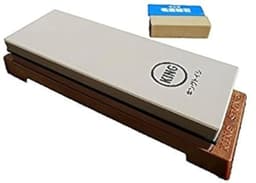
The classic Japanese soaking stone
King (Matsunaga) KW-65 1000/6000 Combination Whetstone
The stone that has taught more people to sharpen than any other. One side 1000-grit to set an edge, one side 6000-grit to polish it, made in Japan, for the price of a takeout dinner. Start here.
Read the full review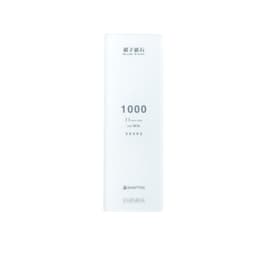
The splash-and-go ceramic
Shapton GlassStone 1000
The upgrade once you know you're sticking with sharpening: a thin, hard ceramic layer bonded to glass. It's splash-and-go (no soaking), stays dead flat far longer than a soft stone, and cuts fast. You'll pay for it.
Read the full reviewPrice as of October 20, 2026. #ad How we’re funded
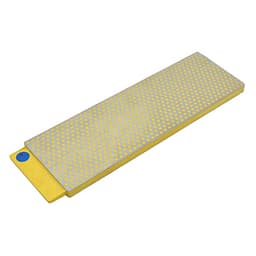
The diamond plate that never needs flattening
DMT DuoSharp 8-inch Bench Stone, Fine/Coarse (W8FCNB)
The diamond plate to buy if you are buying one. Coarse on one face, Fine on the other, on DMT's interrupted 'polka-dot' surface that clears swarf instead of clogging with it. It cuts hard Japanese steel faster than any water stone and it will still be dead flat in ten years.
See the diamond roundupPrice as of October 20, 2026. #ad How we’re funded
Frequently asked questions
What is the best whetstone brand?
There is no single answer, because the brands specialize. King is the classic budget soaking water stone and the standard first purchase. Shapton makes fast splash-and-go ceramics suited to hard steel. Naniwa spans both. DMT and Atoma make diamond plates for repairs and for flattening. Pick by what you need the stone to do, not by the name.
Are expensive whetstones worth it?
Up to a point. A premium stone cuts faster, stays flatter longer and is more consistent grit to grit — real advantages if you sharpen often. What it will not do is make a beginner's edge better: angle consistency and burr removal dominate the result far more than stone quality does. Learn on a cheap stone, upgrade when the stone is genuinely the limiting factor.
Is a Japanese whetstone better than a Chinese one?
Usually more consistent, rather than categorically better. Established Japanese makers publish grit and binder details and hold tolerances tightly; marketplace stones vary more between units and often state a grit with no standard attached. Plenty of inexpensive stones sharpen perfectly well — you are paying for predictability.
What is the difference between King and Shapton stones?
Preparation and speed. King stones are soakers: submerge for several minutes, then they cut smoothly and wear relatively quickly. Shapton GlassStones are splash-and-go ceramic bonded to a glass plate: ready in seconds, dead flat, and fast on hard steel. King is the cheaper way in; Shapton is the one you buy when soak times annoy you.
Do brands matter more than grit?
No. Grit and preparation type decide what a stone does; the brand mostly decides how consistently it does it. A 1000-grit stone from any reputable maker will sharpen your knives. Choose the grit pairing and the soak-or-splash behavior first, and treat the brand as a quality-control signal after that.
Which brands publish real specifications?
DMT is the standout — it publishes mesh and micron figures for every grade, so a Coarse plate is stated as 325 mesh / 45 microns rather than a vague number. Naniwa documents which of its lines soak and which are splash-and-go, line by line. Marketplace brands are frequently the least specific, quoting a grit with no standard named.
Sources
- Sharpening stone — Wikipedia — Reference on water, oil and diamond stones: Japanese water-stone grit ranges, why stones dish in the middle with use, and why a diamond plate retains its flatness (accessed August 13, 2026)
- Japanese Water Stones — Sharpening Supplies — The two families of water stone: soaking stones that must be submerged until saturated, and splash-and-go stones that need only surface water (accessed August 13, 2026)
- Comparing Naniwa Stones — Sharpening Supplies — Line-by-line record of which stones in one maker's range soak (Traditional, Aotoishi, Lobster, Hibiki — 'soaked for several minutes') and which are splash-and-go (Chocera Pro, S1/S2 Advance, diamond) (accessed August 13, 2026)
- DMT Diamond and Ceramic Color-Coded Grit Chart — Sharpening Supplies — DMT's own color codes with the mesh and micron figure for each grade (Coarse 325/45 µm, Fine 600/25 µm, Extra-Fine 1200/9 µm) (accessed August 11, 2026)
Per-knife specs (steel, HRC, blade length, geometry) are read from each maker’s spec sheet or product listing and dated on the individual review cards above. “Not published” means the manufacturer does not state that figure — we flag it rather than guess.
Keep reading
Best Whetstones for Kitchen Knives
Specific stones compared on grit, material and prep.
See the roundupBest Combination Whetstones
Five two-grit stones, with live prices.
See the combinationsSoaking a Whetstone
Which stones must be submerged and which are ruined by it.
Read the explainerKitchen Knife Brands Explained
The same treatment for the knives themselves.
See the knife brands