Knife Handle Materials
The spec that decides whether you enjoy using a knife, and the one nobody researches. What each material is like wet, over years, and in your particular hand.
How this is funded: we earn a commission if you buy through our links, at no extra cost to you. As an Amazon Associate we earn from qualifying purchases. It never changes which knife we recommend, and we’ll tell you when we’d skip one. Full disclosure.
People spend weeks comparing steel grades and about four seconds on the handle, which is backwards. Steel decides how often you sharpen. The handle decides whether you enjoy an hour of prep, whether the knife slips when your hands are wet with chicken, and whether the thing still feels good in a decade.
It is also the one specification where the correct answer depends on your actual hand, which is why we describe what each material is like rather than ranking them. A handle that suits a large right hand can be actively unpleasant in a small left one.
The materials
| Wet grip | Durability | Upkeep | |
|---|---|---|---|
| Pakkawood | Good | Excellent | Hand wash, dry |
| POM (Wüsthof Classic) | Fair | Excellent | Almost none |
| Santoprene (Mercer) | Excellent | Very good | Almost none |
| Fibrox / TPE (Victorinox) | Excellent | Very good | Almost none |
| Polypropylene (Dexter) | Very good | Very good | None |
| G10 / composite | Very good | Excellent | None |
| Magnolia (wa handle) | Fair | Good | Dry, occasional oil |
| Natural hardwood | Fair | Good if cared for | Dry, oil regularly |
Pakkawood
Wood veneers soaked in resin and compressed under heat and pressure. The result looks like wood, does not move with humidity, resists water and takes a fine polish — which is why it is the default premium handle on Japanese knives including the Shun Classic and the Miyabi lines. It is the best all-round compromise available: warmer in the hand than plastic, far more stable than natural wood, and hard-wearing enough to outlast the blade.
Its weakness is glossy finishes. A highly polished pakkawood handle is slippery with wet hands in a way a matte one is not, and that varies between makers rather than being a property of the material.
POM and other rigid polymers
Polyoxymethylene — the black riveted handle on a Wüsthof Classic and most German knives. It is dimensionally perfect, essentially indestructible and completely indifferent to heat, water and detergent. It is also hard and smooth, which means it relies on shape rather than texture for grip. A dry hand on a well-shaped POM handle is secure; a wet, greasy hand is noticeably less so.
Santoprene, Fibrox and the soft synthetics
These are thermoplastic elastomers — slightly soft, slightly grippy, textured rather than polished. Mercer’s Santoprene and Victorinox’s Fibrox are the two you meet most, and they exist because commercial kitchens needed handles that stay secure in a hand covered in fat.
They are, functionally, the best handles here. They are also unmistakably catering equipment to look at, which is the entire reason they are not on premium knives. If you cook a lot of meat and value not dropping a knife over the aesthetics, buy one of these and never think about it again — the Victorinox and Mercer comparison covers both.
Wa handles: magnolia, and the octagon
The traditional Japanese handle is a single piece of light wood — usually magnolia (ho) — fitted onto a hidden tapered tang, in an octagonal, D-shaped or oval cross-section. It is dramatically lighter than a Western handle, which shifts the knife’s balance forward into the blade and makes the knife feel quicker and more blade-led.
Two things to know. An octagonal wa handle is symmetrical and works in either hand; a D-shapedone is handed, almost always right. And magnolia is chosen because it is light, resists water reasonably and is easy to replace — wa handles are considered a consumable in Japan and can be swapped out, which is a genuine advantage rather than a flaw.
Natural hardwood
Unstabilized wood — walnut, olive, rosewood — is the nicest thing to hold and the most demanding to own. It absorbs water, swells and shrinks with humidity, and if it is repeatedly soaked it will crack or work loose around the tang. Kept dry and oiled occasionally with a food-safe mineral oil it lasts indefinitely and looks better every year.
The hygiene objection to wooden handles is largely overstated — wood has some natural antimicrobial behavior and a dry handle is not a problem — but a wet one that never dries out genuinely is. If a knife lives in a sink, do not buy this.
Shape matters more than material
Almost every complaint about a handle turns out on inspection to be about shape rather than what it is made of. Four things to check:
Can you pinch-grip it?The correct chef’s knife grip pinches the blade just forward of the handle, thumb and forefinger on the steel. If the bolster or the handle flare is bulky enough to prevent that, the knife is wrong for you regardless of material.
Is the choil rounded?That is where your finger sits when you choke up. A sharp square corner there is a genuine annoyance and a common failing on budget Japanese knives — two minutes with fine sandpaper fixes it permanently.
Are the rivets flush? Run your palm along the handle. A rivet you can feel is a finishing failure and it will bother you every time.
Does the butt dig in? Only discoverable over a long prep session, and the reason a handle that feels fine in a shop can be tiring at home.
The maintenance rule
Everything except natural wood and magnolia needs nothing but washing and drying. Wooden handles want a wipe of food-safe mineral oil when they start looking dry — two or three times a year is plenty — and no handle of any kind belongs in a dishwasher, whatever the packaging says about being dishwasher-safe. The full routine, including boards and storage, is in knife care and storage.
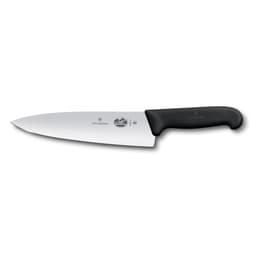
The best wet grip on this site
Victorinox Fibrox Pro 8-inch Chef's Knife
The knife that wins nearly every budget test, and the one to buy if you buy only one. A soft, stamped X50CrMoV15 blade at ~55-56 HRC and a grippy, non-slip handle — it dulls sooner than a hard Japanese knife but takes an edge back in seconds.
Read the full Victorinox reviewPrice as of October 20, 2026. #ad How we’re funded
Frequently asked questions
What is the best knife handle material?
There is no single best. Pakkawood is the best compromise of looks, wet grip and durability, which is why premium Japanese makers use it. Santoprene and Fibrox grip best when wet and look like catering equipment. Natural wood feels finest and needs the most care. Pick by whether you value grip, appearance or low maintenance.
What is pakkawood?
Wood veneers impregnated with resin and compressed under heat, producing a material that looks like wood and behaves like plastic — dimensionally stable, water-resistant and hard-wearing. It is the standard premium handle material on Japanese knives, including the Shun Classic and Miyabi lines.
Are wooden knife handles bad?
Untreated natural wood is not ideal in a kitchen: it absorbs water, can swell and shrink around the tang, and will crack if repeatedly soaked or put in a dishwasher. It is not unhygienic if kept dry — wood has some natural antimicrobial properties — but it needs hand-washing, immediate drying and occasional oiling.
What is the difference between a Western and a Japanese wa handle?
A Western handle is two scales riveted either side of a full tang; it is heavier, symmetrical and puts the balance point near your hand. A Japanese wa handle is a single piece of light wood — often octagonal or D-shaped magnolia — fitted onto a hidden tang. Wa handles are much lighter, which shifts the balance forward into the blade.
Is a D-shaped handle a problem for left-handers?
Usually yes. A D-shape is contoured with a ridge sized for one hand, almost always the right, and in the other hand that ridge sits in the wrong place. Some makers sell left-handed versions of specific models. Symmetrical Western and octagonal wa handles avoid the issue entirely.
Can knife handles go in the dishwasher?
No handle material benefits from it, and several are damaged outright. Natural wood cracks, pakkawood can delaminate over time, and even dishwasher-rated synthetic handles are attached to a blade that the dishwasher will dull and etch. Some makers state their synthetic handles tolerate it, which is not the same as recommending it.
Sources
- Japanese kitchen knife — Wikipedia — Reference on gyuto/santoku/nakiri, single- vs double-bevel (kataba/ryoba) and edge angles (accessed July 21, 2026)
- Knife sharpening — Wikipedia — Reference on edge angle, coarse-to-fine grit progression, and honing vs sharpening (accessed July 21, 2026)
Per-knife specs (steel, HRC, blade length, geometry) are read from each maker’s spec sheet or product listing and dated on the individual review cards above. “Not published” means the manufacturer does not state that figure — we flag it rather than guess.
Keep reading
Knives in the Dishwasher
Why the handle material, not the blade, is what the machine usually ends.
Read the verdictKnife Anatomy
Tang, scales, rivets and everything else the handle attaches to.
Read the guideKnife Care & Storage
How to keep a handle — and the blade — alive for decades.
Read the guideKitchen Knife Brands Explained
Which makers use which handle, and why.
See the brandsBest Chef Knives
The field, with handle material listed on every card.
See the picksLeft-Handed Japanese Knives
Which handles are genuinely handed, and which only look it.
Read the guide