Victorinox vs Mercer
The two knives that dominate every budget recommendation list. Same price, same steel class, opposite construction — and the choice comes down to weight.
How this is funded: we earn a commission if you buy through our links, at no extra cost to you. As an Amazon Associate we earn from qualifying purchases. It never changes which knife we recommend, and we’ll tell you when we’d skip one. Full disclosure.
Ask anywhere for a good chef’s knife under $50 and you will get these two names, usually with someone insisting the other one is wrong. They are not competing on quality. They are competing on a genuine design disagreement about what a cheap kitchen knife should be, and both answers are defensible.
The steel is essentially the same — German-type X50CrMoV15 stainless in the 55–58 HRC band, the same alloy family Wüsthof forges into knives costing four times as much. What differs is how the blade was made: the Victorinox is stamped from rolled sheet, the Mercer is forged from a billet. That difference produces two knives that feel nothing alike.
The decision table
| Victorinox Fibrox | Mercer Genesis | |
|---|---|---|
| Steel | X50CrMoV15-type stainless | X50CrMoV15 (German) |
| Construction | Stamped | Forged, full tang, bolstered |
| Blade length | 203 mm | 203 mm |
| Weight in hand | Light | Noticeably heavier |
| Bolster | None | Full, to the heel |
| Handle | Fibrox (TPE), textured | Santoprene, non-slip |
| Sharpens flat to the heel | Yes | No — bolster blocks it |
| Typical buyer | Restaurant line | Culinary school |
The case for the Victorinox
A stamped blade is thinner, and thin is what actually determines how a knife feels going through food. Once the very apex is sharp, what you notice is how much steel has to be pushed apart behind it — and the Fibrox has less. This is why a knife that looks like catering equipment repeatedly beats forged knives at five times the price in blind cutting comparisons, and it is not a fluke.
The absence of a bolster is the second, underrated advantage. On a forged knife the steel shoulder at the heel sits proud of the edge and keeps that last inch off a flat stone; sharpen for a few years and you develop a blunt hooked section by the handle that only a grinder will fix. The Fibrox has nothing in the way, so the whole edge meets the stone every time.
It is also light enough to use for an hour without your wrist complaining, and cheap enough that nobody in the house treats it as precious. Full write-up in our Victorinox Fibrox review.
The case for the Mercer
Forged construction buys three things, and weight is the one you feel first. A heavier knife does more of the work on its own — you guide it through an onion rather than pushing it — and for a lot of cooks that feels like control rather than effort. If you have used German knives and liked them, the Fibrox will feel like a toy and the Genesis will feel right.
The full tang and bolster buy durability and balance. The blade runs the whole length of the handle, the bolster puts mass at the pivot point, and the knife survives being dropped on a tile floor in a way a stamped blade may not. There is a reason American culinary schools issue this knife to students: it teaches a proper pinch grip and it withstands eighteen months of people who have not yet learned to look after knives.
The Genesis line is also broad — santoku, nakiri, utility and more, all at similar prices — so building a matched kitchen is cheap. Full write-up in our Mercer Genesis review.
How to choose without holding them
Answer one question honestly: do you like a heavy knife or a light one? Everything else follows.
If you have used a Wüsthof or a Zwilling and liked how planted it felt, buy the Mercer. If you have used one and found it tiring, or if you gravitate to Japanese knives, buy the Victorinox. If you have no reference point at all, buy the Victorinox — light and thin is the easier thing to learn on, and the missing bolster makes the sharpening habit simpler to build.
What neither of these gives you is hard steel. Both roll their edges relatively quickly and both come straight back on a honing rod. If you want an edge that lasts weeks instead of days, that is a different purchase entirely and it starts around $100 with a VG10 core — the whole argument is in Japanese vs German knives.
The verdict
There is no wrong answer here, which is unusual and worth saying plainly. Both are real knives from real makers with published steel, both are used professionally every day, and both will outlast any number of prettier knives bought as gifts. Buy the one whose weight you prefer, spend the money you saved on a stone, and the knife will not be the limiting factor in your kitchen.
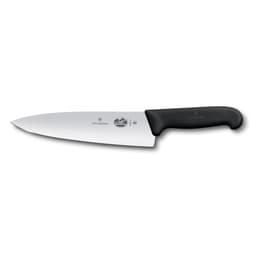
If you want light and thin
Victorinox Fibrox Pro 8-inch Chef's Knife
The knife that wins nearly every budget test, and the one to buy if you buy only one. A soft, stamped X50CrMoV15 blade at ~55-56 HRC and a grippy, non-slip handle — it dulls sooner than a hard Japanese knife but takes an edge back in seconds.
Read the full Victorinox reviewPrice as of October 20, 2026. #ad How we’re funded
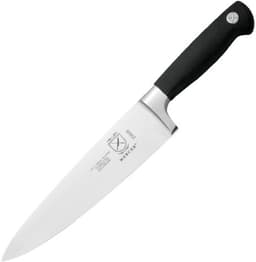
If you want forged and weighted
Mercer Culinary Genesis 8-inch Chef's Knife
A fully forged German-steel knife at a stamped-knife price. It is the culinary-school standby for a reason — you get bolster, full tang and a grippy Santoprene handle for around the cost of a decent stamped blade.
Read the full Mercer reviewPrice as of October 20, 2026. #ad How we’re funded
Frequently asked questions
Victorinox or Mercer: which is better?
Neither is better — they are different knives at the same price. The Victorinox Fibrox is stamped, light and thin, and has beaten far more expensive knives in independent cutting comparisons for decades. The Mercer Genesis is fully forged with a full tang and a bolster, so it is heavier and feels more substantial. Pick by weight preference, not by quality.
Is a forged knife better than a stamped one?
Not for sharpness. Forging hammers the blade from a steel billet and produces a heavier knife with a bolster and more durability; stamping cuts it from rolled sheet and produces a lighter, thinner, cheaper blade. Thin cuts well, which is why the stamped Victorinox out-performs plenty of forged knives. Choose forged for heft, stamped for nimbleness.
Do Victorinox and Mercer use the same steel?
Both use German-type X50CrMoV15 stainless in the 55-58 HRC range — the same alloy family Wüsthof and Zwilling forge. That is the key point of this comparison: the steel is not what separates them. Construction, weight, balance and handle are.
Which is easier to sharpen?
The Victorinox, slightly. Both are soft enough to sharpen easily, but the Mercer has a full bolster running to the heel, and that steel shoulder keeps the last inch of the edge off a flat stone. Over years that produces an unsharpened hooked section by the handle unless you grind the bolster back. The bolsterless Victorinox has no such problem.
Which knife do professional kitchens use?
Both, extensively. Victorinox is the default in a great many restaurant kitchens because it is light, cheap and easy to keep sharp. Mercer is the knife most American culinary schools issue to students, because a forged bolstered knife teaches proper pinch grip and survives being dropped. Neither is a home-cook compromise.
Is Victorinox dishwasher safe?
Victorinox states that the Fibrox Pro handle tolerates a dishwasher, and the handle is genuinely the point of that claim. It is still bad practice for any knife: detergent etches steel, and blades knock against racks and other items. Hand wash and dry both of these and they will last decades.
Sources
- Rockwell hardness test — Wikipedia — Definition of the Rockwell C (HRC) scale used to state knife-steel hardness (accessed July 21, 2026)
- Knife sharpening — Wikipedia — Reference on edge angle, coarse-to-fine grit progression, and honing vs sharpening (accessed July 21, 2026)
- Japanese kitchen knife — Wikipedia — Reference on gyuto/santoku/nakiri, single- vs double-bevel (kataba/ryoba) and edge angles (accessed July 21, 2026)
Per-knife specs (steel, HRC, blade length, geometry) are read from each maker’s spec sheet or product listing and dated on the individual review cards above. “Not published” means the manufacturer does not state that figure — we flag it rather than guess.
Keep reading
Victorinox Fibrox Pro Review
Why soft, stamped steel is a feature here.
Read the reviewMercer Genesis 8-inch Review
A fully forged knife for stamped-knife money.
Read the reviewBest Chef Knives Under $50
Both knives in the context of the whole budget tier.
See the picksBest Chef Knives for Beginners
Forgiving knives that won't punish new technique.
See the picksForged vs Stamped Knives
The construction argument in general, with the maker's own figures.
Read the comparison