Japanese vs German Knives
The whole argument in one place: hardness against toughness, 15° against 20°, whetstone against honing rod — and which side your kitchen is actually on.
How this is funded: we earn a commission if you buy through our links, at no extra cost to you. As an Amazon Associate we earn from qualifying purchases. It never changes which knife we recommend, and we’ll tell you when we’d skip one. Full disclosure.
Short answer: it is a trade between keenness and toughness, and both ends of it are defensible. Japanese knives run harder steel at a finer angle: keener, longer-lasting edges that chip if abused and need a whetstone. German knives run softer steel in a heavier forged blade: tougher, more forgiving, maintainable with a ten-second pass on a rod, and duller sooner. Choose by how you cook and how you maintain, not by which tradition sounds more impressive.
| Japanese | German | |
|---|---|---|
| Typical hardness | 60-62 HRC | 55-58 HRC |
| Typical edge angle | ~15° per side | ~14-20° per side |
| Construction | Often clad (core + jacket) | Forged monosteel or stamped |
| Weight (8-inch) | Lighter | Heavier (often ~250 g) |
| Bolster | Usually none | Usually yes |
| Edge retention | Longer | Shorter |
| Toughness | Chips under abuse | Rolls and recovers |
| Everyday upkeep | Fine ceramic rod | Grooved steel rod |
| Real sharpening | Whetstone | Whetstone or guided system |
| Handle | Light Western or D-shape | Riveted, substantial |
Hardness is the root of everything else
Almost every difference on that table traces back to one number: hardness on the Rockwell C scale. Japanese kitchen steels — VG10, VG-MAX, FC61, the carbon steels — are heat-treated to around 60–62 HRC. German cutlery steel, essentially always X50CrMoV15 or a close variant, lands at 55–58.
Harder steel resists deformation, so a hard edge stays where it was ground for far longer — the practical meaning of “edge retention”. Harder steel also supports a thinner apex without folding over, which is why makers can grind it more acutely. And harder steel is more brittle, so when it does fail it fails by cracking rather than bending.
That last point is the whole cost. A German edge that hits a chicken bone rolls — annoying, fixed in ten seconds on a rod. A Japanese edge that hits the same bone chips — a small crescent of missing steel that only a stone will remove, and only by grinding the whole edge back to meet it. Our steel and hardness guide goes through the metallurgy properly.
The angle myth, updated
“Japanese knives are 15°, German knives are 20°” was true for decades and is now only half true. Wüsthof’s current Classic line ships at roughly 14° per side, which is finer than most Japanese factory edges. Zwilling and others have moved similarly.
What has not changed is what happens next. A 14° edge on 58 HRC steel is keen when new and rolls sooner, because there is less hardness supporting a fine apex. A 15° edge on 61 HRC steel stays keen far longer. So the modern German knife closes the gap on day one and loses it over the following fortnight.
The practical consequence for you: find out what angle your knife actually has before you sharpen it. Grinding a modern Wüsthof at the traditional 20° throws away a better factory edge and wastes a session. Our angle guide has a thirty-second marker-pen test for checking.
Weight, bolsters and how they feel
A forged German 8-inch chef’s knife typically weighs around 250 g, has a bolster and a full tang, and balances at the bolster. That mass does work for you when rock-chopping: the knife falls through dense produce rather than being pushed. Cooks who like German knives usually like them for this, not for the steel.
A Japanese gyuto is lighter, often has no bolster, and balances further back. It feels quick and precise rather than powerful, and over a long prep session it is less tiring. The lack of a bolster is also a sharpening advantage — you can lay the entire edge flat on a stone, including the heel, which a half or full bolster prevents.
Neither is objectively better and this is the single most personal variable in the comparison. If you can hold both before buying, do.
Maintenance is the decision that actually matters
Be honest about this one, because it determines whether your expensive knife performs well or badly.
- German knife: hone before most sessions with a grooved steel rod (ten seconds), sharpen on a stone or a guided system two to four times a year. Very low effort, and the routine tolerates neglect.
- Japanese knife:no grooved rod — use a fine ceramic rod occasionally, and sharpen on a whetstone every one to three months of regular use. Higher skill floor, and no shortcut when the edge finally goes.
This is why we tell people who will not sharpen to buy German. A keen soft knife genuinely outcuts a neglected hard one, and the neglected hard one costs three times as much. If you are not sure which camp you are in, our honing rod comparison and the whetstone roundup will tell you what each routine actually involves.
The recommendation
Buy Japanese if you cut mostly vegetables, fish and boneless meat, you push-cut, you hand-wash and dry your knives, and you own or will buy a whetstone. You get a keener edge that lasts longer, and a lighter knife.
Buy Germanif you rock-chop, you like weight, your kitchen is shared, you occasionally go through a joint or a squash, or your maintenance ceiling is a honing rod. You get a tougher knife that forgives you — and if it is Wüsthof you are weighing, which Wüsthof to buy is a shape question rather than a quality one.
One thing this comparison is really about, underneath the steel and the hardness, is geometry: a Japanese blade is thinner behind the edge and a German one carries more mass above it. How thick should a chef’s knife be sets out the three measurements that hide behind the word, and why essentially no maker publishes the one that decides how a knife cuts.
Buy both eventually, which is what most people who care about this end up doing: a German knife for the rough jobs and a Japanese one for everything you want to cut precisely. It is not a compromise, it is the correct answer to a genuine trade-off.
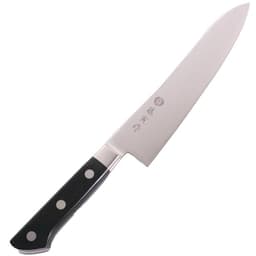
Our Japanese pick
Tojiro DP Gyuto 210 mm
The knife the internet has recommended to first-time gyuto buyers for a decade, and the numbers explain why: a real VG10 core at ~60 HRC for a fraction of the boutique price. Buy this before you spend three times as much.
Read the full reviewPrice as of October 20, 2026. #ad How we’re funded
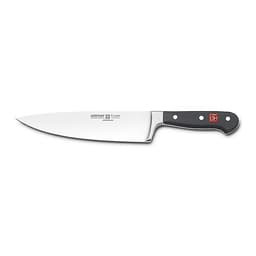
Our German pick
Wüsthof Classic 8-inch Chef's Knife
The benchmark forged German chef's knife: a full-tang X50CrMoV15 blade at ~58 HRC with a bolster and heft that many cooks prefer for rock-chopping. Heavier and softer than a gyuto, and built to last decades.
Read the full reviewPrice as of October 20, 2026. #ad How we’re funded
Frequently asked questions
Are Japanese knives better than German knives?
Neither is better — they optimize for different things. Japanese knives use harder steel (typically 60-62 HRC) ground to a finer angle, so they cut keener and hold that edge longer, at the cost of being more brittle and needing a whetstone. German knives use softer steel (55-58 HRC) in a heavier forged blade, so they are tougher, more forgiving and maintainable with a honing rod, at the cost of dulling sooner.
Which is sharper, a Japanese or German knife?
A Japanese knife, usually — but the gap has narrowed. Japanese blades are typically ground around 15 degrees per side against a traditional German 20, and harder steel supports a finer apex. However, modern German lines such as Wüsthof's Classic now ship at roughly 14 degrees per side, so the factory edge can be just as acute. The difference that remains is how long that keenness lasts.
Do Japanese knives chip easily?
More easily than German ones, yes — that is the direct cost of hardness. A 60+ HRC edge cracks where a 57 HRC edge would bend and recover. Twisting the blade in a cut, hitting bone or a frozen core, scraping the edge sideways across a board and dishwasher racks are the four common causes. Used on vegetables, fish and boneless meat with a wood board, they hold up fine.
Can you use a honing steel on a Japanese knife?
Not a coarse grooved one. A steel rod works by bending a rolled edge back, and hard Japanese steel is more likely to micro-chip than bend. Use a fine ceramic rod, which lightly abrades instead, or a smooth steel rod at most — then sharpen properly on a whetstone when the edge is genuinely worn.
Which should I buy as my first good knife?
A German or Western knife if you have never sharpened anything, share your kitchen with careless hands, or cut through joints and bones. A Japanese knife if you cook carefully, cut mostly vegetables, fish and boneless meat, and are willing to learn a whetstone. If you are unsure, the softer knife is the safer mistake — a keen soft knife beats a neglected hard one.
Are Japanese knives harder to sharpen?
They take more strokes because the steel is harder, and they want a finer angle held more consistently. But they also hold that angle better against the stone and produce a cleaner burr, so many people find them more satisfying once they can sharpen at all. The real difference is that a Japanese knife gives you no honing-rod shortcut — a stone is the only option.
Sources
- Rockwell hardness test — Wikipedia — Definition of the Rockwell C (HRC) scale used to state knife-steel hardness (accessed July 21, 2026)
- Japanese kitchen knife — Wikipedia — Reference on gyuto/santoku/nakiri, single- vs double-bevel (kataba/ryoba) and edge angles (accessed July 21, 2026)
- Knife sharpening — Wikipedia — Reference on edge angle, coarse-to-fine grit progression, and honing vs sharpening (accessed July 21, 2026)
Per-knife specs (steel, HRC, blade length, geometry) are read from each maker’s spec sheet or product listing and dated on the individual review cards above. “Not published” means the manufacturer does not state that figure — we flag it rather than guess.
Keep reading
Are Japanese Knives Worth It?
The buying decision behind the comparison, including who should stay German.
Read the answerKnife Steel & Hardness Guide
VG10, VG-MAX, X50CrMoV15 and what HRC means.
Understand the steelGyuto vs Chef Knife
The same argument at the level of one shape.
Compare themKitchen Knife Brands Explained
Who makes what, on both sides of the divide.
See the brandsBest Chef Knives Under $200
Where the two traditions meet on price.
See the tierCarbon vs Stainless Knives
The other steel argument, settled on published facts.
Compare themTojiro vs Shun
Two Japanese knives, and what the price gap buys.
Compare themKnife Hardness Chart (HRC)
The number this whole argument turns on, band by band.
Read the chartShun vs Wüsthof
The same argument with two specific knives in front of it.
Compare them