Carbon Steel vs Stainless Knives
One takes a keener edge and needs looking after. The other asks nothing and gives back slightly less. The gap is smaller than it was thirty years ago.
How this is funded: we earn a commission if you buy through our links, at no extra cost to you. As an Amazon Associate we earn from qualifying purchases. It never changes which knife we recommend, and we’ll tell you when we’d skip one. Full disclosure.
This argument is older than most of the knives in it, and a lot of what gets repeated about it stopped being true some time in the 1990s. The short version: carbon steel takes a slightly keener edge and sharpens more easily; stainless steel does not rust, does not react with food, and now gets close enough on performance that the practical difference for a home cook is small.
The technical distinction is chromium. Stainless steel contains enough of it — conventionally at least around 11–13% — to form an invisible passive oxide film on the surface that keeps oxygen away from the iron underneath. Carbon steel has essentially none, so it oxidizes freely. Everything below follows from that single alloying decision.
The decision table
| Carbon steel | Stainless steel | |
|---|---|---|
| Corrosion resistance | None — rusts if left wet | High |
| Ease of sharpening | Excellent | Good to very good |
| Peak keenness | Very high | High (hard grades) |
| Edge retention | Good, hardness-dependent | Good to excellent at ~60 HRC |
| Reacts with food | Yes — patina, possible metallic note | No |
| Daily upkeep | Wipe dry after every use | Wash and dry as normal |
| Tolerates neglect | No | Yes |
| Typical buyer | Enthusiast, single-user kitchen | Almost everyone |
Why carbon steel used to win decisively
Chromium does not sit politely in the alloy. It bonds with carbon to form large chromium carbides, and those carbides are what an edge is made of at the microscopic level. Big carbides mean a coarser, more ragged apex when you grind it fine — so early stainless steels could not be sharpened to the same keenness as a simple carbon steel, and they resisted the stone while failing to reward it.
That was a real and obvious difference, and it is why traditional Japanese knives are made from carbon steels such as White #2 (Shirogami) and Blue #2 (Aogami), and why professional cooks of an earlier generation regarded stainless as a compromise for people who could not be bothered.
Why the gap closed
Modern metallurgy fixed the carbide problem. Fine-carbide stainless steels — VG10, VG-MAX, FC61, the powder-metallurgy grades — are formulated and processed so the carbides stay small, which means the steel can be hardened to around 60 HRC and ground to a genuinely fine apex. The result is a knife that sharpens nearly as well as carbon, holds an edge as long or longer, and never rusts.
A modern hard stainless gyuto is not a compromise version of a carbon knife. It is a different and, for most kitchens, better solution to the same problem. The alloys and what their hardness figures mean are set out in our steel and hardness guide.
Living with carbon steel
If you buy one, three habits are non-negotiable and none of them is difficult:
Wipe it dry the moment you finish with it.Not after the meal — after the cutting. A carbon blade left wet on a board for twenty minutes will show spotting. Left in a sink overnight it will show orange rust.
Let the patina form.Cutting acidic food darkens carbon steel to a stable blue-gray oxide, and that layer protects the metal underneath. It looks unattractive at first and then looks characterful. Do not scour it off — a patinated knife is a maintained knife. Orange flaking rust is a different thing entirely and should be removed with a mild abrasive and then prevented.
Never let it near a dishwasher. One cycle is enough to do serious damage. This is true of every kitchen knife and dramatically more true of this one. The rest of the routine is in knife care and storage.
Who should buy which
Buy stainless if more than one person uses your knives; if a blade might sit on the board while something else finishes; if you cut a lot of onions, citrus and tomatoes; or if you simply want a knife that works without a relationship. That covers the overwhelming majority of kitchens, and it is why almost every knife on this site is stainless. Start with the Japanese gyuto field or the general chef’s knife roundup.
Buy carbon ifyou are the only person who touches your knives, you sharpen regularly and enjoy it, and you like the idea of a tool that records its own use. The keenness is real, the sharpening experience is genuinely more pleasant, and the patina is part of the appeal rather than a defect. It is an enthusiast’s choice made with open eyes, not a performance upgrade.
One useful middle path: several Japanese knives use a carbon core clad in stainless, which gives you the carbon cutting edge with stainless sides that do not stain. Only the exposed edge needs wiping. It is more maintenance than full stainless and considerably less than a bare carbon blade.
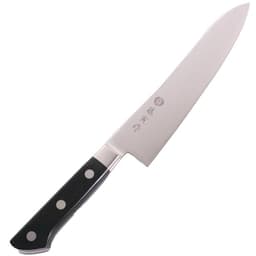
The stainless answer for most kitchens
Tojiro DP Gyuto 210 mm
The knife the internet has recommended to first-time gyuto buyers for a decade, and the numbers explain why: a real VG10 core at ~60 HRC for a fraction of the boutique price. Buy this before you spend three times as much.
See the full gyuto fieldPrice as of October 20, 2026. #ad How we’re funded
Frequently asked questions
Is carbon steel better than stainless for kitchen knives?
It takes a keener edge and is easier to sharpen, but it rusts if you leave it wet and develops a patina from acidic food. Modern hard stainless such as VG10 or VG-MAX at around 60 HRC closes most of the performance gap and asks nothing in return. For most home kitchens, stainless is the better buy; carbon suits people who enjoy the maintenance.
What is the difference between carbon steel and stainless steel?
Chromium. Stainless steel contains enough chromium — conventionally at least about 11-13% — to form a passive oxide layer that resists corrosion. Carbon steel has little or none, so it oxidizes freely. That same chromium ties up carbon in large carbides, which is historically why stainless was harder to sharpen to a fine apex.
Do carbon steel knives rust?
Yes, quickly, if left wet or dirty. What they usually develop instead is a patina — a stable blue-gray oxide layer formed by contact with acidic food that actually protects the steel underneath. Patina is normal and desirable; orange flaking rust is not, and it appears within hours on a knife left in a sink.
Is carbon steel easier to sharpen?
Generally yes. Simple carbon steels have a fine, uniform grain structure with few large carbides, so they take a very fine apex quickly and respond well to a stone. Modern fine-carbide stainless steels have narrowed this gap considerably, but a classic carbon blade still sharpens faster than most stainless of similar hardness.
Can you put a carbon steel knife in the dishwasher?
Absolutely not. A dishwasher will rust a carbon blade in a single cycle — prolonged heat, water and detergent strip any protective patina and leave bare iron. No kitchen knife of any kind belongs in a dishwasher, but with carbon steel the damage is immediate and visible rather than gradual.
Does a carbon steel knife make food taste metallic?
It can, on a new or freshly sharpened blade, particularly with acidic foods such as onions, tomatoes and citrus. Once a stable patina has formed the effect largely disappears. If you cut a lot of acidic ingredients and this bothers you, stainless is the correct answer.
Sources
- Japanese kitchen knife — Wikipedia — Reference on gyuto/santoku/nakiri, single- vs double-bevel (kataba/ryoba) and edge angles (accessed July 21, 2026)
- Rockwell hardness test — Wikipedia — Definition of the Rockwell C (HRC) scale used to state knife-steel hardness (accessed July 21, 2026)
- Rockwell Hardness — an overview (ScienceDirect Topics) — Reference overview of Rockwell indentation hardness measurement (accessed July 21, 2026)
Per-knife specs (steel, HRC, blade length, geometry) are read from each maker’s spec sheet or product listing and dated on the individual review cards above. “Not published” means the manufacturer does not state that figure — we flag it rather than guess.
Keep reading
Why Your Knife Rusts
What the spots actually are on either steel, and how to remove each.
Read the guideKnife Steel & Hardness Guide
VG10, X50CrMoV15, White #2 and what HRC means.
Read the guideDamascus Steel Explained
What cladding does, and why the core is what matters.
Read the guideJapanese vs German Knives
The hardness-versus-toughness argument in full.
Compare themKnife Care & Storage
The habits that decide how long any steel lasts.
Read the guide