Gyuto Club

DMT Diafold Serrated Review

One tapered diamond rod, a published 600 mesh, and a folding handle. Checked against DMT's own product page and grit table — including the one instruction on that page we tell kitchen owners to ignore.

By Stephen V.Last updated How we pick

How this is funded: we earn a commission if you buy through our links, at no extra cost to you. As an Amazon Associate we earn from qualifying purchases. It never changes which knife we recommend, and we’ll tell you when we’d skip one. Full disclosure.

Buy it if you own a serrated knife you intend to keep. The taper is the product: DMT publishes a 4.43-inch rod that narrows from 1/4 inch to 1/16 inch, which means one tool fits every scallop in a kitchen instead of one size of scallop. That single geometric fact is why this unremarkable-looking folding tool is the top pick on our serrated sharpener roundup and why most of what people own cannot do this job at all.

DMT’s own page for the fine Diafold Serrated describes a tool that “not only maintains serrated edges, but also serves as a mini-steel, gut hook sharpener, and conical file,” built on a “micronized monocrystalline diamond surface” in “fine diamond (25 micron / 600 mesh) for honing a razor sharp edge.” It is “convenient sized at 9 1/2” open and 5” closed,” the “folding plastic handles also protect the sharpener when not in use,” and “no messy oils are needed either, so you can sharpen dry or with water.” On provenance DMT is unusually specific: “Sharpener made in the USA, other components made in China.”

We do not own one and we have not worn one out; our methodology page says what we do instead. What follows is DMT’s published specification read against what a serrated kitchen edge actually needs — including the part of DMT’s own advice that does not apply to this tool.

Why a cone and not a rod

Serrations are not one size. A bread knife’s scallops are wide, a utility knife’s are narrow, and on many blades large and small gullets alternate along the same edge. A cylindrical rod has exactly one diameter: it fits one gullet size and bridges across every other one, which means it grinds thepoints of the teeth rather than the cutting edge recessed between them. Do that enough and you have a knife with a decorative wavy line and no bite.

A cone solves it by having every diameter between its two ends. DMT publishes those ends — 1/4 inch down to 1/16 inch — so you slide along the taper until the rod fills the scallop, then work there. The practical rule from the specialist guidance for this category is to position the rod so it fills the gullet without riding up onto the teeth, and the taper is what makes that possible on a whole drawer of different knives.

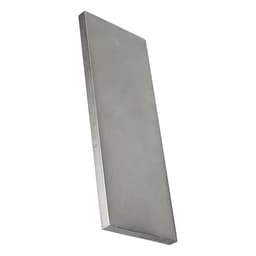
The second half of the geometry is the part most people get wrong, and it is not about the tool. As the specialist instruction puts it, “most serrated knives are chisel ground, one side is beveled, while the back is flat.” So you work the beveled face, inside each gullet, and you do not grind a new bevel into the flat back. The flat side gets deburring only, edge-trailing and very light — which is a job for a flat plate, not for this rod. That is why our serrated roundup pairs this tool with the D8F bench plate, whose continuous surface will not round the flat you are trying to keep flat.

Fine is the right grade, and DMT says why

DMT publishes a full color-coded grit table, which is the main reason we trust its grade claims: Extra-Extra-Coarse at 120 micron / 120 mesh, Extra-Coarse at 60 micron / 220 mesh, Coarse at 45 micron / 325 mesh (blue), Fine at 25 micron / 600 mesh (red), Extra-Fine at 9 micron / 1200 mesh (green) and Extra-Extra-Fine at 3 micron / 8000 mesh. This tool is the red one.

DMT’s own description of that grade is exactly the job here: it “restores to a fine edge any knife or tool that is slightly dull,” and DMT notes that “many of our customers consider the fine grit to be a medium/all purpose sharpener” and that “professional chefs and gourmet cooks work through to our finer grit models.” On a serrated edge that matters more than it would on a flat bevel: coarse diamond inside a gullet does not just sharpen the scallop, it reshapes it, and you cannot put the profile back. Fine removes enough steel to restore bite and not enough to redraw the tooth.

The Diafold Serrated against the other two tools our serrated roundup recommends, on published figures only
 DMT Diafold Serrated, FineLansky Folding Tapered RodChef'sChoice 15XV
FormatFolding tapered diamond rodFolding tapered diamond rod3-stage electric machine
Abrasive grade published?Yes — 25 micron / 600 mesh (Fine)No — 'diamond', no mesh or micronDiamond stages, no grade stated
TaperedYes — 1/4 in. to 1/16 in.Yes — not quantifiedn/a
Working length4.43 in. rodNot publishedn/a
Serrated capability stated by makerYes — purpose-builtYes — tapered serrated rodYes — Stage 3 only, per its manual
Can restore a reshaped gulletYes, slowlyUnknown — grade unpublishedNo — maintenance only
Closed size5 in. closed, 9.5 in. openFolds into handleCountertop appliance

What it is like to live with

Three things about the format rather than the abrasive, because they are what decide whether a tool like this actually gets used.

The folding handle is the reason it survives.Loose diamond abrasive in a kitchen drawer gets blunted by everything it rattles against, and sheaths get lost within a year. DMT’s handles “enclose and protect the diamond serrated sharpener when not in use,” which turns an easily ruined tool into one you can keep next to the whisks. At 5 inches closed it fits anywhere.

It is faster than a stone and slower than you expect.DMT claims it “sharpens knives faster than conventional stones” thanks to the monocrystalline diamond surface, and on a per-stroke basis that is believable — diamond cuts hard steel quickly. But a 9-inch bread knife has thirty-odd gullets and each one needs the same small number of strokes as the last. The honest expectation is a patient few minutes with the radio on, and that is the nature of the job rather than a fault in the tool.

Light hands.The flip side of a fast abrasive on a small contact patch is that pressure does damage quickly. Three or four light passes per gullet, counted, and the same count on every scallop — consistency is what keeps the tooth line even. A heavy hand rounds the points, which is the one kind of damage this tool cannot undo.

The advice on DMT’s own site we would ignore

DMT’s FAQ recommends “sharpening at a 20-degree angle” and adds that “sharpening at the proper angle is not as important as sharpening at a constant angle.” The second half is good advice everywhere. The first half is written for straight Western and outdoor edges and simply does not apply to a serrated blade: there is no angle for you to set. The bevel inside each gullet was ground at the factory, on one side, and your job is to follow it rather than to choose it. If you find yourself thinking about degrees while using this tool, you are about to put a second bevel somewhere that should not have one.

The same FAQ page carries a warning worth repeating because it applies to every DMT grade: “unless the stone is designated Dia-Flat, do not use for lapping.” This is not a stone-flattening tool. Our flattening guide covers what is.

Who should buy something else

If you will not do it by hand.The Chef’sChoice 15XV is the one electric sharpener we list whose maker documents a serrated procedure — its own manual says to “use only Stage 3” with “five (5) to ten (10) pairs of alternating pulls.” That is maintenance of existing teeth, not restoration of lost ones, and it is the honest trade for not doing the work yourself.

If the knife is not worth the evening. A stamped supermarket bread knife costs less than an hour of your time, and if a pull-through sharpener has already ground its points flat there is nothing to recover. Buy a new knife and keep this tool for the serrated blade in a set you actually like.

If your drawer is all straight edges. Then this is the wrong purchase entirely and a 1000/6000 combination stone from our whetstone roundup is the right one. A tapered cone is a specialist tool for a specialist edge, and its value is entirely in being the only thing that fits.

The verdict

This is the rare case where there is no real competition on capability, only on disclosure and price. The Lansky folding rod does the same thing for less and publishes no abrasive grade; the electric machines mostly stay silent about serrated edges, and that silence should be read as a no. DMT prints the taper, the length, the micron and the mesh, puts the grade on a published table with the rest of its range, and tells you which parts are made where. For a tool that will sit in a drawer for years between uses and then be asked to rescue a good bread knife, that is exactly the set of things we want to know before buying.
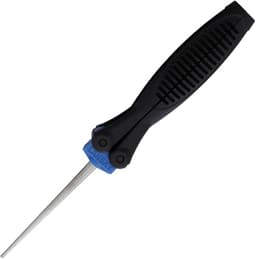
#1Reviewed here

DMT Diafold Serrated Knife Sharpener, Fine (FSKF)

The tool a serrated knife actually needs: a tapered diamond rod that fills each gullet at whatever diameter it happens to be, from a bread knife's wide scallops down to a pocket knife's. Folds into its own handle, which is why it survives a drawer.

Strengths

  • Tapered, so one rod fits every serration size instead of only one
  • DMT publishes the grade: Fine is 600 mesh / 25 microns
  • Folds into the handle — no sheath to lose, no exposed abrasive in a drawer

Trade-offs

  • Diamond cuts fast, so a heavy hand rounds the teeth quickly
  • 4-inch working length means a long bread knife takes a while
TypeManual tapered rod, one gullet at a time
AbrasivesFine — 600 mesh (25 µm)
Abrasive materialMonocrystalline diamond on a tapered rod
Angle controlFollows the knife's existing single-side bevel
DimensionsNot published

Specs read from the manufacturer listing, on August 18, 2026. “Not published” means the maker does not state that figure.

Lansky Folding Diamond Tapered Rod

If you want the same idea for less money

Lansky Folding Diamond Tapered Rod

The cheaper tapered rod. Same idea as the DMT — a cone of diamond abrasive that fits itself to each scallop — with a folding handle and a lower price. Lansky does not publish a mesh or micron figure for it, which is the one thing we hold against it.

See how it compares
$20.64 · View on Amazon

Price as of October 16, 2026. #ad How we’re funded

DMT D8F Dia-Sharp 8-inch Bench Stone, Fine

For the flat back of the blade

DMT D8F Dia-Sharp 8-inch Bench Stone, Fine

The single-grit, continuous-surface plate — no holes, so nothing catches a thin blade tip on the way across. Fine 600 is the grit a kitchen knife actually lives at, and this is the version to buy if you want one plate that does the job properly rather than two that do it adequately.

Read the D8F review
$65.29 · View on Amazon

Price as of October 16, 2026. #ad How we’re funded

Frequently asked questions

Is the DMT Diafold Serrated worth it?

If you own a serrated knife you intend to keep, yes — it is the only format that physically fits the job, and DMT publishes what it is: a 4.43-inch rod tapering from 1/4 inch to 1/16, in fine diamond at 25 micron / 600 mesh. If your only serrated knife is a cheap stamped bread knife, replacing it costs about the same and takes no evening.

What grit is the DMT Diafold Serrated Fine?

Fine, which DMT's own published grit table defines as 25 micron / 600 mesh, color-coded red. DMT describes that grade as what 'restores to a fine edge any knife or tool that is slightly dull' and notes that many customers treat fine as a medium, all-purpose grade. Coarse (45 micron / 325 mesh) would reshape a gullet before you noticed.

How long is the DMT Diafold Serrated?

DMT publishes a 4.43-inch rod with a 1/4-inch to 1/16-inch taper, and the whole tool measures '9 1/2" open and 5" closed'. Amazon's listing rounds the rod to 4 inches. On a 9-inch bread knife with thirty-odd gullets, a 4.43-inch working length means a methodical few minutes rather than a quick pass.

Can the Diafold Serrated sharpen a straight edge too?

DMT says it 'not only maintains serrated edges, but also serves as a mini-steel, gut hook sharpener, and conical file'. As a mini-steel it will touch up a straight edge in a pinch, but a cone is a poor substitute for a flat stone or a smooth rod — the contact patch is tiny and it is easy to round the bevel. Treat the extra uses as a bonus, not a reason to buy.

Do you need oil or water with it?

Neither is required. DMT states 'no messy oils are needed either, so you can sharpen dry or with water'. Dry is simpler for a quick serrated touch-up; water helps carry away steel swarf if you are doing a whole bread knife. Do not use oil on a diamond plate or rod — it just traps metal particles against the abrasive.

Where is the DMT Diafold made?

DMT states 'Sharpener made in the USA, other components made in China' — meaning the diamond rod itself is American-made and the folding plastic handles are not. That is a more precise claim than most 'made in' badges, and we quote it as written rather than summarising it as either one or the other.

Should I sharpen a serrated knife at 20 degrees?

No — that question does not apply. DMT's FAQ recommends 'sharpening at a 20-degree angle', which is written for straight Western and outdoor edges. On a serrated blade you are not setting an angle at all: most serrated knives are chisel ground, so you follow the existing bevel inside each gullet on one side only and leave the flat back alone except for deburring.

Can I use the Diafold to flatten a whetstone?

No. DMT's own grit table carries the warning on every grade: 'unless the stone is designated Dia-Flat, do not use for lapping.' A tapered rod is the wrong shape for it anyway. Use a dedicated coarse flattening plate — our flattening guide covers the pencil-grid routine and the tools that are rated for it.

Sources

  • Diafold Serrated Knife Sharpener - Fine (FSKF) — DMT Diamond Sharpeners — DMT's own product page for the fine Diafold Serrated, and the only place the geometry is published: it 'not only maintains serrated edges, but also serves as a mini-steel, gut hook sharpener, and conical file', 'donning a 4.43 inch rod with 1/4 inch to 1/16 inch taper', with 'fine diamond (25 micron / 600 mesh) for honing a razor sharp edge' on a 'micronized monocrystalline diamond surface'. It is 'convenient sized at 9 1/2 inches open and 5 inches closed', the 'folding plastic handles also protect the sharpener when not in use', it 'sharpens knives faster than conventional stones', and 'no messy oils are needed either, so you can sharpen dry or with water'. Provenance is stated precisely: 'Sharpener made in the USA, other components made in China'. The same page carries DMT's full color-coded grit table (Extra-Extra-Coarse 120 micron / 120 mesh, Extra-Coarse 60 / 220, Coarse 45 / 325 blue, Fine 25 / 600 red, Extra-Fine 9 / 1200 green, Extra-Extra-Fine 3 micron / 8000 mesh), DMT's own description of Fine as what 'restores to a fine edge any knife or tool that is slightly dull' with the note that 'many of our customers consider the fine grit to be a medium/all purpose sharpener' and that 'professional chefs and gourmet cooks work through to our finer grit models', and the warning repeated on every grade: 'unless the stone is designated Dia-Flat, do not use for lapping'. No weight is published (accessed October 11, 2026)
  • How to Sharpen a Serrated Knife with the DMT Serrated Knife Sharpener — Sharpening Supplies — 'Most serrated knives are chisel ground, one side is beveled, while the back is flat' — plus the tapered-rod fit ('position the rod so it fills the gullet without riding up onto the teeth'), the marker trick for staying on the bevel, and edge-trailing deburring on the flat side (accessed August 18, 2026)
  • DMT Diamond and Ceramic Color-Coded Grit Chart — Sharpening Supplies — DMT's own color codes with the mesh and micron figure for each grade (Coarse 325/45 µm, Fine 600/25 µm, Extra-Fine 1200/9 µm) (accessed August 11, 2026)
  • DMT FAQ — DMT Diamond Sharpeners — DMT's own answers: on break-in, 'the diamond surface will seem aggressive in nature; the diamond sharpener will smooth after initial sharpening with no impact to long term performance. Your first few sharpenings are the break-in period'; 'DMT recommends you use DMT products dry or with water only'; care is to 'clean after each use with water and wipe dry' and 'After several sharpenings, use a mild kitchen abrasive cleanser and a nylon scrub brush'; on life, DMT sharpeners 'do not last forever, but they last for several years'; the polka-dot surfaces are 'slightly recessed' so debris falls away while Dia-Sharp's 'continuous diamond surface' suits 'small-pointed tools'; DMT recommends 'sharpening at a 20-degree angle' and notes 'sharpening at the proper angle is not as important as sharpening at a constant angle'; and the guarantee: 'If your product fails to perform due to defects in materials or workmanship, we will replace it regardless of age' (accessed September 18, 2026)
  • 8-in. Dia-Sharp Bench Stone - Fine (D8F) — DMT Diamond Sharpeners — DMT's own product page for SKU D8F: 'Guaranteed not to hollow or groove', a 'precisely engineered Dia-Sharp Bench Stone with continuous diamond surface assures consistent, even sharpening every time', 'fine diamond (25 micron / 600 mesh) for honing a razor sharp edge', 'non-skid rubber feet with the diamond grit clearly marked on side of stone', a 'micronized monocrystalline diamond surface', 'No messy oils are needed either, allowing you to sharpen dry or with water', 'Sharpening surface accommodates range of edges from large knives to small pointed tools', suitable for 'edge repair and honing' and for 'flattening plane soles, irons and chisel backs', and 'Made in the USA'. DMT's own store price on the access date was substantially above what the Amazon listing has been running at. No weight is published (accessed October 7, 2026)
  • Chef'sChoice 0101500 Trizor XV Electric Knife Sharpener - User Guide — A reproduction of EdgeCraft's own user guide for this model. It states that on a first sharpening of a European/American edge 'it may take up to 20 pair of pulls to fully re-angle the edge of a thin blade', that on a contemporary Asian blade 'only a few (1-2) pairs of alternating pulls... will be needed to develop a burr', that afterwards 'you should be able to re-sharpen to a razor sharp edge 3 or more times using only Stage 3', that serrated blades 'use only Stage 3' with 'five (5) to ten (10) pairs of alternating pulls', that you should 'not attempt to use this sharpener to sharpen either ceramic knives or scissors' nor 'ax blades or any blade that does not fit freely', and gives '125W on the nameplate' at 120V (accessed August 28, 2026)
  • Knife sharpening — Wikipedia — Reference on edge angle, coarse-to-fine grit progression, and honing vs sharpening (accessed July 21, 2026)

Per-knife specs (steel, HRC, blade length, geometry) are read from each maker’s spec sheet or product listing and dated on the individual review cards above. “Not published” means the manufacturer does not state that figure — we flag it rather than guess.

Keep reading