Are Japanese Knives Worth It?
Worth it for one kind of cook and genuinely a bad buy for another. The deciding factor is not your budget — it is whether you will sharpen, and what you cut.
How this is funded: we earn a commission if you buy through our links, at no extra cost to you. As an Amazon Associate we earn from qualifying purchases. It never changes which knife we recommend, and we’ll tell you when we’d skip one. Full disclosure.
Worth it if you will sharpen the knife and you mostly cut vegetables, fish and boneless meat. Not worth it if you will not sharpen, if you cut through bone or frozen food, or if the knife is going in the dishwasher. That is the real dividing line, and it has nothing to do with how much you want to spend. A $35 Victorinox in a kitchen that never sharpens will outperform a $300 gyuto in the same kitchen within about two months.
The thing you are buying is not vague. It is two published specifications: hardness and edge angle. Wüsthof’s own account of its processes puts forged German blades at “58 Rockwell” and non-forged ones “between 55 and 57 Rockwell.” Japanese stainless cores sit above that: Shun hardens VG10 and VG-MAX to “60-61 Rockwell,” per its own FAQ, and ZWILLING publishes “60-62 HRC” for the FC61 core in the Miyabi Kaizen II. On angle, EdgeCraft — which builds sharpeners around the difference — describes Western knives as using “sturdy 20 degree facets (40 degree total angle)” and Asian knives “the more delicate 15 degree facets (30 degree total angle).” Shun publishes 16° per side; ZWILLING publishes an edge “hand-honed using the historic Honbazuke method to an exceptionally sharp 9.5 to 12 degrees.”
Harder steel plus a thinner edge equals a knife that cuts with less force and keeps doing it for longer. That part is not marketing. The question is what it costs you.
The four costs
1. The edge chips instead of rolling.Hardness and toughness trade against each other. A soft German edge that meets a chicken bone deforms — you hone it straight again in ten seconds. A 61 HRC Japanese edge in the same situation takes a chip out, and fixing a chip means grinding the edge back on a coarse stone until the damage is gone. Our chip-repair guide shows how much steel that costs.
2. You have to actually learn to sharpen, or pay someone.Hard steel wants a water stone at around 15° and a ceramic rod for touch-ups. A ribbed steel is the wrong tool and a pull-through carbide sharpener is worse — Shun’s own FAQ even warns against diamond steels for routine honing because they “will remove metal from your knife before it is necessary.” Budget either an evening of practice and a stone, or a recurring sharpening bill.
3. The care is non-negotiable.Hand wash, dry immediately, store with its own space. ZWILLING’s own instructions rule out the dishwasher for “aggressive chemical tablets,” “high temperatures” and “bumps and bangs with other objects,” and rule it out entirely for wooden handles. If that is a routine your household will not keep, the premium knife will be the worst-performing knife in the drawer within a year.
4. Some of the price is finish, not performance.This is worth knowing before you pay. Damascus cladding is structural in the sense that a hard core needs a tougher jacket — but a plain three-layer Tojiro does that job exactly as well as 34 patterned layers on a Shun. Shun’s product page publishes the pattern as “34 layers of stainless Damascus cladding each side (68 total)” over a VG-MAX core; the layers are a finish over the structure. Our Damascus explainer separates the two.
Who should say yes
- You cut a lot of vegetables, and you can feel the difference between a knife that slices a tomato and one that squashes it.
- You are willing to own a 1000-grit stone and spend twenty minutes learning to use it. Our walkthrough is the whole commitment.
- Your cooking does not routinely involve bone, frozen product, or hacking through squash with the heel of the blade.
- You hand wash. If someone else in the house loads the dishwasher, this is a household agreement rather than a knife decision.
Who should say no, without embarrassment
- Anyone who will not sharpen. This is most people, and it is a completely reasonable thing to be. Soft steel that comes back to sharp in sixty seconds is the right tool for you.
- Anyone breaking down whole birds, cutting through joints, or working with frozen ingredients. German geometry exists for this.
- Anyone buying for a kitchen they do not control — a shared house, a rental, a holiday let, a teenager’s first flat. Our first-kitchen gift guide is built around exactly that constraint.
- Anyone whose grip strength makes holding a stone angle painful. The weak-grip page takes that case seriously.
The cheap way to find out
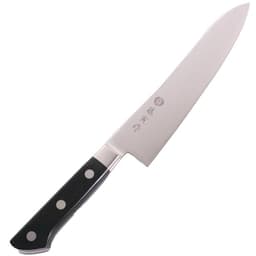
Buy one Tojiro DP gyuto at 210 mm and live with it for three months. It is a real VG10 core at ~60 HRC, stainless-clad, ground to roughly 15° per side, in a plain wrapper — which is the point: it isolates the only variables that matter. If at the end of three months you have sharpened it twice and you reach for it over everything else in the drawer, the answer for you is yes, and the boutique knives are now a reasonable thing to want. If it has sat in the block because you were worried about it, you have your answer much more cheaply than the usual route.
The cheapest honest way to find out
Tojiro DP Gyuto 210 mm
The knife the internet has recommended to first-time gyuto buyers for a decade, and the numbers explain why: a real VG10 core at ~60 HRC for a fraction of the boutique price. Buy this before you spend three times as much.
Read the full Tojiro DP reviewPrice as of October 6, 2026. #ad How we’re funded
If the answer for you is no
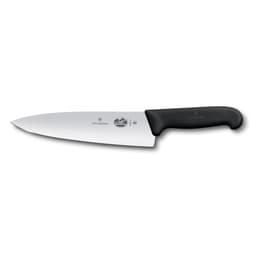
Victorinox Fibrox Pro 8-inch Chef's Knife
The knife that wins nearly every budget test, and the one to buy if you buy only one. A soft, stamped X50CrMoV15 blade at ~55-56 HRC and a grippy, non-slip handle — it dulls sooner than a hard Japanese knife but takes an edge back in seconds.
Read the full Victorinox reviewPrice as of October 6, 2026. #ad How we’re funded
If the answer is yes and you want the full version
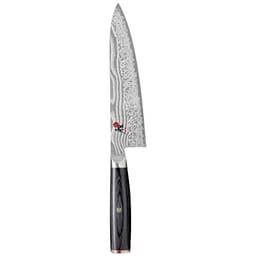
Miyabi Kaizen II 8-inch Chef's Knife
Miyabi is Zwilling's Japan-made line, and the Kaizen II pairs an FC61 core at ~60 HRC with a 48-layer Damascus jacket and a comfortable D-handle. A polished alternative to the Shun Classic at a similar price.
Read the full Miyabi reviewFrequently asked questions
Are Japanese knives worth the money?
If you will maintain the edge and you mostly cut produce, fish and boneless proteins — yes, and the cheapest way to find out is a Tojiro DP gyuto rather than a boutique knife. If you will not sharpen, or you cut through bones and frozen food, or the knife is going in the dishwasher, a soft German or stamped Western knife is the better buy and it is not a compromise.
Are Japanese knives really sharper?
They are ground more acutely and they are harder, which is a measurable difference rather than an impression. Shun publishes a 16 degree edge per side; ZWILLING publishes 9.5 to 12 degrees for the hand-honed Miyabi Kaizen II. EdgeCraft, which builds machines around the distinction, puts Western knives at 'sturdy 20 degree facets (40 degree total angle)' against 'the more delicate 15 degree facets (30 degree total angle)' for Asian knives. A thinner edge at a higher hardness both cuts better and holds that edge longer.
Are Japanese knives better than German knives?
Better at cutting, worse at being ignored. Wusthof's own account puts its forged German blades at '58 Rockwell' and non-forged at 'between 55 and 57'; Japanese stainless cores typically run 60-62 HRC. The hard edge holds longer and chips rather than rolls when it is abused. German steel bends where Japanese steel breaks, which is exactly what you want in a knife that meets bone.
Do Japanese knives chip easily?
Harder steel is less tough, so yes — relative to German steel. In practice chipping comes from specific actions: twisting the blade in a joint, cutting through bone or frozen food, scraping a board with the edge, and contact with other metal in a sink or dishwasher. Avoid those five things and a 60 HRC edge lasts very well. Our chipped-knife guide covers the repair when it happens.
Do you have to sharpen Japanese knives more often?
Less often, and more carefully. Harder steel holds an edge longer, so the sharpening interval is longer than for a soft Western knife. What changes is the method: a hard edge wants a water stone at around 15 degrees and a ceramic rod for touch-ups, not a ribbed steel and not a pull-through. Shun's own FAQ warns against using a diamond steel for regular honing because it 'will remove metal from your knife before it is necessary'.
What is the cheapest Japanese knife worth buying?
A Tojiro DP gyuto at 210 mm — a real VG10 core at around 60 HRC, stainless-clad, ground to roughly 15 degrees per side. It is the standard answer because it isolates the variable: you get the steel and the geometry without paying for Damascus cladding or a premium handle, so you learn whether hard Japanese steel suits your cooking before spending more.
Can I put a Japanese knife in the dishwasher?
No. ZWILLING — which makes Miyabi — rules the dishwasher out in its own care instructions, citing aggressive chemical tablets, high temperatures and bumps and bangs with other objects, and states that wooden-handled knives must be hand washed. A hard thin edge knocking against a rack is the fastest way to chip one.
Sources
- Japanese kitchen knife — Wikipedia — Reference on gyuto/santoku/nakiri, single- vs double-bevel (kataba/ryoba) and edge angles (accessed July 21, 2026)
- Rockwell hardness test — Wikipedia — Definition of the Rockwell C (HRC) scale used to state knife-steel hardness (accessed July 21, 2026)
- Shun Knives FAQ — Shun Cutlery (Kai USA) — Shun's own answers: 'Shun hardens VG10 and VG-Max steel to 60-61 Rockwell and SG2 to 61-62', 'Shun knives, for example, are sharpened to a 16 degree angle on each side of the blade', and on rods, 'Please do not use a diamond steel for regular honing. Diamond steels are for sharpening and will remove metal from your knife before it is necessary' (accessed August 28, 2026)
- Shun Classic 8-inch Chef's Knife — Shun Cutlery (Kai USA) — Shun's published spec for the knife itself: a 'VG-MAX' core in '69 layer Damascus' — described as '34 layers of stainless Damascus cladding each side (68 total)' — a '16 degree edge each side', an '8 in. (203mm)' blade, '6.7 oz (190 g)', an ebony-color Pakkawood D-shaped handle, 'Handcrafted in Seki City, Japan' and a 'Limited Lifetime Warranty'. No Rockwell figure appears on the product page (accessed August 28, 2026)
- MIYABI Kaizen II 5000FCD 8-inch Chef's Knife — ZWILLING — Zwilling's published spec for the line: an 'FC61' core with fine carbide distribution at '60-62 HRC', '48 layers of stainless steel' Damascus over the core (49 total), an edge 'hand-honed using the historic Honbazuke method to an exceptionally sharp 9.5 to 12 degrees', a 'double ice-hardened FRIODUR' blade, a 'thicker and rounded bolster for increased comfort and balance', a black Pakkawood D-shaped handle, a 7.87 in blade at 0.44 lbs, handcrafted in Seki, Japan (accessed August 28, 2026)
- The Difference Between WÜSTHOF Forged and Stamped Kitchen Knives — WÜSTHOF — Wüsthof's own account of both processes: forged blades start as a single piece of steel heated to over 2000°F and take 'over fifty-four manufacturing steps', hardened to '58 Rockwell'; non-forged blades are 'cut from a high-quality steel sheet using a precision laser' in 'thirty-five manufacturing steps' and run 'between 55 and 57 Rockwell' (accessed August 18, 2026)
- Understanding Euro/American and Asian Style Knives - Chef's Choice by EdgeCraft — EdgeCraft's own figures: Euro/American knives are 'sharpened with sturdy 20 degree facets (40 degree total angle)' while Asian knives use 'the more delicate 15 degree facets (30 degree total angle)'; its 15° sharpeners create 'the 15 degree edge with a multi-bevel gothic arch geometry which provides more metal support for the edge, therefore making it more durable'; traditional single-bevel Japanese knives have a primary blade bevel 'ground, commonly at about 10-11 degrees' under 'a very small single cutting edge facet of about 15 degree', and 'Always sharpen this style knife at 15 degree (Asian style)'. The Trizor XV Model 15 is the model it names for converting a 20° edge to 15° (accessed August 28, 2026)
- How to Clean and Care for Your Knife — ZWILLING — ZWILLING's own care instructions: 'clean it by hand using lukewarm water, mild dish soap and a non-scratch cloth or sponge', dried with 'a plain dishtowel or microfiber cloth'; the dishwasher is ruled out for 'aggressive chemical tablets', 'high temperatures' and 'bumps and bangs with other objects'. On wooden handles: 'not dishwasher-safe and should only be washed by hand', with the wood 'regularly treating the wood with oil (e.g. linseed oil) or wax (e.g. beeswax)'. On storage, a knife needs 'its very own space away from other objects, so not simply thrown in the cutlery drawer' — a block, 'drawer organizers or protective sleeves' (accessed September 23, 2026)
Per-knife specs (steel, HRC, blade length, geometry) are read from each maker’s spec sheet or product listing and dated on the individual review cards above. “Not published” means the manufacturer does not state that figure — we flag it rather than guess.
Keep reading
Japanese vs German Knives
The head-to-head on hardness, angle and upkeep.
Compare themJapanese Knife Buying Guide
If the answer is yes: steel, hardness and geometry, in order.
Read the guideYour First Japanese Knife
Gyuto, then petty, then nakiri — the buying sequence.
Read the pathBest Japanese Chef Knives
The gyuto field compared on published steel and hardness.
See the picksKnife Hardness Chart
What 58, 60 and 62 HRC actually mean for an edge.
See the numbersBest Sharpeners for Japanese Knives
The maintenance commitment, costed.
See the options