Why each pick lands, and who it suits
The Victorinox Fibrox 8-inch: buy the cheap one on purpose
A light, stamped X50CrMoV15 blade at about 55–56 HRC on a textured non-slip handle. It lands because it is the knife that keeps beating far more expensive blades in independent tests, and because it is impossible to be precious about. It suits a college student, a first apartment, or anyone you have not watched cook. What to check: nothing about the recipient — symmetrical handle, default size, and no care beyond hand-washing and an occasional pass on a rod. It is utilitarian to look at, so pair it with the stone if the box needs to feel generous.
The Mercer Genesis 8-inch: a forged knife at a stamped price
Fully forged German steel with a full tang and a bolster, on a Santoprene handle that grips when wet. It lands because forged construction is the thing every cook has been told costs three times as much, and this is the knife culinary schools actually issue. It suits someone who would enjoy a little heft and a finger guard. What to check: at about 58 HRC it is soft, so it wants honing often; the Victorinox rod below is the natural partner. The Victorinox vs Mercer comparison settles which of the two to give.
The Sharp Pebble 1000/6000 kit: the stone that comes with training wheels
A 1000/6000 combination water stone with a non-slip bamboo base and a plastic angle guide, in one box. It lands because it unwraps as a complete kit rather than a bare brick, and because the angle guide gets a beginner through the first few sessions. It suits an absolute beginner. What to check: it needs a ten-to-fifteen-minute soak before use and the guide is a training aid to retire. Our beginner whetstones page compares it with the King stone, which is the better stone for a handier recipient.
The Victorinox 10-inch honing steel: the add-on that keeps the gift sharp
A rod does not sharpen; it realigns a rolled soft-steel edge in ten seconds before cooking, which keeps a Victorinox or Mercer feeling keen for months longer between sharpenings. It lands because it costs little and gets used every day. It suits every knife on this page. What to check: nothing — unless you are giving a hard Japanese knife, which none of these are, in which case see the ceramic rod on our honing steels page.
The Mercer Genesis 7-inch santoku: for a small kitchen
The same forged, full-tang construction as the Genesis chef’s knife in the shorter, flatter santoku shape, with a granton edge to release sticky slices. It lands because a santoku feels immediately natural to a beginner — straight up-and-down chopping rather than rocking — and fits a small board and a small drawer. It suits a dorm, a studio, or a smaller hand. What to check: the short blade limits long slicing, so if they will break down big produce, give the 8-inch instead.
The Mercer Genesis 5-inch utility: the cheapest second knife worth owning
Forged, full-tang and bolstered in a 127 mm blade, for the small jobs a chef’s knife is clumsy at. It lands because it is the natural companion to either Genesis knife above and costs about what a takeaway does. It suits someone who already has a chef’s knife — a second knife, not a first. What to check: exactly that. Given alone it is a puzzle; given with the 8-inch it is a set.
The Mercer Genesis 6-piece block: the one set we would give
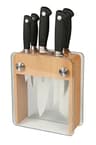
The forged Genesis chef’s knife plus the four other blades a home cook actually reaches for — bread, boning, utility, paring — in a beech-and-glass block. It lands because it is the exception to our usual “never a block” rule: every blade is forged and full-tang, not stamped filler, and five slots is five knives that earn their place. It suits newlyweds or a couple furnishing a kitchen from nothing. What to check: it includes no honing rod, so add the Victorinox steel; and it is hand-wash only. Our full review of the set lists exactly what is in the box.
How to choose between them
- One gift, one person, you know nothing else: the Victorinox Fibrox. Add the Sharp Pebble stone if you can.
- A couple starting from nothing: the Mercer 6-piece block plus the Victorinox rod.
- A dorm or a studio: the Mercer santoku, which fits the board and the drawer.
- They already have one knife: the stone and the rod. They will use both more than a second knife.
What we would not give a first kitchen
- A hard Japanese knife.Not because they are bad — they are the best knives on this site — but because a 60 HRC edge chips when it is used as a lever, and a beginner will use it as a lever. Give one in two years, from our under-$150 guide.
- A 15-slot block. Fifteen stamped blades, three used. The Mercer 6-piece is on this page because it is the exception; our sets page explains why most are not.
- A pull-through carbide sharpener. It scrapes metal off in strips. The stone costs the same and teaches something.
A note on how we picked
Every product on this page also appears in one of our regular roundups, where it was ranked on published specifications rather than gift appeal. We do not own these knives and we do not claim to have tested them. Mercer publishes no Rockwell figure for the Genesis set on its listing, which the card prints as Not published.