Chef Knife Size Guide
Almost everyone should buy 200-210 mm. Here is what the other lengths actually change, and the three situations where the default answer is wrong.
How this is funded: we earn a commission if you buy through our links, at no extra cost to you. As an Amazon Associate we earn from qualifying purchases. It never changes which knife we recommend, and we’ll tell you when we’d skip one. Full disclosure.
The short answer is 200–210 mm— an 8-inch Western chef’s knife or a 210 mm Japanese gyuto. That is the default for the same reason A4 is the default paper size: not because it is optimal for any single task, but because it is the least wrong across all of them. If you want to stop reading here, buy that.
The longer answer is that blade length changes three specific things — how much edge meets the food per stroke, how much clearance your knuckles have, and how much of the blade you can actually control — and those three things do not all improve in the same direction.
What length actually changes
Edge per stroke. The obvious one. A longer blade cuts more in one motion, which is why professional kitchens processing volume favor 10-inch knives. For a home cook dicing two onions, this advantage is essentially imaginary.
Knuckle clearance.Less obvious and more important. Longer knives are usually taller as well, and blade height is what keeps your guiding hand’s knuckles clear of the board when you use a proper claw grip. A short, shallow knife forces you to lift your fingers, which is both slower and less safe.
Control. The counterweight. Every millimeter of blade is a millimeter further from your hand, so small errors at the handle become larger errors at the tip. On a 260 mm knife the tip is a long way from where the correction happens, and that is exactly why long knives feel unwieldy to people who do not use them daily.
Above about 210 mm the first two stop improving much and the third gets steadily worse. That is the whole reason the standard settled where it did.
The sizes, and who each one is for
| 6 in / 150-165 mm | 8 in / 200-210 mm | 10 in / 240-260 mm | |
|---|---|---|---|
| Best for | Small hands, small boards | Almost everyone | High volume, large produce |
| Cabbage, squash, melon | Struggles | Fine | Easiest |
| Garlic, shallots, herbs | Comfortable | Fine | Clumsy |
| Knuckle clearance | Limited | Good | Best |
| Control near the tip | Excellent | Good | Needs practice |
| Board needed | Any | Standard | Large |
| As an only knife | Frustrating | Yes | Workable, not ideal |
The three cases where 8 inches is the wrong answer
1. Your board is small.This is the most common real reason to size down, and nobody mentions it. A 210 mm knife on a 30 cm board overhangs the edge, which means the tip is unsupported and you cannot use the full blade. If your board is small and will stay small — a shared flat, a boat, a small kitchen with no counter — buy a shorter knife rather than fighting the geometry every day. Buying a bigger board is usually the better fix.
2. Wrist strength or joint problems.A shorter, lighter knife is genuinely easier to control for anyone with limited grip strength or wrist pain, and control is worth more than reach. Pair a 165–180 mm knife — a santoku works well here — with a light stamped blade rather than a heavy forged one.
3. You genuinely process volume.If you regularly break down whole cabbages, batch-prep for a family of six, or cook professionally, a 240–260 mm blade earns its length. The extra reach and height are real advantages when the pile is large, and the control penalty stops mattering once the motion is habitual.
Inches, millimeters, and the numbers on the box
Western makers quote inches; Japanese makers quote millimeters. An 8-inch chef’s knife is 203 mm and a standard gyuto is 210 mm, and the 7 mm between them means nothing — do not let it decide a purchase. Where the difference becomes real is at the extremes: a 240 mm gyuto is meaningfully longer than a 9-inch Western knife, and a 165 mm gyuto is a different tool from a 6-inch chef’s knife because the Japanese one is usually taller and thinner.
Note also that stated length is the blade, measured from tip to heel, not the whole knife. A knife described as 8 inches is roughly 13 inches overall, which matters when you are working out whether it fits a block or a drawer insert.
What to buy if you are buying two
The most useful two-knife kitchen is a 200–210 mm chef’s knife or gyuto plus a 130–150 mm petty. Those two cover almost everything, and they do not overlap — the big one does board work, the small one does everything the big one is clumsy at. Add a serrated bread knife third and you are finished.
The pairing to avoid is two knives of similar length, which is what happens when somebody buys a 180 mm santoku alongside a 200 mm chef’s knife. Both do the same job, one of them sits unused, and the money would have been far better spent on the small knife that is genuinely missing — chef knife vs utility knife sets out exactly which jobs the short blade takes off the long one. The case against buying more knives than you need is made at length in best chef knife sets.
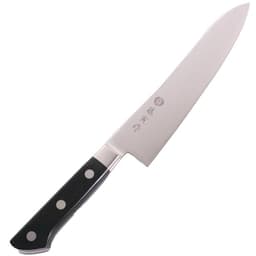
The default size, done well
Tojiro DP Gyuto 210 mm
The knife the internet has recommended to first-time gyuto buyers for a decade, and the numbers explain why: a real VG10 core at ~60 HRC for a fraction of the boutique price. Buy this before you spend three times as much.
See the full gyuto fieldPrice as of October 20, 2026. #ad How we’re funded
Frequently asked questions
What size chef knife should I buy?
An 8-inch (200-210 mm) blade, unless you have a specific reason not to. It is long enough to break down a cabbage or a chicken and short enough to control on an ordinary board, which is why it is the default size for both Western chef's knives and Japanese gyutos. Buy shorter only if your hands or your board are small; buy longer only if you routinely cut large volumes.
Is a 6-inch chef knife too small?
For most people, yes, as a main knife. Six inches cannot span a cabbage, struggles with a squash and needs several passes where an 8-inch does one. It is a good choice for cooks with small hands, small boards or limited wrist strength, and a good second knife — but as an only knife it will frustrate you within a month.
Is a 10-inch chef knife better?
Better for volume, worse for everything else. Ten inches gives more edge per stroke and more knuckle clearance, which is why professional kitchens use them. On a home board it overhangs, it is harder to control near the tip, and it feels intimidating to newer cooks — which in practice means it gets used less than the 8-inch it replaced.
What is the difference between 8 inch and 210 mm?
About 7 mm, and no practical difference. Western makers quote inches and mark their standard chef's knife as 8 inches (203 mm); Japanese makers work in millimeters and build the equivalent gyuto at 210 mm. Both are 'the normal size'. Do not choose between two knives on that gap.
Does hand size determine knife size?
Less than people assume. Handle shape and knife weight matter far more to comfort than blade length does, and plenty of small-handed cooks work happily with a 210 mm blade. Where hand size genuinely matters is grip: if you cannot get a secure pinch grip on the blade near the heel, the knife is wrong for you at any length.
What size santoku or nakiri should I buy?
Both usually come in 165-180 mm, and the logic is different from a chef's knife because these are often second knives. Take 165 mm if it joins an existing 200-210 mm chef's knife, since duplicating reach is pointless; take 178-180 mm if the santoku will be your main knife.
Sources
- Japanese kitchen knife — Wikipedia — Reference on gyuto/santoku/nakiri, single- vs double-bevel (kataba/ryoba) and edge angles (accessed July 21, 2026)
- Rockwell hardness test — Wikipedia — Definition of the Rockwell C (HRC) scale used to state knife-steel hardness (accessed July 21, 2026)
Per-knife specs (steel, HRC, blade length, geometry) are read from each maker’s spec sheet or product listing and dated on the individual review cards above. “Not published” means the manufacturer does not state that figure — we flag it rather than guess.
Keep reading
Best Chef Knives for Small Hands
The 150-170 mm band applied to one buyer, with published weights where they exist.
See the picksBest Chef Knives
The field at the standard size, ranked on specs.
See the picksGyuto Knife Guide
The Japanese equivalent, and why 210 mm is its default.
Read the guidePetty Knife Guide
The small knife that fills the gap under a chef's knife.
Read the guideJapanese Knife Buying Guide
Steel, hardness, geometry and budget in one place.
Read the guideSujihiki Knife Guide
Where a 240 mm slicer fits, and when 270 makes sense.
Read the guide