Your First Japanese Knife (and the Two After It)
One knife does almost all the work. The second doubles what the first is comfortable at. The third is optional, and it is the one most people buy too early.
How this is funded: we earn a commission if you buy through our links, at no extra cost to you. As an Amazon Associate we earn from qualifying purchases. It never changes which knife we recommend, and we’ll tell you when we’d skip one. Full disclosure.
Almost nobody buys their Japanese knives all at once, and the ones who do usually buy the wrong ones. The useful question is not “which knives should I own?” but “in what order?” — because each knife on this path only makes sense once the one before it is in the drawer, and buying out of order is how people end up with three blades that all do the same job.
The order is gyuto, then petty, then nakiri. A gyuto because it is the only shape that can be your whole kitchen on its own. A petty because the jobs a gyuto is bad at are small ones, and they are most of what you actually do on a weeknight. A nakiri last, and only if the way you cook justifies it.
| 1. Gyuto | 2. Petty | 3. Nakiri | |
|---|---|---|---|
| Typical length | 210 mm | 135-150 mm | 165-180 mm |
| What it adds | Everything on a board | Small and in-hand work | Full-contact vegetable chopping |
| Has a usable tip | Yes | Yes | No |
| Can be your only knife | Yes | No | No |
| Buy it when | Now | The gyuto annoys you on a shallot | You prep vegetables in volume |
| Spend the money here? | Yes — this is the knife | No — cheap is fine | Only if you will use it |
Stage 1: the gyuto, and why it has to be first
A gyuto is the Japanese version of the Western chef’s knife: a double-bevel, general-purpose blade with a pointed tip, ground flatter and thinner than a German knife and hardened further. Wikipedia’s reference on Japanese kitchen knives puts the common double-bevel grind at roughly 15° per side, against the 20° a Western knife is usually ground to — and that difference, more than the steel, is why a gyuto feels keener the first time you use one.
It goes first because it is the only shape on this page that does not need another knife to be useful. It slices, it dices, it minces herbs, it breaks down a cabbage, it portions a chicken breast, and the tip does the detail work. Every other Japanese shape is a specialist that assumes you already own this.
Buy 210 mm unless you have a specific reason not to. Drop to 180 mm for a small board or small hands; go to 240 mm only if you prep in volume on a large surface. The full argument, including the three cases where 210 mm is the wrong answer, is in the chef knife size guide.
What the money buys at each tier
The single filter that removes most of the junk is a named steel with a stated hardness. A listing that says only “high carbon stainless steel” is telling you it has nothing specific to claim. Here is what each tier looks like among the gyutos we track, with the figures each maker publishes:
| Entry | The sweet spot | Premium | |
|---|---|---|---|
| Example | Mitsumoto Sakari 8-inch | Tojiro DP 210 mm | Shun Classic 8-inch |
| Core steel | 9Cr18MoV | VG10 | VG-MAX |
| Hardness | Not published | ~60 HRC | 60-61 HRC |
| Construction | 3-layer San-Mai | 3-layer, stainless-clad | 34-layer Damascus cladding |
| What you gain | The shape, cheaply | A real, measurable edge | Finish, and a keener 16° grind |
| What you give up | Any hardness guarantee | The Damascus pattern | A lot of money for the pattern |
The middle column is where almost everyone should land, and it is not close. The Tojiro DP runs a VG10 core at about 60 HRC — the same hardness band Shun publishes for VG10 and VG-MAX in its own FAQ — without the Damascus jacket that carries most of the price difference. The premium tier is real, but what it buys is largely finish and a slightly more acute factory edge: Shun states 16° per side, and Zwilling publishes 9.5–12° for the Miyabi Kaizen II. Neither is a different category of knife.
The entry tier is a fair way to try the shape, with one honest caveat: the maker publishes no per-model Rockwell figure, so the hardness claim is marketing rather than a number you can hold anyone to. We print “Not published” rather than estimating it. All five gyutos, with live prices, are in best Japanese chef knives.
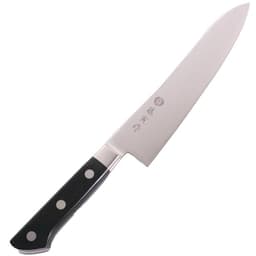
Stage 1 — the gyuto to start on
Tojiro DP Gyuto 210 mm
The knife the internet has recommended to first-time gyuto buyers for a decade, and the numbers explain why: a real VG10 core at ~60 HRC for a fraction of the boutique price. Buy this before you spend three times as much.
Read the full gyuto guidePrice as of October 20, 2026. #ad How we’re funded
Stage 2: the petty, and why it is the one you will use most
About a month into owning a good gyuto, a specific irritation shows up. The knife is superb on a board and genuinely clumsy on a shallot, a garlic clove, a lime or a strawberry. A 90 mm paring knife handles those and then runs out of blade halfway through a tomato. The petty — a scaled-down gyuto of roughly 135–150 mm, with the same pointed tip and thin grind — covers that middle, and in most kitchens it becomes the second-most-used knife in the house.
This is the stage where we would not push you toward hard steel, and the reason is arithmetic rather than snobbery. Edge retention matters in proportion to how many cuts you make between sharpenings, and a petty makes a handful at a time. A soft German utility knife at about 58 HRC stays sharp for perfectly long enough and costs a fraction of a VG10 petty.
The one argument for buying the hard one is consistency: if your gyuto is a VG10 knife ground at 15° per side, a matching petty means a single stone session covers both knives at one angle instead of two. If you own a Tojiro DP, buy the DP petty. If you own a Wüsthof, buy the Wüsthof. Sizes, steels and the trade-offs between the five we track are in the petty knife guide.
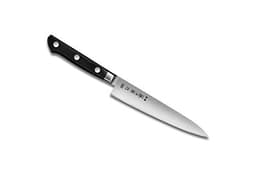
Stage 2 — the petty that matches the stage-1 gyuto
Tojiro DP Petty 150 mm (F-802)
The DP gyuto's little brother, and the petty we would buy. Same VG10 core, same stainless cladding, same ~60 HRC — shrunk to the size where a big knife stops being useful. If you already own a Tojiro gyuto, this is the knife that fills the gap under it.
Compare five pettysPrice as of October 20, 2026. #ad How we’re funded
Stage 3: the nakiri, which is optional and usually bought too early
A nakiri is a tall, flat, double-bevel vegetable knife with no tip at all. Its one real advantage is geometry: because the edge is dead straight, it meets the board along its entire length, so a chop goes all the way through instead of leaving the uncut hinge a curved blade leaves at the end of its arc. The height also makes the blade a usable scoop for moving prep off the board.
What you give up is the tip, and the tip is not a small thing. You cannot core a pepper with a nakiri, score fat, start a cut in the middle of something, or work around a joint. That is why it is third and why it is optional: it is a better vegetable knife than a gyuto and a much worse everything-else knife. If you prep vegetables in volume — a household that actually cooks from raw most nights — it earns its place. If you cook twice a week, it will sit in the block.
Two honest routes exist here. A soft-steel nakiri is the low-risk way to find out whether you like the shape before committing to a hard one; the premium Japanese nakiris are lovely and are also a lot of money for a knife that does one job. The field, from the budget end up, is in best nakiri knives, and the shape itself is argued in the nakiri guide.
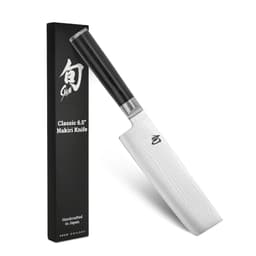
Stage 3 — if the shape has earned its place
Shun Classic 6.5-inch Nakiri (DM0728)
The nakiri most people end up buying, and a fair default: VG-MAX core, Damascus cladding, and a genuinely flat 165 mm edge that meets the board along its whole length. Buy it if you want one vegetable knife and you want it to be nice.
See all six nakirisPrice as of October 20, 2026. #ad How we’re funded
The knife that is not on this path
A serrated bread knife. It is not Japanese, it is not interesting, and every kitchen needs one — because the one job no thin, hard, straight edge does well is sawing through a crust or a waxy skin, and trying it is a reliable way to chip a gyuto. Buy a cheap one; the steel barely matters when the teeth are doing the work. It also cannot be sharpened on any of the stones on this site, which is its own small argument for not spending much: serrated edges need a tapered rod and a one-sided method.
With a gyuto, a petty and a bread knife, there is very little in a domestic kitchen you cannot do. Everything after that — nakiri, santoku, sujihiki, cleaver — is a specialist bought to solve a problem you have personally run into, which is a much better reason than a block having an empty slot.
The accessory that is not optional
Hard Japanese steel changes the maintenance story, and this catches people out. A soft German knife rolls its edge over as you cut, and a grooved honing rod straightens it back — ten seconds, no metal removed, and the knife feels new again. A 60 HRC Japanese edge barely rolls, so there is much less for a rod to straighten; when it finally stops biting, the edge has worn rather than bent, and the only fix is grinding a new one on a stone. A coarse steel rod can even micro-chip a hard, brittle edge.
In practice that means a 1000/6000 combination whetstone belongs in the same order as the gyuto, not a year later. One block, both stages: the 1000 face cuts a fresh apex and raises a burr, the 6000 face refines it. If you want the distinction spelled out before you spend anything, read sharpening vs honing; if you are ready to choose a stone, the pairings are compared in best combination whetstones, and the technique itself is in how to sharpen a knife on a whetstone.
Five wrong turns on this path
- Buying a block set instead of stage 1. A fifteen-slot block spreads one budget across a dozen blades you will not use. Three bought separately beat all fifteen, and we set out why in best chef knife sets.
- Buying a gyuto and a santoku. They are the same knife at different lengths with the same grip and the same cutting style, so the second one adds almost nothing. Pick one; the head-to-head decides which.
- Starting with the nakiri because it looks Japanese. It is the most photogenic shape and the least capable one, and it cannot be your only knife.
- Buying carbon steel first. White #2 takes a keener edge and rusts in minutes if left wet. It is a great third knife and a punishing first one; the trade is laid out in carbon vs stainless.
- Paying for the pattern. Damascus cladding is a decorative jacket around the core that actually does the cutting. Buying the same core without the jacket is the single biggest saving available on this path — see Damascus steel explained.
The short version
Buy a 210 mm gyuto with a named steel and a published hardness, and a 1000/6000 combination stone at the same time. Add a 135–150 mm petty when the big knife starts annoying you on small work, and match its steel to the gyuto if you can. Add a nakiri only after you have noticed yourself wanting one. Everything else on this site is detail underneath those three decisions — and the detail on choosing inside a single knife, rather than between them, is in the Japanese knife buying guide.
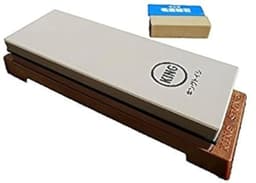
The stone that keeps all three knives working
King (Matsunaga) KW-65 1000/6000 Combination Whetstone
The stone that has taught more people to sharpen than any other. One side 1000-grit to set an edge, one side 6000-grit to polish it, made in Japan, for the price of a takeout dinner. Start here.
Compare five combination stonesFrequently asked questions
What should my first Japanese knife be?
A 210 mm double-bevel gyuto in a named stainless steel. It is the Japanese chef's knife — the only shape here that can do every board job on its own, which is what a first knife has to do. Buy the shape before you buy the upgrade: a plain three-layer gyuto with a stated steel and hardness cuts as well as a Damascus one with the same core.
What knives do I actually need in a Japanese set?
Two, plus one that is not Japanese. A gyuto for everything on a board, a 135-150 mm petty for the small work a gyuto is clumsy at, and a serrated bread knife for crusts and skins. A nakiri is a fourth knife and a genuine luxury; a santoku overlaps the gyuto so heavily that owning both is usually a mistake.
Should I buy a gyuto or a santoku first?
A gyuto, unless your board is small or you find a 210 mm blade unwieldy. A santoku is shorter, flatter and blunt-tipped, which makes it nimble but leaves you without reach or a proper point — and the point is what lets one knife cover everything. Buy the santoku as a second knife if you liked the shape, not as a first one.
Do I need a nakiri if I already have a gyuto?
No. A nakiri does one thing better than a gyuto — its dead-flat edge meets the board along its whole length, so a chop never leaves an uncut hinge — and it gives up the tip entirely in exchange. If you prep large volumes of vegetables it is a real upgrade. If you cook two or three nights a week it will sit in the block.
How much should the whole path cost?
Less than most people assume, because only the gyuto has to be good. The prices on this site are pulled live and dated, so use the buy buttons rather than any figure quoted in an article — but the shape of it is that a named-steel gyuto plus a soft-steel petty plus a 1000/6000 combination stone costs less than one premium Damascus knife, and cuts better than that knife will after six months without a stone.
What should I buy alongside the knives?
A 1000/6000 combination whetstone and a wooden or soft-plastic board, in that order. Hard Japanese steel holds an edge for a long time but cannot be brought back on a grooved honing rod the way a soft German knife can — sooner or later it needs a stone. A knife you cannot sharpen is a knife on a timer.
Is a knife block set a shortcut to this?
It is the opposite. A block spreads one budget across a dozen blades, most of which you will not use, so every individual knife is worse than the one you would have bought on its own. Buying the gyuto now and the petty in six months gets you materially better steel for the same money.
Sources
- Japanese kitchen knife — Wikipedia — Reference on gyuto/santoku/nakiri, single- vs double-bevel (kataba/ryoba) and edge angles (accessed July 21, 2026)
- Rockwell hardness test — Wikipedia — Definition of the Rockwell C (HRC) scale used to state knife-steel hardness (accessed July 21, 2026)
- Shun Knives FAQ — Shun Cutlery (Kai USA) — Shun's own answers: 'Shun hardens VG10 and VG-Max steel to 60-61 Rockwell and SG2 to 61-62', 'Shun knives, for example, are sharpened to a 16 degree angle on each side of the blade', and on rods, 'Please do not use a diamond steel for regular honing. Diamond steels are for sharpening and will remove metal from your knife before it is necessary' (accessed August 28, 2026)
- MIYABI Kaizen II 5000FCD 8-inch Chef's Knife — ZWILLING — Zwilling's published spec for the line: an 'FC61' core with fine carbide distribution at '60-62 HRC', '48 layers of stainless steel' Damascus over the core (49 total), an edge 'hand-honed using the historic Honbazuke method to an exceptionally sharp 9.5 to 12 degrees', a 'double ice-hardened FRIODUR' blade, a 'thicker and rounded bolster for increased comfort and balance', a black Pakkawood D-shaped handle, a 7.87 in blade at 0.44 lbs, handcrafted in Seki, Japan (accessed August 28, 2026)
Per-knife specs (steel, HRC, blade length, geometry) are read from each maker’s spec sheet or product listing and dated on the individual review cards above. “Not published” means the manufacturer does not state that figure — we flag it rather than guess.
Keep reading
Gyuto Knife Guide
Stage one in depth: profile, steel, sizing and our picks by budget.
Read the gyuto guidePetty Knife Guide
Stage two in depth, including which of the sizes is genuinely different.
Read the petty guideNakiri Knife Guide
Stage three, and an honest account of the tip you give up.
Read the nakiri guideBest Japanese Chef Knives
Five gyutos compared on steel, hardness and geometry, with live prices.
See the gyutosBest Petty & Utility Knives
Five small knives compared on length, steel and grind.
See the pettysBest Nakiri Knives
Six vegetable knives from the budget end to the Damascus end.
See the nakirisJapanese Knife Buying Guide
The other half of the decision: what to optimize for inside one knife.
Read the buying guideBest Combination Whetstones
The one accessory this path actually requires, compared five ways.
See the stones