How Much Should a Chef Knife Cost?
Four price tiers, and the specific thing each one buys. Two of the steps are large and worth taking; one of them buys almost nothing you can feel.
How this is funded: we earn a commission if you buy through our links, at no extra cost to you. As an Amazon Associate we earn from qualifying purchases. It never changes which knife we recommend, and we’ll tell you when we’d skip one. Full disclosure.
“How much should I spend” is really two questions stacked on top of each other: what does each price tier physically contain, and at what point does paying more stop changing the cut? Both have answers, and the second one is more interesting than the knife industry would like.
Prices move, so this page deals in tiers rather than exact figures. Live prices sit on the individual picks below and on every roundup.
Under $50 — geometry, without hardness
At this price a maker has to choose what to spend on, and the good ones spend it on blade shape. What you get is a stamped blade — cut from a sheet of steel rather than forged from a billet — in a soft stainless, typically around 55 to 56 HRC, on a molded synthetic handle. Wüsthof itself publishes 55-57 HRC for its laser-cut line against 58 for its forged one, so the softness is a construction consequence rather than a mystery.
What that buys: a light, agile knife that is easy to sharpen, cheap to replace, and completely uninteresting to steal. What it costs: edge retention. A 55 HRC edge rolls under normal board work, which is exactly why a honing rod belongs in every kitchen at this tier. The knives here are not compromises so much as a different bargain — do a little maintenance, spend almost nothing.
$50-$100 — forging, and the first published numbers
This is where fully forged Western knives start: a single billet, hot-worked, with a bolster and a full tang, at around 58 HRC. Wüsthof describes over fifty-four manufacturing steps for a forged blade against thirty-five for a laser-cut one, which is a fair summary of where the extra money goes.
The knife gains weight and heft, holds its edge meaningfully longer than the tier below, and — more importantly for how we buy — the maker starts publishing a steel grade and a hardness figure. That transparency is itself worth paying for. A knife whose maker states X50CrMoV15 at 58 HRC is a knife whose behavior you can predict; a knife that states “high-carbon German steel” is a knife whose maker is telling you nothing.
$100-$200 — the jump that actually matters
Here is the step worth taking. This is where Japanese stainless cores arrive: VG10 at about 60 HRC, VG-MAX at 60-61, FC61 at 60. Because the steel is hard enough not to roll, it can be ground far thinner and taken to 15° per side or less instead of the Western 20°.
The result is the single largest perceptible change in this entire price ladder. A thin, hard, acute edge does not feel like a sharper version of a German knife — it feels like a different tool, falling through a tomato skin instead of pressing into it. That is the change people are describing when they say a Japanese knife “ruined them” for their old one, and it costs less than most people assume: a plain-clad VG10 gyuto sits comfortably inside this tier.
The trade comes with it. A hard edge chips rather than rolls, a steel rod is off the menu in favor of a ceramic rod or a strop, and you now genuinely want a combination whetstone. Budget for the stone as part of the knife.
$200 and up — where the money stops buying cutting
Past roughly $200 the specifications stop moving and the finish takes over. Damascus cladding, hand-finished spines and choils, pakkawood or ebony handles, hand-honed edges, and the name on the blade. Compare a plain-clad VG10 knife with a Damascus VG-MAX one: near-identical core hardness, a factory edge two degrees apart, and a price gap that could buy a second knife and the stones to maintain both.
The exception is powder steels — SG2 and R2 at 63-64 HRC — which do deliver conspicuously longer edge retention and are a real, if narrow, reason to spend. And the honest caveat to all of this: finish is not fraud. A beautifully made object you enjoy picking up is a legitimate thing to buy, and cooks who love their knife use it more. Just know which of the two things you are paying for. The pattern in particular is more decorative than most listings imply, as Damascus steel explained sets out.
The total cost nobody quotes
A chef’s knife is not the only line on the invoice, and the accessories are where a budget quietly fails. A hard Japanese knife wants a whetstone; a soft Western one wants a honing rod. Either wants a wooden or soft-plastic board, because a glass or stone board will undo any amount of money spent on steel. Sending knives out to be sharpened instead is a real option with real, published prices — laid out in is professional knife sharpening worth it — and after two or three years it usually costs more than the stone would have.
The short version
- Spend $30-$50 if you are equipping a first kitchen, a rental or a second home, or if you know you will not maintain anything. Buy a rod with it.
- Spend $60-$100 if you want one forged Western knife to last decades and you like a heavier blade.
- Spend $100-$200 if you want the actual upgrade in how the knife cuts, and you are willing to own a stone.
- Spend more than $200 because you want a specific beautiful object, or because you are buying powder steel deliberately. Not because you expect it to cut better than the tier below.
And regardless of tier: a sharp cheap knife beats a dull expensive one every single time. If your budget forces a choice between a better knife and the means to keep one sharp, buy the means.
Price and value are different questions, and this page only answers the first one. If what you want to know is where each extra dollar stops buying anything you can feel, best chef knives for the money ranks the registry on published steel and hardness per dollar, shape by shape.
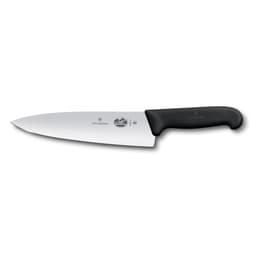
The under-$50 tier
Victorinox Fibrox Pro 8-inch Chef's Knife
The knife that wins nearly every budget test, and the one to buy if you buy only one. A soft, stamped X50CrMoV15 blade at ~55-56 HRC and a grippy, non-slip handle — it dulls sooner than a hard Japanese knife but takes an edge back in seconds.
See the whole budget fieldPrice as of October 19, 2026. #ad How we’re funded
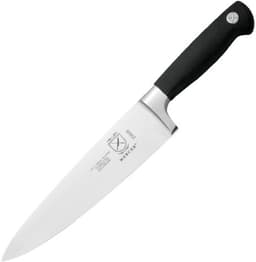
The under-$100 tier
Mercer Culinary Genesis 8-inch Chef's Knife
A fully forged German-steel knife at a stamped-knife price. It is the culinary-school standby for a reason — you get bolster, full tang and a grippy Santoprene handle for around the cost of a decent stamped blade.
See the under-$100 roundupPrice as of October 19, 2026. #ad How we’re funded
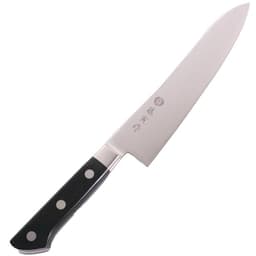
The under-$200 tier
Tojiro DP Gyuto 210 mm
The knife the internet has recommended to first-time gyuto buyers for a decade, and the numbers explain why: a real VG10 core at ~60 HRC for a fraction of the boutique price. Buy this before you spend three times as much.
See the upgrade tierPrice as of October 19, 2026. #ad How we’re funded
Frequently asked questions
How much should you spend on a chef's knife?
Most home cooks are best served somewhere between about $40 and $150. Under $40 you can still buy a genuinely good knife — a Victorinox Fibrox is proof — but you are buying soft steel and a stamped blade. Above about $150 the improvements become finish, cladding and brand rather than cutting performance. The single biggest jump in what you can feel happens around the $60-$100 mark, where published steel grades and 60 HRC hardness appear.
Are expensive chef knives worth it?
Up to a point, and the point is lower than the shelf suggests. Paying more buys harder, better-documented steel and a thinner grind up to roughly $150. Past that you are mostly paying for Damascus cladding, pakkawood, hand finishing and a name — all real things, none of which cuts an onion better. Whether they are worth it is a legitimate question about how much you enjoy the object.
Is a $30 chef knife any good?
It can be excellent. The Victorinox Fibrox costs about as little as a serious knife can and repeatedly beats far more expensive knives in professional test kitchens, because at that price a maker can afford good geometry if it skips forging and decoration. What $30 cannot buy is hard steel: expect around 55-56 HRC, which means it dulls sooner and needs a honing rod.
Why are Japanese knives more expensive?
Harder steel, thinner grinding and more finishing steps. A hard core has to be clad in softer stainless, ground thin without overheating it, and often hand-honed to a 15° or finer edge — all slower and more failure-prone than stamping a softer blade. Some of the premium is also cladding pattern and handle material, which is why a plain-clad Japanese knife costs a fraction of a Damascus one with the same cutting core.
Does a more expensive knife stay sharp longer?
Usually, but the cause is hardness, not price. A knife at ~60 HRC will hold an edge several times longer than one at ~56 HRC, and hardness broadly rises with price up to about $150. Above that, price rises without hardness following, so the edge-retention benefit flattens out while the invoice does not.
Should I buy one good knife or a set?
One good knife, then a small second one. A block set spends your budget on knives you will not use — most 15-piece sets contain a dozen pieces that never leave the block — and the per-knife quality drops accordingly. Two well-chosen knives at $80 each will outperform a $160 set of fifteen every time.
Sources
- The Difference Between WÜSTHOF Forged and Stamped Kitchen Knives — WÜSTHOF — Wüsthof's own account of both processes: forged blades start as a single piece of steel heated to over 2000°F and take 'over fifty-four manufacturing steps', hardened to '58 Rockwell'; non-forged blades are 'cut from a high-quality steel sheet using a precision laser' in 'thirty-five manufacturing steps' and run 'between 55 and 57 Rockwell' (accessed August 18, 2026)
- Rockwell hardness test — Wikipedia — Definition of the Rockwell C (HRC) scale used to state knife-steel hardness (accessed July 21, 2026)
- Enso Knives — Japanese Crafted HD, Hizashi, SG2, Hachi (Cutlery and More) — Published Enso HD line spec: 'VG10 stainless steel core. 61 Rockwell.', '37-layer Damascus with a hammered tsuchime finish', a triple-riveted canvas micarta handle, made in Seki, Japan (accessed August 18, 2026)
Per-knife specs (steel, HRC, blade length, geometry) are read from each maker’s spec sheet or product listing and dated on the individual review cards above. “Not published” means the manufacturer does not state that figure — we flag it rather than guess.
Keep reading
Best Chef Knives for the Money
One knife per shape at the price where the spec sheet stops improving.
See the value picksBest Chef Knives Under $100
The tier where published steel grades start appearing.
See the under-$100 picksBest Chef Knives Under $200
Where an extra hundred buys harder steel — and where it buys a pattern.
See the upgrade tierBest Chef Knives Under $50
Six blades under $50, two of them fully forged.
See the budget picksKnife Hardness Chart (HRC)
The number that actually tracks price, band by band.
Read the hardness chart