Left-Handed Japanese Knives
Three separate things get called 'right-handed' on a Japanese knife, and only two of them will actually bother you. Here is which is which, and what to buy.
How this is funded: we earn a commission if you buy through our links, at no extra cost to you. As an Amazon Associate we earn from qualifying purchases. It never changes which knife we recommend, and we’ll tell you when we’d skip one. Full disclosure.
Left-handed cooks get told two contradictory things about Japanese knives: that they are all right-handed and unusable, and that handedness is a myth invented to sell more knives. Neither is true. Three genuinely different features get lumped together under “right-handed,” they matter to wildly different degrees, and only one of them should change what you buy.
1. The D-handle — real, and mildly annoying
A traditional Japanese handle is a wa handle: octagonal or oval in section, symmetrical, and completely ambidextrous. What gets called a D-handle is a Western adaptation — Shun’s Classic line and Miyabi’s Kaizen II both use one — where the cross-section is rounded on one side and flatter on the other so it beds into a right palm.
In a left hand, the flat runs along your fingers rather than your palm. It is less comfortable. It is not unusable, and how much it bothers you depends entirely on how you hold a knife. If you use a pinch grip — thumb and forefinger on the blade, remaining fingers wrapped loosely — the shaped part of the handle is barely loaded and many left-handers report never noticing. If you hold the handle in a full fist, you will notice on the first onion.
Shun does make left-handed Classic knives, sold as separate products rather than as an option. If you go that route, buy from an authorized dealer: Shun’s own counterfeit guidance is that warranty service is tied to authorized purchase, and the specialist channels are covered in where to buy a Japanese chef knife.
2. The single bevel — real, and genuinely disqualifying
A single-bevel knife (kataba) is ground on one face only; the other face is flat, with a shallow hollow called the urasuki behind a narrow flat rim. Yanagiba, usuba and deba are the classic examples. That geometry does something specific and useful: the bevel acts like a wedge that steers the blade and lets you take an extraordinarily thin, clean slice.
Put a right-handed single bevel in a left hand and the wedge pushes the wrong way. The knife steers into your cut instead of away from it, the slice wanders, and nothing about your technique will fix it, because the problem is the shape of the blade rather than the way you are holding it. Left-handed single bevels exist, cost more, and are usually a special order.
For almost every home cook this is an easy decision: do not buy a single bevel. They are specialist tools for specific tasks, they are the hardest kitchen knives to sharpen — about 90% of the work goes on one face and the flat back must stay flat — and a left-hander pays a premium for the privilege. A double-bevel gyuto does 95% of what a home kitchen actually asks for.
3. The asymmetric grind — real, and almost never a problem
Some Japanese double-bevel knives are ground with an uneven split — more of the total angle on the right face than the left. The intent is to borrow a little of the single bevel’s steering and food-release behavior without any of its drawbacks. In a left hand the effect reverses, so the knife nudges the other way.
In practice this is the least consequential of the three by a wide margin. The asymmetry is small, most cooks cannot feel it, and it is not permanent: the first time you sharpen the knife evenly on a stone at 15° per side, it is gone. If you are a left-hander who sharpens, the asymmetric grind is something you fix by accident on your first pass.
What to actually buy
A Western-handled, double-bevel Japanese knife, and stop thinking about it. That covers most of the Japanese knives worth owning and every one of them is symmetrical in the ways that count. Our best Japanese chef knives roundup is largely made of them.
Two specific notes for left-handers going through that list. The Tojiro DP line — gyuto, santoku, petty, slicer — uses a plain symmetrical Western handle across the range, so you can build a whole set without thinking about handedness. The MAC Chef Series does the same with pakkawood. Where you have to pay attention is the Shun Classic and the Miyabi Kaizen II, both of which are excellent knives on a D-handle.
Everything else in the kitchen
The rest of the handedness question is smaller than people expect. Whetstones are ambidextrous— you sharpen both sides of a double-bevel knife anyway, so a left-hander simply mirrors the standard technique in how to sharpen a knife on a whetstone. Honing rods are ambidextrous, though the vertical tip-down method is the one worth learning in either hand. Granton dimples— the oval scallops on a hollow-edge blade — are cut on both faces and do nothing handed.
The one thing genuinely worth changing is your board position. Most cutting-board advice assumes a right-hander sweeping prep to the right; mirror it, and put your scrap bowl on the side your knife hand is not crossing. That single change fixes more left-handed prep frustration than any knife purchase.
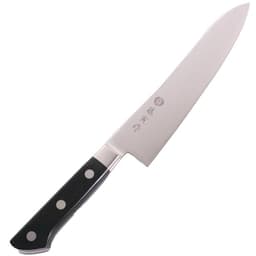
Symmetrical, and the best value on this site
Tojiro DP Gyuto 210 mm
The knife the internet has recommended to first-time gyuto buyers for a decade, and the numbers explain why: a real VG10 core at ~60 HRC for a fraction of the boutique price. Buy this before you spend three times as much.
Read the full reviewPrice as of October 19, 2026. #ad How we’re funded
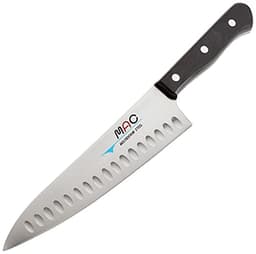
Symmetrical pakkawood, lighter in the hand
MAC Chef Series Hollow-Edge 8-inch
MAC's thin, light molybdenum blade is the one professional cooks quietly reach for — less flashy than a Damascus Shun, but famously nimble. The hollow-edge dimples reduce sticking on wet produce.
Read the MAC reviewPrice as of October 19, 2026. #ad How we’re funded
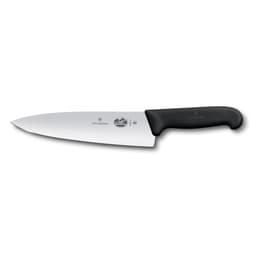
Symmetrical and cheap enough to test the question
Victorinox Fibrox Pro 8-inch Chef's Knife
The knife that wins nearly every budget test, and the one to buy if you buy only one. A soft, stamped X50CrMoV15 blade at ~55-56 HRC and a grippy, non-slip handle — it dulls sooner than a hard Japanese knife but takes an edge back in seconds.
Read the Victorinox reviewPrice as of October 19, 2026. #ad How we’re funded
Frequently asked questions
Are Japanese knives right-handed?
Some are. Three features can be handed: a D-shaped handle, which is contoured to fill a right palm; a single bevel, which is ground on one face only and is genuinely unusable in the other hand; and an asymmetric double-bevel grind, which is subtler and rarely a problem in practice. A Western-handled, double-bevel Japanese knife — which describes most of what is sold — is not handed at all.
Can a left-handed person use a D-handle knife?
Yes, and plenty do. A D-handle in the wrong hand puts the flat of the D against your fingers instead of your palm, which is less comfortable rather than unusable. If you hold a pinch grip on the blade — which is the grip most Japanese knives are designed around — your hand barely touches the shaped part anyway. Try one before assuming it is a problem.
Do I need a left-handed single-bevel knife?
If you want a single-bevel knife at all, yes — a right-handed yanagiba or usuba in a left hand steers into the cut rather than through it, and no amount of technique fixes it. Left-handed single bevels are made, cost more, and usually have to be ordered rather than picked off a shelf. For most home cooks the honest answer is to buy a double-bevel knife and skip the problem entirely.
Does Shun make left-handed knives?
Shun makes left-handed versions of some Classic-line knives as separate products, because the D-shaped pakkawood handle is genuinely contoured. They are ordered as their own item rather than as an option on the standard knife, so check the listing carefully — and buy from an authorized dealer, since Shun's own guidance is that warranty service depends on it.
What is an asymmetric bevel?
A double-bevel knife ground with more of the edge angle on one face than the other — say 70% on the right side and 30% on the left. It is a traditional Japanese refinement that makes the knife steer slightly and release food slightly better for a right-hander. In a left hand the effect reverses, but it is small enough that most people never notice it, and it disappears the first time you sharpen the knife evenly yourself.
What is the best chef's knife for a left-handed cook?
A Western-handled, double-bevel gyuto or chef's knife — the handle is symmetrical, the bevel is even, and there is nothing to accommodate. A Tojiro DP gyuto, a MAC Chef Series or a Victorinox Fibrox are all completely ambidextrous, and the last of those is also the cheapest good knife on this site.
Sources
- Japanese kitchen knife — Wikipedia — Reference on gyuto/santoku/nakiri, single- vs double-bevel (kataba/ryoba) and edge angles (accessed July 21, 2026)
- How to Sharpen Single Bevel Knives with Whetstones — Knifewear — Specialist walkthrough naming the parts — kireha ('the flat part from the Shinogi line to the edge'), uraoshi ('the small flat parts on the back (<2mm)'), urasuki ('the concave part on the back') and koba ('micro bevel') — with the warning that 'if you sharpen the Uraoshi too much, you shorten the life of the knife by removing too much of the steel that forms the edge' (accessed August 18, 2026)
- How to Spot a Fake Shun Knife — Shun Cutlery — Shun's own statement that no single visual feature confirms authenticity, that not all sellers on a trusted marketplace are authorized, and that only knives bought from an authorized dealer are eligible for warranty service (accessed August 13, 2026)
Per-knife specs (steel, HRC, blade length, geometry) are read from each maker’s spec sheet or product listing and dated on the individual review cards above. “Not published” means the manufacturer does not state that figure — we flag it rather than guess.
Keep reading
Knife Handle Materials
D-shape, octagonal, Western and Fibrox compared on grip and shape.
Compare handlesHow to Sharpen a Single-Bevel Knife
Why the handedness of a single bevel is a sharpening problem too.
Read the techniqueGyuto Knife Guide
The double-bevel Japanese chef's knife, in full.
Read the gyuto guideJapanese Knife Buying Guide
The whole buying process, handedness included.
Start here