Bunka Knife Guide
A santoku that grew a point. The bunka takes the flat Japanese profile and gives it back the tip a santoku gave up — at the cost of the most fragile corner in the drawer.
How this is funded: we earn a commission if you buy through our links, at no extra cost to you. As an Amazon Associate we earn from qualifying purchases. It never changes which knife we recommend, and we’ll tell you when we’d skip one. Full disclosure.
The bunka is the knife people buy after they have used a santoku for a year and got tired of not having a tip. It keeps everything the santoku is good at — the flat edge, the tall blade, the short and controllable length — and replaces the rounded sheepsfoot nose with a hard angular corner that can actually do fine work.
The name means something like “culture” and it was, historically, a home-kitchen general-purpose knife in Japan in the same way the santoku was. It has had a substantial revival outside Japan in the last decade, largely on looks: a bunka photographs extremely well. That is a slightly embarrassing origin story for a shape that turns out to be genuinely useful.
The shape, and what it is for
A bunka is typically 165-180 mm long and tall in the blade — usually 45 mm or more at the heel. The edge is flat or very nearly flat for most of its length, then the spine runs dead straight until it drops on a sharp angle to meet the edge at the front. That angled drop is the reverse-tanto, or k-tip.
Everything follows from those two features. The flat edge means the whole blade meets the board at once on a downward push, so a slice separates completely instead of hanging on by an uncut hinge — the same virtue that makes a nakiri so fast on a cabbage. The tall blade gives knuckle clearance for a proper claw grip and a big enough face to carry chopped prep to the pan in one lift.
And the k-tip gives you back what the flat blade normally costs you. A nakiri has no point at all and a santoku has a rounded one; a bunka’s corner is sharp, thin and precise. Coring a pepper, scoring skin, splitting a shallot lengthwise, opening a packet, starting a cut in the middle of a large squash — all the quiet daily work that stops dead without a point.
Bunka against santoku, gyuto and nakiri
Against a santoku: same length, same height, same flat edge, better tip, more fragile tip. If you already know you like a santoku and you have wished for a point, the bunka is that knife. If you have never wished for a point, the santoku is the tougher tool.
Against a gyuto: the gyuto is longer (200-240 mm), has a curved belly you can rock through herbs, and carries a strong tapered tip that survives abuse. The bunka is shorter, flatter and more precise, and cannot rock-cut at all. Most kitchens should own the gyuto first — the case for it is in our gyuto guide — and add the bunka as the knife they reach for on a vegetable-heavy day.
Against a nakiri: the nakiri is flatter still and taller, and is the better pure vegetable knife by a small margin. The bunka is far more versatile because it has a point. If you were choosing between them as a second knife, the question is whether you want a specialist or a generalist.
The tip is the catch
We are going to be blunt about this, because listings never are. The reverse-tanto corner is a thin wedge of very hard steel with no supporting mass behind it, on knives that typically run 60-61 HRC. Hard steel does not bend; it breaks. Levering a stuck blade out of a squash, prying anything at all, or dropping the knife tip-first onto a tiled floor will take a piece out of that corner, and it is the single most common bunka complaint.
This is not a reason to avoid the shape. It is a reason to use the tip for cutting and never for force. A chipped k-tip is repairable on a coarse stone — the process is the same as any chip repair — but grinding the corner back changes the profile, and enough repairs will turn your bunka into an expensive santoku.
Steel and hardness
Bunkas are a Japanese-maker shape, so they arrive with Japanese-maker steel. Enso’s HD line publishes a VG10 core at 61 HRC under 37 hammered Damascus layers; Miyabi’s Kaizen II uses FC61 at about 60 HRC with a hand-honed 9.5-12° per side edge. Both sit squarely in the hard-stainless band, which is what allows the thin grind that makes the shape feel keen.
Practically, that means a bunka is maintained like any hard Japanese knife: a ceramic rod or a strop between sharpenings, never a steel rod, and a 1000/6000 stone when it needs real work. The flat edge is a bonus here — it is conspicuously easier to sharpen than a curved gyuto because you never have to sweep through a belly. Hold the angle and go straight.
Should you buy one?
Buy a bunka if you already own a chef’s knife you like, you have found yourself preferring flat blades and push cuts, and you want a shorter, more precise knife for the days that are mostly vegetables. It is one of the more genuinely useful “second Japanese knife” purchases, and it is a far better all-rounder than the nakiri it is often shelved next to.
Do not buy a bunka as your only knife. It is short, it cannot rock-cut, and its tip is not built to be treated like a workhorse. If you want one knife that does everything, the answer is still a 210 mm gyuto or a Western chef’s knife — our best Japanese chef knives roundup covers that field, and how much a chef knife should cost covers what to spend on it. And if the knife you are really weighing this against is a santoku — the shape it shares a size class with — bunka vs santoku is the head-to-head, including the budget argument that usually settles it.
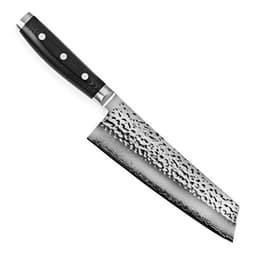
Our pick for a first bunka
Enso HD 7-inch Bunka
The bunka that actually publishes its numbers: a VG10 core at 61 HRC under 37 hammered Damascus layers, made in Seki. The reverse-tanto tip is the whole point of the shape, and this is the cheapest way to own one from a maker that states the hardness.
Read the VG10 steel guidePrice as of October 20, 2026. #ad How we’re funded
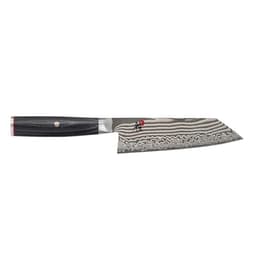
If you want the boutique version
Miyabi Kaizen II 6.5-inch Bunka
The same FC61 core, 48-layer Damascus and hand-honed edge as the Kaizen II chef's knife, in the shorter bunka shape. If you already wanted a Kaizen II and prefer a flat edge with a tall tip, this is the one to buy.
Read our Miyabi Kaizen II reviewPrice as of October 20, 2026. #ad How we’re funded
Frequently asked questions
What is a bunka knife used for?
General kitchen work, with a bias toward vegetables and precision. The flat edge push-cuts cleanly across its whole length, the tall blade gives knuckle clearance and scoops prep, and the angular reverse-tanto tip handles the fine work a santoku struggles with — scoring, coring, splitting a shallot, starting a cut mid-vegetable.
What is the difference between a bunka and a santoku?
The tip. Both are flat-edged Japanese knives around 165-180 mm with similar blade height, and the edges do the same job. A santoku's spine curves gently down to a rounded sheepsfoot point; a bunka's spine runs straight then drops on an angle to a sharp reverse-tanto corner. That corner is a much more capable point, and much easier to chip.
Is a bunka better than a gyuto?
Not better, shorter and flatter. A gyuto at 210 mm has more reach, more belly for rock-cutting and a stronger tip; a bunka at 165-180 mm is more nimble, cuts more cleanly on a flat push, and is easier to store and control in a small kitchen. If you can only own one knife, own the gyuto. The bunka is a very good second one.
What is a reverse tanto tip?
A tip formed by a straight spine that drops abruptly on an angle to meet the edge, producing a sharp forward corner rather than a curved point. It is called reverse tanto because the angle runs the opposite way to a tanto blade. It gives you a genuine, usable point for fine work — and because that point is a thin corner of hard steel, it is the first thing to break if you lever with it.
What size bunka should I buy?
165 mm if it joins an existing chef's knife or gyuto, 180 mm if it will be a main knife. Bunkas are not made in the long lengths a gyuto is, so a bunka is inherently a shorter knife; if you want 210 mm of blade, you want a gyuto with a k-tip rather than a bunka.
Is a bunka good for beginners?
It is a good second knife rather than a good first one. The flat edge is very easy to sharpen and forgiving on a stone, which is a genuine beginner virtue, but the tip is fragile and the shape rewards a push-cutting technique a new cook may not have yet. Learn on a gyuto or a Western chef's knife, then buy a bunka when you know you like flat blades.
Sources
- Japanese kitchen knife — Wikipedia — Reference on gyuto/santoku/nakiri, single- vs double-bevel (kataba/ryoba) and edge angles (accessed July 21, 2026)
- Enso Knives — Japanese Crafted HD, Hizashi, SG2, Hachi (Cutlery and More) — Published Enso HD line spec: 'VG10 stainless steel core. 61 Rockwell.', '37-layer Damascus with a hammered tsuchime finish', a triple-riveted canvas micarta handle, made in Seki, Japan (accessed August 18, 2026)
- Rockwell hardness test — Wikipedia — Definition of the Rockwell C (HRC) scale used to state knife-steel hardness (accessed July 21, 2026)
Per-knife specs (steel, HRC, blade length, geometry) are read from each maker’s spec sheet or product listing and dated on the individual review cards above. “Not published” means the manufacturer does not state that figure — we flag it rather than guess.
Keep reading
Enso HD 7-Piece Block Set Review
The same VG10 HD line as the Enso bunka, in a complete five-knife set.
Read the reviewSantoku Knife Guide
The flat Japanese knife the bunka is a variation on.
Read the santoku guideKiritsuke Knife Guide
The other k-tip shape, and the one with the complicated history.
Read the kiritsuke guideChef Knife Types Explained
Every shape on this site in one scannable reference.
See all the shapesKnife Hardness Chart (HRC)
Why a hard, thin k-tip chips instead of bending.
Read the hardness chart