Divide the price by the number of knives
This is the only arithmetic that matters on this page, and it reframes the whole category. A set under $200 containing two knives is spending about a hundred dollars a blade. A set under $200 containing eight knives, shears, a rod and a block is spending perhaps fifteen dollars a blade — and at fifteen dollars a blade, stamped steel in a soft alloy is not a cost-cutting decision, it is the only thing physically available.
Neither answer is wrong. They are answers to different questions. If the question is “what will cut best for the longest,” buy fewer, better knives. If the question is “how do I fill a kitchen for someone moving into their first apartment,” a full block is a perfectly reasonable thing to want and pretending otherwise is just snobbery. What we will not do is tell you the 15-piece block cuts as well as the two-piece Japanese set. It does not, and the arithmetic above is why.
Forged or stamped, and why it shows up at this price
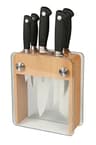
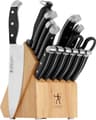
Forged blades start as a billet that is heated and pressed into shape; they are heavier, usually have a full tang and often a bolster. Stamped blades are punched out of rolled sheet and ground — lighter, cheaper and how most 15-slot blocks reach their price. The Mercer Genesis set here is forged German stainless; the two 15-piece blocks are stamped. Our forged vs stamped comparison goes into what that does and does not change.
A note on the Mercer, because it is a genuinely unusual item: it is a forged set at close to a stamped set’s price, and the trade is that neither the set listing nor Mercer’s own chef-knife listing publishes a Rockwell figure. Our registry entry for it says “Not published” rather than inventing one. What Mercer does publish is the steel — high-carbon German stainless — the forged construction, the full tang and the Santoprene handles, and the set contains an 8-inch wavy-edge bread knife, which is the one blade a two-piece set cannot give you.
What is actually in each box
Tojiro DP 2-piece (F-SET-2).A 210 mm chef’s knife and a 100 mm paring knife, both a VG10 core clad in 13-chrome stainless. No block, no rod, no shears, no sheaths. Tojiro publishes no Rockwell figure on its own site — the 60 HRC comes from the listing, and a specialist retailer states 60 ±1 for the same DP line — and Tojiro’s site documents a 90 mm paring knife in this line but not the 100 mm in this set, so the smaller knife is described by the listing rather than the maker. Covered in full in our Tojiro roundup.
Mercer Genesis 6-piece. Forged knives plus a wood-and-glass block. Six pieces, including the bread knife; no shears. The full review walks the contents and the missing hardness figure.
HENCKELS Statement 15-piece.A full block: stamped German stainless, every slot filled, including shears and a honing rod. This is the set to buy when the brief is “a complete kitchen, today.”
McCook 15-piece (MC29).The budget block, with a built-in sharpener in the block itself. Treat that sharpener as a convenience rather than a feature — pull-through sharpeners at fixed angles remove more steel than they need to, which our sharpening systems page explains. On knives at this price it is not a tragedy; on a VG10 blade it would be.
What no set under $200 includes
A whetstone. Not one of these four boxes contains a real sharpening stone, and the two that contain a sharpening device contain either a honing rod (which does not sharpen) or a carbide pull-through (which sharpens badly). That gap matters more than any difference between the four sets, because a $200 set you never sharpen cuts worse within a year than a $60 knife you keep keen. Our combination whetstone roundup covers the companion purchase, and sharpening vs honing explains why the rod in the block is not it.
The second thing no set includes is a reason to own eight knives. Honestly, a chef’s knife, a paring knife and a serrated bread knife cover almost everything a home kitchen does; a boning knife, a utility knife, a sandwich knife and four steak knives are the slots a block has to fill to look like a block. If you are buying for yourself rather than furnishing a kitchen, start with our best chef knives under $200 and add the other two pieces separately.
If you can stretch past $200
The field changes shape rather than just improving. Above this ceiling you reach the Japanese block sets — where every blade in the box is one you might buy alone — and the premium Western starter pairs. Our Japanese knife set roundup judges that field on exactly that test, and our general set roundup covers the forged-versus-stamped argument across all price bands.
How we ranked these
Order is by what the box actually contains and what its makers publish about it, not by piece count. We read Mercer’s own set and chef-knife listings, Tojiro’s own pages for the knives in the DP pair, and the steel maker’s published composition for VG10; where no hardness figure is published we print “Not published” on the card instead of estimating. Every price on this page comes from our live price layer with the date it was read, and the “under $200” threshold is checked against that layer rather than asserted in prose. No ratings, no awards, no tests we did not run.