Nakiri Knife Guide
The flat, tall, tipless vegetable knife. What the shape is genuinely for, why the missing point is deliberate, and whether it earns space on your rack.
How this is funded: we earn a commission if you buy through our links, at no extra cost to you. As an Amazon Associate we earn from qualifying purchases. It never changes which knife we recommend, and we’ll tell you when we’d skip one. Full disclosure.
A nakiri is a Japanese vegetable knife: a tall, rectangular, double-bevel blade of roughly 160–180 mm with a dead-flat edge and essentially no tip. It looks like a small cleaver and it is nothing like one — it is thin, light and precise, and it would be ruined by anything a cleaver is for. The name translates roughly as “leaf cutter”, which tells you the design brief.
What the shape is actually solving
Every feature of a nakiri exists to make one motion better: the straight-down chop.
The flat edge. A chef’s knife has a curved belly so it can rock. That curve is a liability if you are chopping straight down — only part of the edge meets the board, so a slice at the end of the cut stays connected by a hinge and you have to go back for it. A nakiri’s edge is flat, so the whole length lands at once and every slice separates cleanly. Over a cabbage or three onions, that difference in wasted motion is substantial.
The height. A nakiri blade is typically 50–60 mm tall against roughly 45 mm on a chef’s knife. That gives you more knuckle clearance above the board, which means you can chop faster with the blade fully vertical without grazing your fingers. It also gives you a broad, flat face that works as a scoop: turn the knife over, sweep the board, carry a whole pile of diced onion to the pan in one movement.
The missing tip. A tapered point contributes nothing to a straight chop and takes up edge length that could be doing work. Removing it also removes the most fragile part of a thin Japanese blade. What you lose is real — no boning, no scoring, no fine point work — which is exactly why a nakiri is a second knife.
Nakiri, santoku, usuba: which is which
| Nakiri | Santoku | Usuba | |
|---|---|---|---|
| Bevel | Double (both sides) | Double (both sides) | Single (one side) |
| Edge profile | Dead flat | Slight curve | Flat |
| Tip | None | Blunt but usable | None (varies by region) |
| Handedness | Either hand | Either hand | Handed — buy for your hand |
| Intended use | Vegetables | Meat, fish, vegetables | Professional vegetable work |
| Who it suits | Home cooks, as a second knife | Home cooks, as a main knife | Trained professionals |
The short version: the santoku is the all-rounder, the nakiri is the vegetable specialist, and the usuba is the professional single-bevel version of the nakiri that almost no home cook should buy. Single-bevel knives cut in an asymmetric arc, need a different sharpening technique including maintaining the hollow-ground back, and come in left- and right-handed versions you cannot swap between. They are wonderful in trained hands and a bad first purchase. Our santoku guide covers the all-rounder in the same detail.
How to use one properly
The technique is genuinely different from a chef’s knife, and using it wrongly is why some people try a nakiri and conclude it is bad.
- Do not rock. There is no belly to rock on. Try it and the blade slaps the board and leaves the ends of the cut connected.
- Push-cut or chop straight down. Lift the whole blade clear of the board, bring it down flat, let the full edge land. For firmer produce, push slightly forward as you come down.
- Use the height. Keep your guiding knuckles against the flat of the blade and let the extra height give you clearance. This is the safest grip on any knife and the nakiri makes it easy.
- Scoop with the face, not the edge. Turn the knife so the spine leads when you sweep the board. Scraping with the edge is the fastest way to dull a thin Japanese blade — a habit we list among the worst in our knife care guide.
Buying one: what to look at
Steel and hardness first. A nakiri is thin, and thin blades live or die on their steel. The Japanese options here use VG-MAX or FC61 cores at around 60–61 HRC, which take a keen edge and hold it — and chip if you twist them. The German option is X50CrMoV15 at ~58 HRC: duller sooner, far more forgiving. The trade-off is the same one that runs through every page on this site, and it is set out in our steel and hardness guide.
Length. 165 mm is the classic and suits most home boards. 178–180 mm gives you more edge for a big cabbage at the cost of a little nimbleness. Beyond that the knife starts to be unwieldy for the fine work it is supposed to be good at.
Handle. Japanese D-handles are contoured and usually right-handed; Western handles are symmetrical. Since a nakiri is used with a lot of repeated vertical motion, comfort matters more here than on a knife you pick up twice a meal.
Do not buy the $30 hammered mystery-steel nakiri. The shape has become a favorite of brands that market on a photograph and publish no steel grade or hardness. A thin blade in unknown steel is the worst combination available: it will not hold an edge and it may chip anyway.
Should you buy one?
Buy a nakiri if you already own a chef’s knife or gyuto you are happy with, and vegetables are the bulk of your prep. It is faster, cleaner and more controlled at that job than a chef’s knife is, and the height makes chopping in volume genuinely pleasant.
Do not buy one as your only knife, or as your first Japanese knife. Without a tip you will be reaching for something else constantly, and a gyuto gives you most of the Japanese-steel benefit with none of the limitation. If you are torn, the chef knife vs nakiri comparison lays the decision out in a table, and how to use a nakiri is worth reading first if you have never push-cut with a flat edge — most people who dislike the shape are rocking it.
That is really a question about order rather than about the knife. A nakiri is the third purchase in a Japanese kitchen, after a gyuto and a petty, and it is the one most often bought second by mistake — the full sequence, and what each stage adds, is in your first Japanese knife.
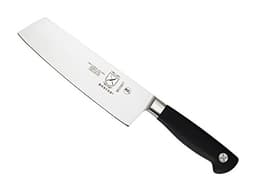
Best way to try the shape
Mercer Culinary Genesis 7-inch Nakiri (M20907)
The sane way to find out whether you like the nakiri shape. Forged German steel, full tang, bolster, grippy handle — around a quarter of what the Japanese nakiris cost, and soft enough that a beginner can sharpen it on a cheap stone.
See how it compares to the santokusPrice as of October 20, 2026. #ad How we’re funded
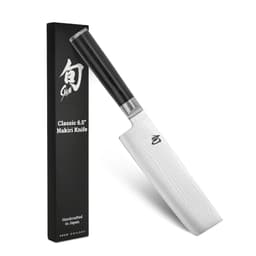
Our premium nakiri pick
Shun Classic 6.5-inch Nakiri (DM0728)
The nakiri most people end up buying, and a fair default: VG-MAX core, Damascus cladding, and a genuinely flat 165 mm edge that meets the board along its whole length. Buy it if you want one vegetable knife and you want it to be nice.
Read our Shun Classic nakiri reviewPrice as of October 20, 2026. #ad How we’re funded
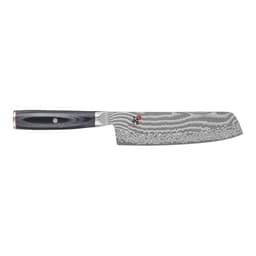
The fuller-handled alternative
Miyabi Kaizen II 6.5-inch Nakiri
Zwilling's Japan-made answer to the Shun Classic nakiri: an FC61 core under 48 layers of flower-Damascus, with a rounder pakkawood D-handle that suits larger hands better than Shun's narrower one.
See the rest of the Japanese fieldPrice as of October 20, 2026. #ad How we’re funded
Frequently asked questions
What is a nakiri knife used for?
Vegetables, almost exclusively. The name means roughly 'leaf cutter' and the shape is built for straight-down chopping and push-cutting on a board: a dead-flat edge that contacts the board along its whole length, a tall blade for knuckle clearance, and no tip to get in the way. It is superb on cabbage, onions, carrots, herbs and anything you dice in volume.
What is the difference between a nakiri and a santoku?
A santoku has a slight curve to the edge and a usable (if blunt-ish) tip, and it is intended as an all-purpose knife for meat, fish and vegetables. A nakiri has a dead-flat edge, a taller blade and effectively no tip at all, and it is a vegetable specialist. If you want one knife, take the santoku; if you already have a main knife and prep a lot of veg, the nakiri is the better second.
Is a nakiri the same as an usuba?
No. An usuba is the single-bevel professional version — ground on one side only, handed (separate left- and right-handed versions), and requiring specific sharpening technique. A nakiri is the double-bevel domestic equivalent: it cuts straight, works in either hand and sharpens like any other kitchen knife. For a home cook, the nakiri is the right one.
Do I need a nakiri?
Only if you already own a good chef's knife or gyuto and you prep a lot of vegetables. A nakiri cannot do most of what a chef's knife does — no tip means no boning, no scoring, no fine point work — so it is a second knife, not a first. If you do prep vegetables in volume, it is genuinely faster and more controlled at that one job.
Why does a nakiri have no point?
Because a point is useless for the job and gets in the way. The nakiri is designed for a straight up-and-down chop where the whole edge lands on the board at once; a tapered tip would leave part of the cut unfinished and add nothing. Removing it also gives you a tall, rectangular blade face, which doubles as a scoop for carrying prep to the pan.
Can you cut meat with a nakiri?
Boneless meat, yes — it will slice chicken breast or steak perfectly well. What it cannot do is anything requiring a point (trimming silverskin, boning, scoring) or anything requiring a rocking motion. And like all thin Japanese knives, it should never meet bone or frozen food: the hard, thin edge chips rather than deforms.
Sources
- Japanese kitchen knife — Wikipedia — Reference on gyuto/santoku/nakiri, single- vs double-bevel (kataba/ryoba) and edge angles (accessed July 21, 2026)
- Rockwell hardness test — Wikipedia — Definition of the Rockwell C (HRC) scale used to state knife-steel hardness (accessed July 21, 2026)
Per-knife specs (steel, HRC, blade length, geometry) are read from each maker’s spec sheet or product listing and dated on the individual review cards above. “Not published” means the manufacturer does not state that figure — we flag it rather than guess.
Keep reading
Your First Japanese Knife
Why the nakiri is the third knife to buy, never the first.
See the buying pathChef Knife vs Nakiri
The side-by-side, with a decision table.
Compare themChef Knife Types Explained
Where the nakiri sits among gyuto, santoku and petty.
See all the shapesBest Santoku Knives
The all-purpose Japanese shape next door.
See the santokusKnife Steel & Hardness Guide
VG-MAX, FC61 and what HRC means for a thin blade.
Understand the steelBest Nakiri Knives
Six vegetable knives compared on steel and grind, with live prices.
See the picksSantoku vs Nakiri
The closest comparison there is, settled on one centimeter of tip.
Compare themHow to Sharpen a Single-Bevel Knife
What an usuba commits you to that a nakiri does not.
See the techniqueBest Knives for Cutting Vegetables
Nakiri against santoku and gyuto for produce prep.
See the picks