Chef Knife vs Nakiri
A nakiri is not a shorter chef's knife. It has no tip and a dead-flat edge — which buys you real speed on vegetables and costs you everything else.
How this is funded: we earn a commission if you buy through our links, at no extra cost to you. As an Amazon Associate we earn from qualifying purchases. It never changes which knife we recommend, and we’ll tell you when we’d skip one. Full disclosure.
Short answer: buy the chef’s knife. It is the more capable tool by a wide margin and it is the correct first purchase for essentially everyone. A nakiriis a specialist second knife: on the one job it is designed for — chopping and slicing vegetables on a board — it is genuinely faster and cleaner, and on everything else it is either awkward or impossible.
| Chef's knife | Nakiri | |
|---|---|---|
| Edge profile | Curved belly | Dead flat |
| Tip | Fine, usable point | None |
| Typical length | 200-210 mm | 165-180 mm |
| Blade height | ~45 mm | ~50-60 mm |
| Cutting motion | Rock or push | Straight down / push only |
| Vegetables | Very good | Excellent |
| Boneless meat & fish | Very good | Adequate (slicing only) |
| Trimming, scoring, boning | Yes | No |
| Role in a kitchen | The one knife | A second knife |
What the nakiri actually wins at
The advantage is not sharpness — a good gyuto and a good nakiri from the same line share a steel and a hardness. The advantage is geometry doing one job perfectly.
Chop an onion with a chef’s knife and the curved belly means only part of the edge contacts the board on each stroke. The slices at the far end stay attached by a thin hinge, and you make an extra pass to free them. Multiply that across three onions, a cabbage and a bag of carrots and the wasted motion is real.
A nakiri’s flat edge lands all at once. Every slice is separated on the first stroke. The taller blade means your guiding knuckles sit further from the edge, so you can go faster with the blade vertical, and the broad face scoops the board clean in one movement instead of three. If vegetable prep is the bulk of your cooking, that adds up to a noticeably faster, less irritating session.
What it gives up, concretely
Here is the list of things you cannot do with a nakiri, and it is longer than people expect:
- Trim silverskin or fat from a piece of meat — needs a point.
- Score the skin on a duck breast or a fish — needs a point.
- Split a chilli or de-seed a pepper neatly — needs a point.
- Separate a chicken at the joint — needs a point and some toughness.
- Rock-chop herbs — needs a belly.
- Halve a large squash or watermelon — needs length the nakiri does not have.
- Anything involving bone or frozen food — a thin Japanese blade at 60 HRC chips.
None of that is a design failure. It is the deliberate consequence of removing the tip and flattening the edge, and it is why the nakiri exists alongside the gyuto in a Japanese kitchen rather than instead of it.
The technique trap
Most people who buy a nakiri and dislike it are using it like a chef’s knife. They try to rock, the flat edge slaps the board, and the cut does not finish. Then they conclude the knife is dull or badly made.
The correct motion is to lift the whole blade clear and bring it straight down, adding a small forward push for firmer produce. Nothing about it is difficult — it is arguably the most natural motion for someone who never learned to rock — but it is different, and the knife will not adapt to you.
How to decide
Three questions.
- Do you already own a chef’s knife you like? If no, buy one. That is the entire answer; come back to the nakiri later. Our chef knife roundup covers the field.
- Is more than half your prep vegetables?If yes, a nakiri will earn its space. If no, a santoku is the more useful second knife because it can still handle protein — see chef knife vs santoku.
- Do you push-cut or rock? If you rock everything and have no intention of changing, a nakiri will annoy you regardless of what you cut.
If all three point the right way, the nakiri is one of the more satisfying second knives you can own. If any of them do not, buy a better chef’s knife instead — the money goes further.
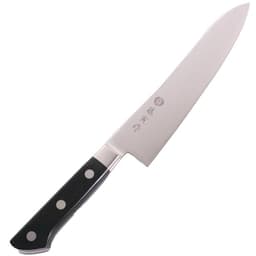
Our all-purpose pick
Tojiro DP Gyuto 210 mm
The knife the internet has recommended to first-time gyuto buyers for a decade, and the numbers explain why: a real VG10 core at ~60 HRC for a fraction of the boutique price. Buy this before you spend three times as much.
Read the full reviewPrice as of October 19, 2026. #ad How we’re funded
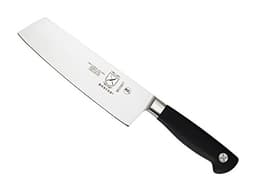
The low-risk way to try a nakiri
Mercer Culinary Genesis 7-inch Nakiri (M20907)
The sane way to find out whether you like the nakiri shape. Forged German steel, full tang, bolster, grippy handle — around a quarter of what the Japanese nakiris cost, and soft enough that a beginner can sharpen it on a cheap stone.
Read the nakiri guidePrice as of October 19, 2026. #ad How we’re funded
Frequently asked questions
What is the difference between a chef knife and a nakiri?
A chef's knife has a curved belly and a fine tip and is built to be an all-purpose blade. A nakiri has a dead-flat edge, a taller blade and no tip at all, and is built solely for vegetables. The chef's knife can rock-chop, trim, score and bone; the nakiri cannot do any of those, but it chops vegetables straight down faster and more cleanly.
Can a nakiri replace a chef's knife?
No, not really. Without a point you cannot trim silverskin, score skin, split a chilli or separate a joint, and without a belly you cannot rock. If you cook only vegetables you might manage, but for most kitchens the nakiri is a second knife that lives alongside a chef's knife or gyuto rather than replacing one.
Is a nakiri better for chopping vegetables?
Yes, measurably. Because the edge is flat, the whole length lands on the board at once and every slice separates — no hinge left at the end of the cut to go back for. The extra blade height gives more knuckle clearance so you can chop faster with the blade vertical, and the tall face doubles as a scoop for moving prep off the board.
Is a nakiri good for beginners?
It is very easy to use safely — no point, tall blade, one simple motion — but it is a poor first knife because it does so little. A beginner is better served by a chef's knife or gyuto that handles everything, and can add a nakiri later if vegetable prep turns out to be the bulk of their cooking.
Nakiri or santoku as a second knife?
If your first knife is a Western chef's knife, the santoku overlaps with it less than you would think and is more useful day to day. If your first knife is already a gyuto, the santoku adds very little and the nakiri adds a genuinely different tool. Choose based on how much of your prep is vegetables: heavy veg, take the nakiri.
Sources
- Japanese kitchen knife — Wikipedia — Reference on gyuto/santoku/nakiri, single- vs double-bevel (kataba/ryoba) and edge angles (accessed July 21, 2026)
- Rockwell hardness test — Wikipedia — Definition of the Rockwell C (HRC) scale used to state knife-steel hardness (accessed July 21, 2026)
Per-knife specs (steel, HRC, blade length, geometry) are read from each maker’s spec sheet or product listing and dated on the individual review cards above. “Not published” means the manufacturer does not state that figure — we flag it rather than guess.
Keep reading
Nakiri Knife Guide
The shape in full — and how to use it properly.
Read the guideChef Knife vs Santoku
The closer, more common version of this question.
Compare themBest Chef Knives
The all-rounders, ranked on steel and geometry.
See the picksChef Knife Types Explained
Every shape in one scannable reference.
See all the shapesSantoku vs Nakiri
The closer comparison, once a chef's knife is ruled out.
Compare themBest Nakiri Knives
Six nakiris with live prices and honest cons.
See the picks