Why Your Knife Won't Get Sharp
Six causes, in the order they're worth checking — starting with the one that accounts for most failures: you never raised a burr.
How this is funded: we earn a commission if you buy through our links, at no extra cost to you. As an Amazon Associate we earn from qualifying purchases. It never changes which knife we recommend, and we’ll tell you when we’d skip one. Full disclosure.
You spent twenty minutes on the stone and the knife still will not slice a tomato. This is a solvable problem, and it is nearly always one of six things. Work through them in this order — the first cause accounts for more failures than the other five combined.
1. You never raised a burr
This is the big one. Sharpening is not polishing the sides of an edge. It is grinding metal away from both bevels until they physically meet at a line thin enough to cut. The proof that they have met is a burr: a thin ribbon of steel pushed over to the far side, because there is nowhere else for it to go.
Until you can feel a burr along the entire length of the edge, including the heel and the last centimeter before the tip, that part of the knife is not sharp and no amount of finer grit will make it so. Beginners almost universally stop too early on the coarse stone, then spend a long time polishing a rounded edge to a mirror shine and wonder why it will not cut.
Test: drag a fingertip from the spine down and off the edge— never along it. A burr catches like a tiny lip. Check the heel and the tip separately; they are the two places it usually has not formed.
Fix: go back to your coarsest stone and keep working one side until the burr appears everywhere. Then do the other side. Only then move up in grit.
2. You left the burr on
The opposite failure, and it produces a very specific symptom: the knife slices paper beautifully and fails on a tomato. That is a wire edge — a burr still attached, thin and flexible, that shears paper on the way past and then folds over the instant it meets something with a skin.
Test:paper yes, tomato no. Or look at the edge under a bright light at an angle — a burr catches the light as a fine bright line.
Fix:alternate single, ultra-light passes on your finest stone, reducing pressure each time, until the burr breaks off. Then strop — a dozen strokes spine-first on leather, a strop, or even the back of a leather belt. Never cut into the strop; you are dragging the edge backwards.
3. Your stone is dished
Soft water stones wear fastest where you use them most, which is the middle. A hollowed stone grinds a convex bevel, and the effective angle changes as you move the blade along the surface. The apex never comes together cleanly, and you can work forever without success.
Test: draw a pencil grid across the stone and take a few passes on a flattening plate. If the grid disappears from the edges but survives in the middle, the stone is hollow.
Fix: flatten it. It takes about two minutes with a flattening plate, a diamond plate, or wet-and-dry paper on a known-flat surface, and it should be part of your routine rather than an emergency measure. Full method in how to flatten a whetstone.
4. Your angle is wrong — or drifting
Two separate problems that look the same. Either you are consistently at the wrong angle (too steep, so you cut a fat micro-bevel that never sharpens; too shallow, so you grind the shoulder and never touch the edge), or your angle is inconsistent stroke to stroke, which rounds the apex over rather than converging on it.
Test: the marker test. Color the bevel, take three light strokes, and see where the ink went. Even removal across the whole bevel means you are matched; ink gone only at the edge means too steep; ink gone only at the shoulder means too shallow.
Fix: lock your wrist and elbow and move from the shoulder. If your hand will not cooperate, a guided system removes the variable entirely. Our angle guide has three ways to hold one by hand.
5. Your stone is too fine for the job
A 6000-grit finishing stone will not sharpen a genuinely blunt knife in any reasonable amount of time, and a 1000-grit stone will not repair a chip. People buy a fine stone because “higher is better” and then grind away for an hour with nothing to show for it.
Test: is the knife merely dull, or is it damaged? Look along the edge under a light. Visible chips, a rolled section, or a rounded profile you can see means damage, not dullness.
Fix: match the grit to the job. 1000 to sharpen a dull knife, 6000 to finish, and something around 400 for chips or reprofiling. Our grit guide maps the numbers to the tasks.
6. You are using too much pressure
Leaning on the knife feels productive and is counterproductive. Heavy pressure flexes a thin blade, so the apex lifts away from the stone; it also creates a larger, more stubborn burr and, on soft steel, can round the very edge you are trying to form.
Test: if the stone squeals or the slurry disappears under the blade rather than spreading, you are pressing too hard.
Fix: firm but moderate pressure on the coarse stone while establishing the burr, then progressively lighter, ending with strokes that are barely more than the weight of the knife. The last few passes should feel like you are dusting the stone.
If none of that worked
Two remaining possibilities. Your knife may have a bolster in the way— on many forged Western knives the bolster runs down past the heel, so the last centimeter of edge cannot reach the stone and stays permanently dull. You can sharpen deliberately around it, or file the bolster back, which is what professionals do.
Or the steel itself may be the problem. Unbranded knives with no published steel grade or hardness sometimes simply will not take a fine edge — there is not enough carbon, or the heat treatment is poor. If a knife resists every technique above and it cost $18 and its listing never named a steel, that is your answer. It is also the reason we only feature knives whose makers publish a steel grade; see our methodology and the steel guide.
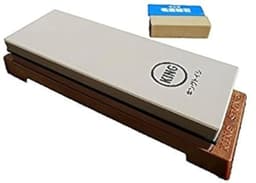
A forgiving stone that gives clear feedback
King (Matsunaga) KW-65 1000/6000 Combination Whetstone
The stone that has taught more people to sharpen than any other. One side 1000-grit to set an edge, one side 6000-grit to polish it, made in Japan, for the price of a takeout dinner. Start here.
Read the full review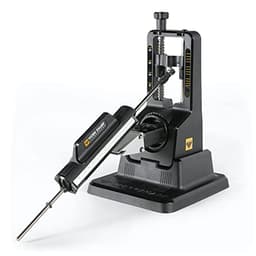
If angle consistency is the problem
Work Sharp Precision Adjust Knife Sharpener
The guided system to buy if a whetstone has beaten you. The blade clamps, the angle sets by knob anywhere from 15 to 30 degrees in one-degree steps, and a rotating handle carries coarse diamond, fine diamond and a fine ceramic. It removes the one variable beginners cannot control: holding a consistent angle.
See all the systemsPrice as of October 20, 2026. #ad How we’re funded
Frequently asked questions
Why is my knife still dull after sharpening?
The most common reason by far is that you never raised a burr. Until a thin lip of displaced steel appears along the entire far side of the edge, the two bevels have not met and there is no apex to sharpen — you have only polished the sides of a dull edge. Check for a burr along the full length before you switch sides or move to a finer grit.
What is a burr and how do I feel for it?
A burr is a thin ribbon of steel pushed over to the opposite side of the edge as the two bevels finally meet. Feel for it by dragging a fingertip gently from the spine down and off the edge (never along it) — a burr catches like a tiny lip. It should be present along the whole blade, including the heel and the tip, not just in the middle.
Can a dished whetstone stop a knife getting sharp?
Yes. If the stone is hollow, the bevel you grind against it is convex and the apex angle changes as you move along the blade, so the edge never comes together cleanly. Draw a pencil grid on the stone and take a few passes on a flattening plate; if the grid survives in the middle, the stone is dished and needs flattening before you go further.
How do I know if my sharpening angle is wrong?
Color the bevel with a permanent marker and take three light strokes. If the ink comes off only at the very edge, your spine is too high. If it comes off only at the shoulder, your spine is too low. Only when ink is removed evenly across the whole bevel are you actually sharpening the apex.
Why does my knife feel sharp on paper but not on tomatoes?
Usually a burr that was never fully removed. A wire edge is thin, flexible steel that slices paper convincingly and then folds over the moment it meets tomato skin. Remove it with a few alternating ultra-light passes on your finest grit, then a dozen strokes on a strop or the back of a leather belt.
How long should sharpening take?
Longer than most beginners expect on the first session — establishing a burr along a neglected edge on a 1000-grit stone can take several minutes per side, sometimes considerably more on hard steel. Subsequent touch-ups take a fraction of that. If you have been at it for twenty minutes with no burr anywhere, the problem is the angle or the stone, not the time.
Sources
- Knife sharpening — Wikipedia — Reference on edge angle, coarse-to-fine grit progression, and honing vs sharpening (accessed July 21, 2026)
- How to Sharpen a Knife With a Whetstone — Montana Knife Company — Master-bladesmith walkthrough of whetstone angle, grit progression and deburring (accessed July 21, 2026)
- 20° & 25° Angle Guides for Whetstone Sharpeners — Work Sharp — Tool-maker reference for common Western (20°) vs finer (Japanese) sharpening angles (accessed July 21, 2026)
Per-knife specs (steel, HRC, blade length, geometry) are read from each maker’s spec sheet or product listing and dated on the individual review cards above. “Not published” means the manufacturer does not state that figure — we flag it rather than guess.
Keep reading
How to Sharpen a Knife
The full workflow, done in the right order.
Learn the methodHow to Flatten a Whetstone
Fix cause number three in two minutes.
Read the guideKnife Sharpening Angle Guide
Three ways to hold an angle without a jig.
Read the angle guideWhetstone Grit Guide
Whether you need a coarser stone than you have.
Read the grit guideHow to Strop a Knife
Deburring properly, which fixes most of these cases.
Read the how-toWork Sharp Precision Adjust Review
If holding the angle is the problem, this removes it.
Read the reviewHow to Fix a Chipped Knife
When the problem is missing steel rather than technique.
Read the how-to