Do Japanese Knives Need Honing?
Rarely, gently, and on a smooth rod rather than a ribbed one. Two of the makers on this site go further and tell you not to use a rod at all — here is who says what, and why.
How this is funded: we earn a commission if you buy through our links, at no extra cost to you. As an Amazon Associate we earn from qualifying purchases. It never changes which knife we recommend, and we’ll tell you when we’d skip one. Full disclosure.
Mostly no — not in the daily way a German knife needs it. A hard Japanese edge deforms far less in use, so there is little for a rod to realign; and when you do want a touch-up, use a smooth ceramic rod at about 10 degrees rather than the ribbed steel that came with your block. Two makers we cite tell you to skip the rod entirely and go to a stone.
This is one of the few questions in kitchen knives where the published positions of the makers themselves disagree, and that disagreement is more informative than any single answer. So this page sets out who says what, and why the physics supports the Japanese-knife guidance rather than the Western habit.
Why honing exists at all
Honing is not sharpening. Wüsthof draws the line plainly in its own material: honing “realigns the microscopic teeth on the edge of the blade and prolongs your knife’s lifespan,” while sharpening “takes a small amount of steel off the blade, creating a new edge.” A working edge is only a few microns of steel wide, and in soft steel it folds sideways rather than wearing away. A rod pushes it straight again. Nothing has been removed; the geometry has been recovered.
That is honest for soft steel, and only approximately true for any rod. The general reference on honing rods notes that “non-abrasive honing rods such as smooth ceramic or ribbed steel are able to remove small amounts of metal via adhesive wear.” So every rod takes something, which matters when the thing it is taking from is a thin, hard, expensive edge.
The hardness argument, in numbers
Honing pays off in proportion to how much your edge rolls, and that is a function of hardness. Wüsthof’s own account puts its forged German blades at “58 Rockwell” and its non-forged ones “between 55 and 57 Rockwell.” Shun’s FAQ states that it “hardens VG10 and VG-Max steel to 60-61 Rockwell and SG2 to 61-62.” Those few points are the whole story: softer steel is tougher and bends, harder steel resists bending and chips instead.
The reference literature draws the practical conclusion for us: “in East Asia, notably Japan, harder knives are preferred, so there is little need for steeling intra-day, as the edge does not deform as much. Instead, the blade is honed as needed on a waterstone.” That is the answer to the question in one sentence — a 60 HRC edge does not need daily realignment, and when it does need attention, the stone is the tool.
Compare that with the Western instruction. Wüsthof’s own how-to says a honing steel “should be used regularly” and even “after each use,” with “2-3 repetitions” for a fairly sharp knife and more for a dull one. Applied to a soft German knife that is excellent advice. Applied to a hard Japanese one it is a recipe for slowly abrading a good edge for no reason.
If you do hone: rod type, angle, pressure
Rod type matters most.The general reference describes the field as follows: “the steel and ceramic honing steels may have longitudinal ridges, whereas the diamond-coated steels are smooth but embedded with abrasive diamond particles.” Ridges concentrate force into narrow contact lines. That is fine on steel that bends; on a hard thin edge it is a chipping mechanism. A smooth fine ceramic rod spreads the contact and abrades very lightly, which is why it is the rod we recommend alongside Japanese knives.
Diamond rods are sharpening tools, and the maker says so.Shun’s own FAQ is explicit: “please do not use a diamond steel for regular honing. Diamond steels are for sharpening and will remove metal from your knife before it is necessary.” That is a maker telling you its own accessory category is the wrong choice for a routine, and it is worth taking at face value.
Angle: match the bevel, not the habit.Wüsthof publishes a “14.5-degree angle between the edge of the blade and the honing steel” for Western knives and a “10-degree angle” for Asian knives — which is the clearest published acknowledgement we have found that the two families need different treatment. Shun grinds its Classic line to “a 16 degree angle on each side of the blade.” Hold a rod steeper than the bevel and you are not realigning the edge, you are rounding it over.
Pressure: almost none. The weight of the knife, drawn heel to tip, alternating sides, a handful of passes at most. If you can hear it, you are pressing too hard. Our honing walkthrough covers the motion, and the rod-length rule from Wüsthof’s own guidance applies to any brand: “you want to make sure the steel is at least as long as the blade you are either honing or sharpening.”
| Ribbed steel rod | Smooth ceramic rod | 1000-grit water stone | |
|---|---|---|---|
| What it does | Realigns a rolled edge; removes a little steel | Realigns and lightly abrades | Removes steel and forms a new apex |
| Right for a 60–61 HRC edge | No — ridges concentrate force | Yes, used lightly | Yes |
| Right for a 55–58 HRC Western edge | Yes — this is what it is for | Yes | Yes |
| Frequency | Western guidance: regularly, even after each use | Japanese knives: occasionally, when it starts pushing | When the edge is genuinely gone |
| Can it fix a lost apex | No | No | Yes |
| Can it chip a thin hard edge | Yes | Unlikely at light pressure | No |
| Published angle guidance | 14–14.5° for Western knives | ~10° for Asian knives | The maker's edge angle — 15–16° per side is typical |
The strictest position, and why it is reasonable
Yoshihiro’s own care instructions for its VG-10 Damascus knives say: “hand wash only. Dry immediately. Avoid the dishwasher,” and “sharpen by hand using whetstones. Do not use honing rods.” No hedging. On a 60 HRC hand-ground edge, the maker’s view is that a rod has nothing useful to offer and some risk attached.
We would not call that an overreaction. The case for a rod is convenience: ten seconds on the counter versus ten minutes at the sink with a stone. The case against is that the thing you are being convenient with is the most fragile part of an expensive knife. If you own one Japanese knife and a stone, the honest answer is that you do not need a rod at all.
Where a rod does earn its place is a mixed drawer. If half your knives are German and half are Japanese, one smooth ceramic rod serves both — the Western knives get frequent honing, the Japanese ones get it rarely, and nothing in the block meets a ribbed steel. That is the realistic recommendation for most kitchens, and it is what our honing rod roundup is built around.
What to do instead, in order
1. Stop damaging the edge.Most “my Japanese knife went dull” stories are storage and washing stories. ZWILLING’s own care page rules out the dishwasher for “aggressive chemical tablets,” “high temperatures” and “bumps and bangs with other objects,” and says a knife needs “its very own space away from other objects, so not simply thrown in the cutlery drawer.” A hard edge that never meets another piece of metal stays sharp for a remarkably long time. Our knife care guide covers the rest.
2. Touch up on ceramic, occasionally. When the knife starts pushing into a tomato instead of parting it, a few very light passes on a fine ceramic rod often brings it back. If they do not, the edge is gone rather than folded, and no rod will help.
3. Sharpen on a stone when it is actually dull.A 1000-grit water stone is the tool that restores a hard Japanese edge, and the interval is long — this is the payoff for owning hard steel in the first place. Our combination whetstone roundup covers the stones, how to sharpen a knife covers the motion, and how often to sharpen sets the realistic interval.
4. Consider a strop rather than a rod. For maintaining a freshly sharpened hard edge, leather and compound are gentler than any rod and genuinely effective. Our stropping guide explains the technique.
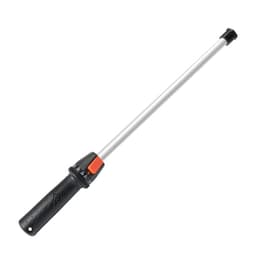
The rod we would put next to a Japanese knife
SHARPAL 111H RODALL Ceramic Sharpening Rod, Angle Adjustable
The rod to own if your knives are Japanese. A grooved steel rod is too aggressive for a 60+ HRC edge; a ceramic rod abrades a whisker of metal instead of bending the edge back, which is what hard steel actually needs between stone sessions. This one is the rare rod that publishes an angle — a guide adjustable from 14° to 25°, which covers the 15–16° a Japanese edge is ground to.
See it against the fieldPrice as of October 16, 2026. #ad How we’re funded
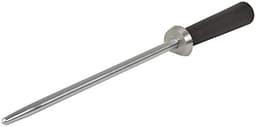
If you cannot hold an angle yet
Shun Sora 9-inch Combination Honing Steel
Two rods in one: a smooth face for daily realignment and a micro-ribbed face for a weekly, slightly more aggressive pass. The handle carries a molded guide for Shun's 16-degree edge, which is the part beginners actually get wrong.
See it against the fieldPrice as of October 16, 2026. #ad How we’re funded
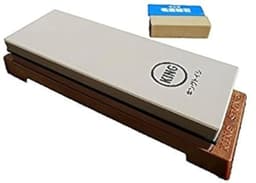
What actually restores a hard edge
King (Matsunaga) KW-65 1000/6000 Combination Whetstone
The stone that has taught more people to sharpen than any other. One side 1000-grit to set an edge, one side 6000-grit to polish it, made in Japan, for the price of a takeout dinner. Start here.
Read the King KW-65 reviewFrequently asked questions
Do Japanese knives need honing?
Much less often than Western knives, and with a different tool. Because the steel is harder, the edge deforms less in use — as the general reference on honing rods puts it, 'in East Asia, notably Japan, harder knives are preferred, so there is little need for steeling intra-day, as the edge does not deform as much. Instead, the blade is honed as needed on a waterstone.' When you do hone, use a smooth ceramic rod, lightly, at the maker's angle.
Can I use a honing steel on a Japanese knife?
A smooth ceramic rod, yes. The ribbed steel rod that came with your German knife block, no — the ridges concentrate force on a hard thin edge and can chip it rather than realign it. Shun also warns specifically against diamond rods for routine honing: 'diamond steels are for sharpening and will remove metal from your knife before it is necessary.'
What angle should I hone a Japanese knife at?
Around 10 degrees, which is what Wusthof publishes for Asian knives against '14.5-degree' for its own Western blades. The rule is to match the angle the edge was ground at, not to pick a number: Shun grinds the Classic line to '16 degree angle on each side', and holding a rod steeper than the bevel just rounds the apex.
How often should I hone a Japanese knife?
When it starts to feel like it is pushing rather than slicing — which for a 60 HRC blade in home use might be every few weeks, not every day. Western guidance to steel 'after each use' is written for soft steel that rolls daily. Over-honing a hard edge is a real way to damage it.
Do any makers tell you not to use a honing rod at all?
Yes. Yoshihiro's own care instructions for its VG-10 Damascus knives say 'sharpen by hand using whetstones. Do not use honing rods.' That is the strictest position among the makers we cite, and it is a defensible one: on a very hard, thin, hand-ground edge, a stone restores geometry where a rod can only realign or abrade it.
What is the difference between honing and sharpening?
Wusthof's own account is the clearest: honing 'realigns the microscopic teeth on the edge of the blade and prolongs your knife's lifespan', while sharpening 'takes a small amount of steel off the blade, creating a new edge'. In practice even a ceramic rod removes a little steel — the general reference notes that smooth ceramic and ribbed steel rods 'are able to remove small amounts of metal via adhesive wear'.
What should I use instead of a honing rod on a Japanese knife?
A fine ceramic rod for a quick touch-up, and a 1000-grit water stone for anything more than that. A strop with compound is a gentler third option for maintaining a freshly sharpened edge. The ceramic rod is the one worth keeping on the counter; the stone is the one that does the real work.
Will honing fix a Japanese knife that will not cut?
No. If a knife has genuinely lost its apex, no amount of rod work brings it back — honing realigns an edge that still exists. A hard Japanese blade that has stopped cutting usually needs a 1000-grit stone, and if there are visible chips or flat spots it needs a coarse stone first.
Sources
- Honing steel — Wikipedia — Reference on rod types and what they do: 'The steel and ceramic honing steels may have longitudinal ridges, whereas the diamond-coated steels are smooth but embedded with abrasive diamond particles'; 'Non-abrasive honing rods such as smooth ceramic or ribbed steel are able to remove small amounts of metal via adhesive wear'; 'It is often recommended that steeling be performed immediately before or after using a knife and can be done daily'; and, on hard blades, 'In East Asia, notably Japan, harder knives are preferred, so there is little need for steeling intra-day, as the edge does not deform as much. Instead, the blade is honed as needed on a waterstone' (accessed September 1, 2026)
- Shun Knives FAQ — Shun Cutlery (Kai USA) — Shun's own answers: 'Shun hardens VG10 and VG-Max steel to 60-61 Rockwell and SG2 to 61-62', 'Shun knives, for example, are sharpened to a 16 degree angle on each side of the blade', and on rods, 'Please do not use a diamond steel for regular honing. Diamond steels are for sharpening and will remove metal from your knife before it is necessary' (accessed August 28, 2026)
- How To Sharpen Your WÜSTHOF Knives — The Chef's Table, WÜSTHOF — Wüsthof's published honing procedure and the distinction it draws: honing 'realigns the microscopic teeth on the edge of the blade and prolongs your knife's lifespan', while sharpening 'takes a small amount of steel off the blade, creating a new edge'. It gives a '14.5-degree angle between the edge of the blade and the honing steel' for Western knives and a '10-degree angle' for Asian knives, and says to run the blade 'from the "heel" to the "tip" of the knife' and 'Repeat this process 6-8 times while alternating sides' (accessed September 1, 2026)
- Using a Steel — WÜSTHOF Australia — Wüsthof's own how-to: 'Tilt the knife so that there is a 14 degree angle between the knife and the steel', 'A fairly sharp knife may only need 2-3 repetitions, while a dull knife will need more', 'Honing re-aligns the microscopic teeth in the blade', a honing steel 'should be used regularly' and even 'after each use', and the sizing rule — 'You want to make sure the steel is at least as long as the blade you are either honing or sharpening' (accessed September 1, 2026)
- Yoshihiro VG-10 46 Layers Hammered Damascus Gyuto & Petty Chef's Knife Set — Yoshihiro Cutlery — Yoshihiro Cutlery's own store page for the 46-layer set, and the only place the line's hardness is published: 'VG-10 Steel', '60 HRC', 'Multi-Layer Damascus (46-Layer)', 'Double Bevel', made in 'Japan', with a saya included. The care instructions are the maker's own and matter for a hard thin edge: 'Hand wash only. Dry immediately. Avoid the dishwasher', 'Sharpen by hand using whetstones. Do not use honing rods', and avoid 'cutting on hard surfaces or using the knives on items like bones, nutshells, or frozen foods'. The handle variants shown here are rosewood and ambrosia (accessed September 29, 2026)
- How to Clean and Care for Your Knife — ZWILLING — ZWILLING's own care instructions: 'clean it by hand using lukewarm water, mild dish soap and a non-scratch cloth or sponge', dried with 'a plain dishtowel or microfiber cloth'; the dishwasher is ruled out for 'aggressive chemical tablets', 'high temperatures' and 'bumps and bangs with other objects'. On wooden handles: 'not dishwasher-safe and should only be washed by hand', with the wood 'regularly treating the wood with oil (e.g. linseed oil) or wax (e.g. beeswax)'. On storage, a knife needs 'its very own space away from other objects, so not simply thrown in the cutlery drawer' — a block, 'drawer organizers or protective sleeves' (accessed September 23, 2026)
- Rockwell hardness test — Wikipedia — Definition of the Rockwell C (HRC) scale used to state knife-steel hardness (accessed July 21, 2026)
- Knife sharpening — Wikipedia — Reference on edge angle, coarse-to-fine grit progression, and honing vs sharpening (accessed July 21, 2026)
Per-knife specs (steel, HRC, blade length, geometry) are read from each maker’s spec sheet or product listing and dated on the individual review cards above. “Not published” means the manufacturer does not state that figure — we flag it rather than guess.
Keep reading
SHARPAL 111H Ceramic Rod Review
The ceramic rod for hard Japanese steel, on the adjustable angle its maker publishes and the grit figure it does not.
Read the reviewSharpening vs Honing
What each process does to the steel, with the makers' own definitions.
Read the guideBest Honing Steels and Rods
The field, including which rods are safe on hard Japanese edges.
See the picksHow to Hone a Knife
The motion, the angle and the stroke count.
Learn the methodHoning Steel vs Sharpening Steel
Two names, two very different tools in the same shape.
Compare themBest Sharpeners for Japanese Knives
What can hold a 15 degree edge on 60 HRC steel.
See the optionsKnife Care
Washing, drying and storage — where most edge damage comes from.
Read the guide