How to Tell If a Japanese Knife Is Good Quality
You cannot feel a knife through a listing, and you should not have to. A good Japanese knife announces itself in what the maker is willing to put in writing — and a bad one announces itself in what it leaves out.
How this is funded: we earn a commission if you buy through our links, at no extra cost to you. As an Amazon Associate we earn from qualifying purchases. It never changes which knife we recommend, and we’ll tell you when we’d skip one. Full disclosure.
The question people actually type is “how do I know if this Japanese knife is any good,” and it is usually asked while looking at a listing: a photo of a Damascus pattern, a price that seems either too high or too low, and a paragraph of adjectives. You cannot hold the knife. What you can do is read what the maker was willing to commit to in writing, because there is a pattern to it. Makers of good Japanese knives publish specific, checkable things about them — the steel by name, the hardness by number, the city, the construction, the angle, the warranty. Makers of bad ones publish adjectives. Here are the seven checks, in the order we run them, with the makers in our registry who pass each one named so you can see what passing looks like.
Check 1: is the steel named?
A good Japanese knife tells you what it is made of, and the name is one you can look up. VG10 and VG-MAX are Takefu-family stainless steels — Takefu publishes VG10’s exact composition on its own site (1.00% carbon, 15.00% chromium, 1.00% molybdenum, 0.25% vanadium, 1.55% cobalt). FC61 is ZWILLING’s fine-carbide stainless. SG2 and AUS-10 are named. Shirogami and Aogami are named carbon steels. Every one of those names commits the maker to a specific material with known properties.
The tells of a bad listing are the words that sound like a steel and are not: “Japanese steel,” “high-carbon stainless steel,” “premium German-Japanese steel,” “super steel.” None of those is a grade. A subtler case is a real, named steel that is not Japanese at all: 9Cr18MoV, 10Cr15CoMoV and 8Cr13MoV are Chinese stainless grades — genuine steels, sometimes perfectly usable — and a knife made of them with “Japanese” in its name is telling you about its shape, not its origin. Judge it as a budget knife with a named Chinese steel, which is a fair thing to be, rather than as the Japanese knife the title implies. Our steel guide covers the grades in detail.
Check 2: is the hardness published?
This is the single most useful check, because hardness on the Rockwell C scale (HRC) is the number that most directly decides how a knife behaves, and because a maker who prints it is accepting accountability for it. Shun’s FAQ states it “hardens VG10 and VG-Max steel to 60–61 Rockwell and SG2 to 61–62.” ZWILLING prints “Blade hardness (HRC): 61 HRC” on the Miyabi Koh page and 60–62 on the Kaizen II. Enso publishes “61 Rockwell” for its HD line. Takefu publishes 60 and above for VG10 itself.
Notice where the number lives, because that is a quality signal in itself. Shun prints it in its FAQ, not on the product page; Tojiro publishes the construction of its knives on its own site but no hardness figure at all, so the “60 ±1 HRC” you see quoted for a Tojiro DP comes from a specialist retailer’s sheet, not the maker. That is still far better than nothing, and we say which source is which on every card. The tell of a bad listing is the absence of any number, or a number with no source — “62+ HRC” on a knife whose steel is not even named is a claim with nothing behind it. Our hardness chart explains what the bands mean.
Check 3: is a place of manufacture stated?
Japan’s kitchen knives come from a handful of towns with long records — Seki, Sakai, Tsubame-Sanjo, Echizen — and makers who work there say so. Shun’s product pages say “Handcrafted in Japan”; ZWILLING says “Handcrafted in Seki, Japan” for the Miyabi lines; Enso’s published spec says Seki; KAI’s Seki Magoroku line carries the city in its name. Origin alone does not guarantee quality — a Seki factory can make a cheap knife — but it is a checkable fact, and it is one that bad listings avoid.
The tells: “Japanese-style,” “Japanese design,” “inspired by Japanese craftsmanship,” and a brand name that sounds Japanese with no city anywhere on the page. Those phrases are chosen carefully to describe the shape while implying the origin. A knife can be a decent budget knife and still be none of the things its name suggests; the problem is not where it is made, it is the pretending.
Check 4: does the maker have its own spec page for the model?
Real makers publish their own product pages, with a model number, and the listing you are looking at can be checked against them. Tojiro’s site has a page for the F-808 gyuto (“Blade is VG10 as core steel, clad by 13-Chrome stainless steel”), and when Tojiro renamed the DP line “TOJIRO CLASSIC,” the specialist retailer’s listing recorded that the knife was “completely unchanged, name only updated.” Shun’s site has a page for the Classic 8-inch chef’s knife and one for the DM0728 nakiri. ZWILLING has a page per Miyabi model with the hardness on it. If you can find the maker’s own page and it matches the listing, you know what you are buying. If the only place the knife exists is the marketplace listing, the “maker” is a label.
Check 5: is the construction described specifically?
Good makers describe how the blade is built in terms you can picture. Shun: a VG-MAX core with “34 layers of stainless Damascus cladding each side (68 total).” ZWILLING: an FC61 core under “48 layers of stainless steel.” Tojiro: a VG10 core clad in 13-chrome stainless, three layers. Enso: VG10 under “37-layer Damascus with a hammered tsuchime finish.” Each of those tells you what the core is and what the cladding is, and the core is what cuts.
The tell is a Damascus layer count doing the work the spec sheet should. “67-layer Damascus” on a knife with no named core steel is decorated unknown steel; the layers are cladding, and on the cheapest knives the pattern is sometimes etched onto a single-piece blade rather than made of layers at all. The Damascus guide explains how to tell. A plain, unpatterned knife with a named core (a Tojiro DP, a Miyabi Koh) is a better sign than a dramatic pattern with no core named.
Check 6: is the edge angle published?
A smaller check, but a telling one, because it means the maker controls the grind closely enough to state it. Shun: “sharpened to a 16 degree angle on each side of the blade.” Miyabi: a “9.5–12° edge angle” from a three-step hand-honing process. Tojiro’s knives are widely listed at about 15° per side. An angle figure is also practically useful: it is the angle you sharpen at, and our angle guidestarts from it. The absence of an angle is not damning on its own — some good makers omit it — but “razor sharp” in place of a number is the same pattern as “Japanese steel” in place of a grade.
Check 7: is there a warranty with terms you can read?
Good makers publish a warranty, and the terms tell you two things. First, what the maker thinks the knife is for: Shun’s warranty voids for “any use other than cutting (such as stabbing or prying)” and says to use the knives “on meat and produce only. Do not use directly on bones, frozen food, or produce pits” — which is an honest description of a hard, thin Japanese edge. Second, where to buy: Shun’s warranty applies “to purchases made through our authorized dealers only,” and Kai USA “will NOT honor” products from unauthorized sources. Shun’s own counterfeit guidance adds that no single visual feature confirms authenticity and that not every seller on a trusted marketplace is authorized. A knife with a real warranty is a knife whose maker expects to be around, and buying it from a seller the warranty covers is part of buying a good one. Our where-to-buy guide covers the channels.
The tell: no warranty at all, or a “lifetime guarantee” from a brand with no website, no address and no model numbers. A promise with nobody behind it is not a warranty.
Scoring it
No knife in our registry passes all seven cleanly, and that is the honest state of the market. Shun passes six on its own pages and the seventh (the hardness) in its FAQ. Miyabi passes six and will not name the alloy behind “FC61.” Tojiro passes five and leaves the hardness to a retailer. MAC publishes the construction and the country and no per-model hardness. Those are all good knives, and the gaps are worth knowing about; they are not disqualifying. What is disqualifying is a listing that passes none: no named steel, no hardness, no city, no maker’s page, a layer count instead of a construction, “razor sharp” instead of an angle, and a guarantee from nobody. That knife might still cut an onion. You just have no way of knowing what it is, and you are paying for the word “Japanese” on the box.
Three knives from the registry that pass the checks are below, with the exact gaps noted on each. If you want the full buying framework rather than the listing-level checks, the Japanese knife buying guide is the longer version, and the first-Japanese-knife path says which shape to buy first.
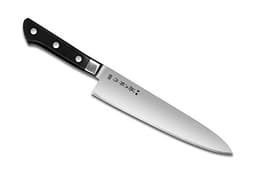
Passes the checks — maker publishes the construction, steel maker publishes the recipe
Tojiro DP Gyuto 210 mm
The knife the internet has recommended to first-time gyuto buyers for a decade, and the numbers explain why: a real VG10 core at ~60 HRC for a fraction of the boutique price. Buy this before you spend three times as much.
Read the reviewPrice as of September 18, 2026. #ad How we’re funded
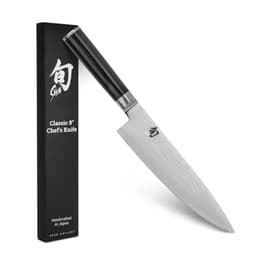
Passes the checks — steel, hardness (FAQ), layers, angle, country and warranty all in writing
Shun Classic 8-inch Chef's Knife
The knife most people picture when they think 'nice Japanese knife': a VG-MAX core at ~61 HRC under 34 layers of Damascus cladding, with a slim D-shaped handle. You pay for the finish, but the steel is genuinely hard.
Read the review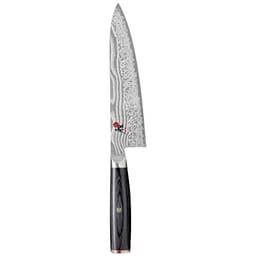
Passes the checks — hardness, angle, layers and city published; the alloy is the one gap
Miyabi Kaizen II 8-inch Chef's Knife
Miyabi is Zwilling's Japan-made line, and the Kaizen II pairs an FC61 core at ~60 HRC with a 48-layer Damascus jacket and a comfortable D-handle. A polished alternative to the Shun Classic at a similar price.
Read the reviewFrequently asked questions
How do I know if a Japanese kitchen knife is good quality?
Run the listing through seven checks: a named steel grade (VG10, VG-MAX, FC61, SG2, a named carbon steel) rather than 'Japanese steel'; a published Rockwell hardness; a stated place of manufacture (Seki, Sakai, Tsubame) rather than 'Japanese-style'; a maker with its own spec page for that model; a specific construction description; a published edge angle; and a warranty with terms you can read. A good knife passes most of them. A bad one passes almost none.
What does 'Japanese steel' mean on a knife listing?
Usually nothing. Real Japanese kitchen knives name their steel — VG10 and VG-MAX (Takefu-family stainless), FC61, SG2, AUS-10, or a carbon steel like Shirogami or Aogami — and the steel maker or the knife maker publishes the composition or the hardness. A listing that says only 'Japanese steel', 'high-carbon stainless' or 'premium steel' is not telling you what the blade is made of, and a knife whose maker will not name the steel should be treated as unknown steel.
Is a Damascus pattern a sign of quality?
No. Damascus on a modern kitchen knife is decorative cladding around a core steel that does the actual cutting — a Shun Classic is 34 layers each side around a VG-MAX core; an Enso HD is 37 layers around VG10. The core is what matters. A very cheap knife with a dramatic '67-layer Damascus' pattern, no named core steel and no hardness figure is decorated unknown steel, and the pattern may be etched on rather than layered.
Does 'made in Japan' guarantee quality?
It guarantees origin, which is a real signal because the traditional knife-making regions have long records, but it is not sufficient on its own — a maker in Seki can still make a cheap knife. Combine it with a named steel and a published hardness. Conversely, a knife described as 'Japanese-style' or 'Japanese design' with no city and no steel grade is usually not made in Japan and should be judged as whatever it actually is.
Why does published hardness matter so much?
Because it is the number that most directly decides how a knife behaves — how long an edge lasts, how easily it chips, how it sharpens — and because a maker that prints it is accepting accountability for it. Shun states 60-61 Rockwell for VG10 and VG-MAX; ZWILLING states 61 HRC for FC61; Enso states 61 for its HD line. A maker that will not print a number has decided you should not know, and that is a finding, not a gap.
How can I tell if a Shun or Miyabi is fake?
Shun's own advice is that no single visual feature confirms authenticity, that not every seller on a trusted marketplace is authorized, and that only knives bought from an authorized dealer are eligible for warranty service. The practical checks are the seller (is it the brand or a named authorized retailer?), the price (far below the maker's own listed price is a warning), and the paperwork. Buy where the warranty will be honored.
Is a cheap 'Japanese' knife from a marketplace brand ever worth buying?
Sometimes, if you judge it as what it is. A knife with a named Chinese stainless core like 9Cr18MoV, three-layer construction and an honest price can be a usable budget knife — one is in our registry. What makes it a bad buy is pretending: 'Japanese' in the name, no city, no hardness, and a Damascus pattern doing the work the spec sheet should. Buy it as a budget knife or not at all.
Sources
- Shun Knives FAQ — Shun Cutlery (Kai USA) — Shun's own answers: 'Shun hardens VG10 and VG-Max steel to 60-61 Rockwell and SG2 to 61-62', 'Shun knives, for example, are sharpened to a 16 degree angle on each side of the blade', and on rods, 'Please do not use a diamond steel for regular honing. Diamond steels are for sharpening and will remove metal from your knife before it is necessary' (accessed August 28, 2026)
- Shun Classic 8-inch Chef's Knife — Shun Cutlery (Kai USA) — Shun's published spec for the knife itself: a 'VG-MAX' core in '69 layer Damascus' — described as '34 layers of stainless Damascus cladding each side (68 total)' — a '16 degree edge each side', an '8 in. (203mm)' blade, '6.7 oz (190 g)', an ebony-color Pakkawood D-shaped handle, 'Handcrafted in Seki City, Japan' and a 'Limited Lifetime Warranty'. No Rockwell figure appears on the product page (accessed August 28, 2026)
- How to Spot a Fake Shun Knife — Shun Cutlery — Shun's own statement that no single visual feature confirms authenticity, that not all sellers on a trusted marketplace are authorized, and that only knives bought from an authorized dealer are eligible for warranty service (accessed August 13, 2026)
- Warranty & Service — Shun Cutlery (Kai USA) — Shun's own warranty terms: 'Shun Cutlery from Kai USA Ltd. carries a limited warranty for the lifetime of the original owner', guaranteed 'against manufacturing defects in material and construction and to perform as advertised when properly used and maintained'. The exclusions are explicit — 'Any use other than cutting (such as stabbing or prying) is considered misuse and abuse—and will void your warranty', 'Use your Shun knives on meat and produce only. Do not use directly on bones, frozen food, or produce pits', and the warranty 'does not extend to normal signs of wear, rust, damage or breakage due to improper use, improper maintenance, accidents, loss, or theft'. It applies 'to purchases made through our authorized dealers only', and 'Kai USA will NOT honor any Kai or Shun branded products purchased from unauthorized sources with our limited lifetime warranty' (accessed September 15, 2026)
- TOJIRO CLASSIC Chef Knife 210mm — TOJIRO JAPAN — Tojiro's own product page for model F-808, now titled 'TOJIRO CLASSIC Chef Knife 210mm': blade length 210 mm, 'Blade is VG10 as core steel, clad by 13-Chrome stainless steel', reinforced laminated handle with a metal bolster (accessed September 15, 2026)
- TOJIRO CLASSIC Santoku 170mm | Tojiro DP Santoku — Chef Knives To Go — Specialist retailer's listing for the F-503: 'The CLASSIC line is the DP line - completely unchanged, name only updated at the request of the manufacturer.' Its F-808 gyuto listing says the same: 'formerly called the DP' and 'The name changed; the knife did not.' (accessed September 15, 2026)
- MIYABI KOH 4000FC 8-inch Chef's Knife — ZWILLING — ZWILLING's own description of the steel: 'Crafted from revolutionary FC61 fine carbide stainless steel', 'Blade hardness (HRC): 61 HRC', an 'Ice-hardened FRIODURx2 blade for exceptional durability', a '9.5-12° edge angle' from a 'Hand-honed, 3-step Honbazuke blade', 'Handcrafted in Seki, Japan', 7.87-inch blade, 0.62 lb. ZWILLING does NOT state what alloy FC61 is on this page — it names it only as 'FC61 fine carbide stainless steel' (accessed September 18, 2026)
- Enso Knives — Japanese Crafted HD, Hizashi, SG2, Hachi (Cutlery and More) — Published Enso HD line spec: 'VG10 stainless steel core. 61 Rockwell.', '37-layer Damascus with a hammered tsuchime finish', a triple-riveted canvas micarta handle, made in Seki, Japan (accessed August 18, 2026)
- VG10 — TAKEFU SPECIAL STEEL CO., LTD. — The steel maker's own published composition for VG10: 'C: 1.00, Cr: 15.00, Mo: 1.00, V: 0.25, Co: 1.55' (percent), a hardness of 'HRC60≦' (60 HRC and above), and the maker's own explanation that '15% chromium (Cr), 1% molybdenum (Mo), and 1.5% cobalt (Co) which all strengthen the matrix, yielding high hardness, in addition to maintaining a long-lasting sharp edge'. Intended uses listed as kitchen knives, general-purpose knives and machine blades (accessed September 18, 2026)
- Japanese kitchen knife — Wikipedia — Reference on gyuto/santoku/nakiri, single- vs double-bevel (kataba/ryoba) and edge angles (accessed July 21, 2026)
- Rockwell hardness test — Wikipedia — Definition of the Rockwell C (HRC) scale used to state knife-steel hardness (accessed July 21, 2026)
Per-knife specs (steel, HRC, blade length, geometry) are read from each maker’s spec sheet or product listing and dated on the individual review cards above. “Not published” means the manufacturer does not state that figure — we flag it rather than guess.
Keep reading
Japanese Knife Buying Guide
Steel, hardness and geometry — the full buying framework.
Read the buying guideWhere to Buy Japanese Knives
Authorized dealers, marketplaces and the counterfeit problem.
Read the guideDamascus Steel Explained
What the pattern is, what it is not, and how to spot an etched one.
Read the guideKnife Hardness Chart
What the HRC number on a good listing actually tells you.
Read the chartKitchen Knife Brands Explained
Who actually makes what, and which brands publish their specs.
Read the guideBest Chef Knives for the Money
The cheapest knives that pass these checks, shape by shape.
See the picks