How to Fix a Chipped Knife
There is no way to put the missing steel back. The repair is to remove metal from everywhere else until the edge is continuous again — and the skill is doing that without ruining the shape.
How this is funded: we earn a commission if you buy through our links, at no extra cost to you. As an Amazon Associate we earn from qualifying purchases. It never changes which knife we recommend, and we’ll tell you when we’d skip one. Full disclosure.
A chip is a piece of your edge that is no longer there. There is no process that puts it back. The only repair available is to remove metal from the rest of the edge until the edge is continuous again at the depth of the damage — which means every chip you fix costs you a slice of blade height permanently.
That is worth understanding before you start, because it changes the first question from “how do I fix this” to “is this worth fixing?”
First: measure the chip
Hold the knife edge-up under a strong light and sight along it. A sharp edge is invisible — there is no flat surface to reflect. Damage shows up as a bright spot or a notch.
- Under about half a millimeter— do nothing deliberate. Ordinary sharpening removes a little metal each time, and a chip this size will quietly disappear over the next two or three sessions. Grinding it out on purpose costs you more steel than waiting does.
- Half a millimeter to two millimeters— a normal home repair. Fifteen to thirty minutes on a coarse stone.
- Deeper than about two millimeters, or at the tip— consider sending it out. Repairs this size change the profile of the blade, and a service with a belt grinder will do it faster and more evenly than you will by hand. The published surcharges are covered in is professional sharpening worth it.
Use a coarse stone, not your usual one
This is the single biggest determinant of whether the job takes ten minutes or ninety. A 1000-grit stone can remove a chip, but it is not designed to move that much metal: it loads up with swarf, glazes over, and dishes badly while you grind. You want 400 grit or coarser, or a coarse diamond plate.
A coarse diamond plate is the ideal repair tool for exactly the reasons set out in diamond stone vs whetstone: it cuts hard steel fast, it does not dish, and it does not care that your knife is 60 HRC. If you own one, use it. If you do not, a three-grit combination stone with a 400 face is the cheapest way to have one available.
The counter-intuitive step: blunt the knife first
Hold the blade perpendicular to the stone — edge straight down, spine straight up — and draw it along. You are deliberately grinding the apex flat.
This feels wrong and it is correct. What you are doing is lowering the whole edge to the depth of the chip, and the fastest, most controlled way to do that is to take it down square rather than trying to grind at the bevel angle. Working at your sharpening angle would remove the same amount of steel far more slowly and leave you chasing an uneven bevel.
Keep going until the bright reflective line along the edge is continuous with no dark notch in it. On a long chip, take the surrounding area down slightly further than the chip itself so the finished edge does not develop a dip.
Keeping the profile
This is the part that separates a repair from a disfigurement. If you grind straight down only where the chip is, you end up with a scalloped edge — a visible dip in the profile that never fully sharpens because the surrounding steel sits higher.
Instead, blend the grinding over several centimeters either side of the damage, following the original curve of the edge. On a curved Western chef’s knife that means sweeping through the belly rather than working one spot; on a flat Japanese profile it means keeping the edge straight. Step back and sight along the spine every few minutes to check the line is still fair.
A chip at the tip is the hardest case, because the tip is where profile errors show most and where the least metal is available. If a hard knife has lost its tip, the honest options are a professional reprofile or accepting a slightly blunter point.
Rebuilding the edge
Once the notch is gone, you have a knife with a flat, blunt edge and no bevel. From here it is ordinary sharpening, starting on the same coarse stone:
Set your usual angle — roughly 15° per side for a Japanese knife, 20° for a Western one — and grind one side until a burr forms along the full length, then the other. Because you are starting from a flat edge, this takes longer than a normal sharpening session; that is expected. Then work up: 1000 grit to remove the coarse scratches, your finishing stone, and a strop to clean off the last of the burr. The full sequence is in how to sharpen a knife on a whetstone.
Flatten your stone afterwards. A repair session removes a lot of metal and dishes a water stone noticeably — how to flatten a whetstone covers it.
Not chipping it again
Chips are almost never a steel defect. They are a mismatch between how hard a knife is and what it was asked to do. At 60 HRC and above the edge cannot deform out of the way, so it breaks instead. The usual causes, in rough order of frequency:
- Twisting the blade to free it from a dense vegetable rather than backing it out.
- Cutting through a bone, a joint, or frozen food.
- Contact with a hard surface — a glass or stone board, a ceramic plate, a sink.
- Scraping prep off a board with the edge instead of turning the knife over and using the spine.
- A fall onto a tiled floor. Never try to catch a falling knife.
If a knife chips repeatedly under normal use, the mismatch is the knife rather than your technique — a hard thin blade is the wrong tool for a kitchen where it will meet bones. That is a legitimate reason to keep a cheap tough knife alongside a good one, and the argument runs through Japanese vs German knives.
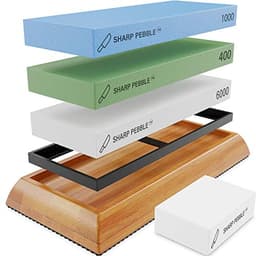
A coarse repair face plus the two grits you finish on
Sharp Pebble 400/1000/6000 Three-Grit XL Kit
The pick if you have knives that are actually dull or chipped, not just tired. Adding a 400 side means you can reset a bad edge without spending an hour on a 1000. Two extra-large stones and a base in one kit.
See the combination stones compared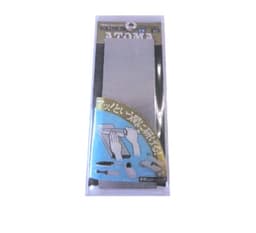
If the chip is deep, or you repair often
Atoma Diamond Sharpener #140 (Coarse)
Not really a sharpening stone — this is the flattening plate the Japanese stone world standardized on, and the tool that fixes the one problem every water stone develops. #140 is brutally coarse: it is for lapping stones flat and reprofiling wrecked edges, nothing else.
See the diamond platesPrice as of October 20, 2026. #ad How we’re funded
Frequently asked questions
Can a chipped knife be fixed?
Almost always, yes. The repair is to grind the surrounding edge down to the depth of the chip so the edge becomes continuous again, then re-sharpen. What you cannot do is replace the missing steel, which means every chip repair costs you a little blade height — the price of the fix.
How do you fix a chip in a knife blade?
Take the whole edge straight down on a coarse stone — 400 grit or a coarse diamond plate — holding the blade perpendicular so you blunt it flat, until the notch disappears. Then re-establish your normal bevel angle on both sides until a burr forms along the full edge, and work back up through the grits to a finish.
Is a small chip worth repairing?
If it is under about half a millimeter deep, do nothing special — it will disappear over the next couple of ordinary sharpening sessions. Deliberate repair is for chips deep enough that you can catch a fingernail in them or see them clearly under a light. Grinding out a tiny chip wastes more steel than leaving it does.
Why do Japanese knives chip?
Because they are hard. At around 60 HRC and above the edge steel will not bend out of the way, so when it is overloaded it fractures instead of rolling. Bones, frozen food, twisting a stuck blade, ceramic plates in the sink, and a fall onto a hard floor are the usual culprits. Softer German steel absorbs the same events by rolling.
Can you fix a chipped knife without a coarse stone?
Slowly and badly. A 1000-grit stone will eventually remove a chip, but it can take an hour of grinding, it glazes as it loads with steel, and you will dish the stone in the process. A cheap coarse stone or a coarse diamond plate turns an hour into a few minutes and is the right tool.
When should a chipped knife be professionally repaired?
When the chip is deeper than a couple of millimeters, when it is at the tip, or when the knife is expensive enough that you do not want to be the one who alters its profile. Deep repairs change the shape of the blade, and a service with a belt grinder will do that far faster and more evenly than you can by hand.
Sources
- Knife sharpening — Wikipedia — Reference on edge angle, coarse-to-fine grit progression, and honing vs sharpening (accessed July 21, 2026)
- Sharpening stone — Wikipedia — Reference on water, oil and diamond stones: Japanese water-stone grit ranges, why stones dish in the middle with use, and why a diamond plate retains its flatness (accessed August 13, 2026)
- Rockwell hardness test — Wikipedia — Definition of the Rockwell C (HRC) scale used to state knife-steel hardness (accessed July 21, 2026)
- How to Sharpen a Knife With a Whetstone — Montana Knife Company — Master-bladesmith walkthrough of whetstone angle, grit progression and deburring (accessed July 21, 2026)
Per-knife specs (steel, HRC, blade length, geometry) are read from each maker’s spec sheet or product listing and dated on the individual review cards above. “Not published” means the manufacturer does not state that figure — we flag it rather than guess.
Keep reading
How to Sharpen a Knife on a Whetstone
The routine process this repair returns you to.
Learn the techniqueWhetstone Grit Guide
Why a repair starts under 400 and finishes above 3000.
Read the grit guideKnife Hardness Chart (HRC)
Why hard steel chips where soft steel rolls.
Read the chartIs Professional Sharpening Worth It?
Published repair surcharges, and when to send it out.
See the costs