Diamond Stone vs Whetstone
A diamond plate stays flat forever and cuts anything. A water stone finishes finer and costs a third as much. The right answer depends on what your knives are made of.
How this is funded: we earn a commission if you buy through our links, at no extra cost to you. As an Amazon Associate we earn from qualifying purchases. It never changes which knife we recommend, and we’ll tell you when we’d skip one. Full disclosure.
Both of these are bench abrasives you draw a knife across, and both will make a blade sharp. Structurally they could not be more different. A water stone is a block of abrasive particles held in a binder that is designed to wear away, constantly exposing fresh cutting grit. A diamond plate is a layer of industrial diamond bonded to a rigid steel or plastic base that is designed not to wear away at all.
Every practical difference below comes out of that one distinction.
The comparison
| Diamond plate | Water stone | |
|---|---|---|
| Cutting speed | Fast on any steel | Moderate; slower on hard steel |
| Stays flat? | Yes, permanently | No — dishes and needs flattening |
| Preparation | None — dry or splash | Soak or splash, depending on the stone |
| Finest grit available | Around 1200 mesh (9 µm) typically | 8000+ readily available |
| Finish quality | Toothy; good working edge | Can be polished to a mirror |
| Forgiveness of angle error | Low — removes metal fast | Higher — slower to do damage |
| Lifespan | Years; slows as diamond sheds | Consumable — wears down and away |
| Cost | High per plate | Low, especially combination stones |
| Best at | Repairs, hard steel, flattening stones | Routine kitchen sharpening |
Flatness is the diamond plate’s real argument
A water stone wears fastest where you use it most, which is the middle. Over time the surface becomes concave, and a hollow stone grinds a corresponding curve into your bevel — the edge stops meeting the stone evenly and the knife gets harder to sharpen for reasons that are invisible until you check with a straightedge. The fix is flattening the stone, which is a routine chore rather than a crisis, but it is a chore.
A diamond plate never develops that problem, because the abrasive sits on a rigid base that does not erode. That is why a coarse diamond plate is the standard tool for flattening water stones — the two technologies work better together than either does alone.
Speed, and why it is a double-edged advantage
Diamond is harder than any knife steel by a wide margin, so it does not care whether your blade is 55 HRC German stainless or 64 HRC powder steel. A diamond plate cuts both at the same rate, which makes it the clear choice for repair work — resetting a bevel, grinding out a chip, reviving a genuinely neglected knife.
The same property makes it unforgiving. A water stone removes metal slowly enough that a wobbly angle produces a slightly rounded bevel you can correct next time; a diamond plate will grind that error in decisively before you notice. On a thin Japanese blade with limited height to spare, that is a real risk rather than a theoretical one.
Finish: where water stones win
Fine water stones go far beyond what diamond plates offer. 3000, 6000, 8000 and higher are ordinary and inexpensive; diamond plates are typically finest at around 1200 mesh, which corresponds to roughly 9 microns. That means a water stone can produce a genuinely polished, gliding edge that a diamond plate cannot match.
Whether you want that is a separate question — a toothy 1000-grit edge bites into tomato skin better than a polished one, as 1000 vs 6000 grit argues. But if you want the option, only water stones offer it affordably. A diamond plate followed by a strop is the usual workaround and it works well.
The grit numbers are not comparable
This trips people up constantly. Diamond plates are graded in mesh with a micron figure attached — DMT publishes Coarse at 325 mesh / 45 µm, Fine at 600 mesh / 25 µm and Extra-Fine at 1200 mesh / 9 µm. Japanese water stones use the JIS scale, where 1000 and 6000 are the familiar numbers. A diamond “600” and a water-stone “600” are not the same thing at all.
As a rough working translation: a diamond Fine (600 mesh) sits somewhere near a 1000-grit water stone in effect, and a diamond Extra-Fine near a 3000. Do not build a progression by mixing the numbers across systems — the grit guide explains why the scales cannot be lined up.
Which should you buy?
Buy a water stone if this is your first sharpening purchase, if your knives are ordinary kitchen stainless, if you want the finest possible edge, or if the budget is limited. A 1000/6000 combination stone does everything a home kitchen needs for a fraction of the price of a diamond plate, and its slower cut is more forgiving while you learn.
Buy a diamond plate if you own very hard steel and find water stones slow; if you cannot be bothered with soaking and flattening; if you need to repair chips or reset bevels; if you sharpen occasionally and want a tool that is ready instantly after months in a drawer; or if you already own water stones and need something to flatten them with.
Own bothand you have the setup most experienced sharpeners converge on: a coarse diamond plate for repairs and for flattening, and water stones for routine sharpening and finishing. That is not fence-sitting — the two do genuinely different jobs, and neither replaces the other. The fields are in best diamond sharpening stones and best whetstones.
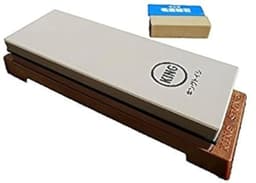
If the answer is a water stone
King (Matsunaga) KW-65 1000/6000 Combination Whetstone
The stone that has taught more people to sharpen than any other. One side 1000-grit to set an edge, one side 6000-grit to polish it, made in Japan, for the price of a takeout dinner. Start here.
See all six whetstones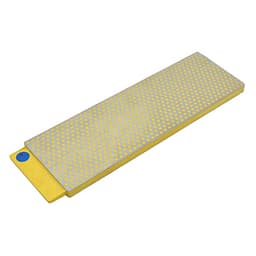
If the answer is a diamond plate
DMT DuoSharp 8-inch Bench Stone, Fine/Coarse (W8FCNB)
The diamond plate to buy if you are buying one. Coarse on one face, Fine on the other, on DMT's interrupted 'polka-dot' surface that clears swarf instead of clogging with it. It cuts hard Japanese steel faster than any water stone and it will still be dead flat in ten years.
See all six diamond platesPrice as of October 20, 2026. #ad How we’re funded
Frequently asked questions
Is a diamond stone better than a whetstone?
Better at some things. Diamond plates cut faster, work on any steel however hard, need no soaking, and never need flattening. Water stones cut slower, wear down, and require prep — but they are available in much finer grits, produce a finer finish, and cost considerably less. For a kitchen of normal stainless knives, a water stone is usually the better buy.
Do diamond stones need to be flattened?
No, and that is their headline advantage. The diamond abrasive is bonded to a rigid steel or plastic plate, so the surface stays flat for the life of the plate. A water stone is a consumable block of abrasive that wears in the middle where you sharpen most, and has to be flattened periodically to stay usable.
Do diamond stones wear out?
Yes, but differently. The plate stays flat; the diamond particles gradually break down or shed, so the plate cuts more slowly over years of use — often becoming finer in effect as it ages. New plates also cut aggressively for the first few uses before settling down. A quality plate lasts a very long time in a home kitchen.
Can you use a diamond stone on Japanese knives?
Yes, and it is the fastest way to work hard steel — diamond is far harder than any blade, so a 63 HRC powder steel gives it no more trouble than soft German stainless. The caution is that diamond removes metal quickly, so a light hand matters more on a thin Japanese blade than it does on a thick Western one.
Do you use water on a diamond stone?
You can use it dry or with a little water, and water is generally better because it floats away the metal swarf that would otherwise clog the surface. What you must not do is soak it — there is nothing to absorb water and the steel plate behind the abrasive can corrode if left wet.
Which is better for beginners?
A water stone, for two reasons. Fine grits are cheaper, so a 1000/6000 combination stone gives a beginner both operations in one block for very little money. And a water stone's slower cut is more forgiving of a wobbly angle — a diamond plate will grind an inconsistent bevel into your knife much faster than you can notice.
Sources
- Sharpening stone — Wikipedia — Reference on water, oil and diamond stones: Japanese water-stone grit ranges, why stones dish in the middle with use, and why a diamond plate retains its flatness (accessed August 13, 2026)
- DMT Diamond and Ceramic Color-Coded Grit Chart — Sharpening Supplies — DMT's own color codes with the mesh and micron figure for each grade (Coarse 325/45 µm, Fine 600/25 µm, Extra-Fine 1200/9 µm) (accessed August 11, 2026)
- Japanese Water Stones — Sharpening Supplies — The two families of water stone: soaking stones that must be submerged until saturated, and splash-and-go stones that need only surface water (accessed August 13, 2026)
Per-knife specs (steel, HRC, blade length, geometry) are read from each maker’s spec sheet or product listing and dated on the individual review cards above. “Not published” means the manufacturer does not state that figure — we flag it rather than guess.
Keep reading
DMT DuoSharp 8-Inch Review
The plate this comparison recommends, examined on DMT's own material.
Read the reviewBest Diamond Sharpening Stones
Six plates compared on grit, surface type and what's in the box.
See the diamond roundupBest Whetstones for Kitchen Knives
Six water stones compared on grit, material and prep.
See the whetstone roundupHow to Flatten a Whetstone
The maintenance job diamond plates never need.
Read the how-toWhetstone Grit Guide
Why a diamond 600 and a water-stone 1000 are not comparable numbers.
Read the grit guide