1000 vs 6000 Grit Whetstone
One of these two stones makes your knife sharp. The other makes it feel nicer doing it. Confusing which is which is the most common reason a sharpening session ends in a dull knife.
How this is funded: we earn a commission if you buy through our links, at no extra cost to you. As an Amazon Associate we earn from qualifying purchases. It never changes which knife we recommend, and we’ll tell you when we’d skip one. Full disclosure.
The two numbers printed on a combination whetstone are not two settings for the same job. They are two different operations, and only one of them makes a knife sharp.
1000 grit sharpens.Its abrasive is coarse enough to cut into the steel, remove the worn apex, and grind a fresh one until a burr forms along the whole edge. That burr is the proof that the two bevels have met — which is the definition of sharp.
6000 grit refines. Its abrasive is far too fine to remove meaningful metal. What it does is smooth the scratch pattern the 1000 stone left, so the edge glides through food instead of biting into it. It cannot create an edge, and it cannot rescue one that was never properly formed.
The comparison
| 1000 grit | 6000 grit | |
|---|---|---|
| Job | Cuts a new edge | Polishes the existing one |
| Removes metal | Yes, meaningfully | Almost none |
| Raises a burr | Yes — this is the goal | Only a very fine one |
| Edge feel | Toothy — bites into skin | Smooth — glides |
| Best for | Tomatoes, peppers, everyday prep | Fine slicing, hard steel, protein |
| Time on the stone | 5-15 minutes | 2-5 minutes |
| Order | First, always | Second, optional |
| If you buy one | Buy this one | Not on its own |
Higher is not sharper
This is the misconception the whole page exists to correct. Grit numbers rise because the abrasive particles get smaller, and smaller particles cut a smoother surface — not a keener one. Sharpness is the geometry of the apex: two bevels meeting at a fine, clean line. You reach that on a 1000-grit stone. Every stone above it is changing the finish, not the apex angle.
A well-executed 1000-grit edge will slice printer paper, take the skin off a tomato with no pressure, and cut cleanly through a week of cooking. A badly executed 6000-grit edge will do none of those, because the finish is beautiful and the two bevels never met. This is the single most common reason people report that their knife is duller after sharpening than before — more causes are in why your knife won’t get sharp.
Toothy against polished, and why you might want either
A 1000-grit edge is microscopically serrated. Those tiny teeth catch and start a cut, which is exactly what you want on anything with a skin: tomato, pepper, sausage casing, the outside of a roast. A 6000-grit edge is smooth, so it glides rather than catches, which is what you want when the cut is long and continuous and the food is soft — fish, protein, anything you want a clean face on.
Neither is objectively better. Plenty of experienced cooks deliberately stop at 1000 or 3000 on a workhorse chef’s knife and go to 6000 only on a slicer. That is a legitimate preference and not a shortcut.
The order matters and cannot be skipped
Sharpening is a sequence in which each stone removes the scratches the previous one left. Start at 1000: raise a burr along the entire edge, flip, do the same on the other side, and only then move to 6000 to refine what you have. Jumping straight to 6000 on a dull knife accomplishes nothing measurable, because the fine abrasive cannot reach fresh steel below the worn apex.
Skipping downis different: if the edge is chipped or badly neglected, a 1000 stone may not be coarse enough either, and you want something under 400 to reset the bevel first — the process in how to fix a chipped knife. For everything else, 1000 is the starting point.
1000/6000 or 1000/3000?
Both are standard and both are correct. A 1000/6000 combination — the King KW-65 is the archetype — gives the most polished finish and is the most widely recommended first stone. A 1000/3000 leaves a slightly toothier edge that many people prefer for general kitchen work, and the finishing side lasts longer because you spend less time on it.
The one practical caution about combination stones: the 1000 side does nearly all the work and wears down considerably faster, so it dishes first and you cannot replace it independently. That is a five-years-from-now problem, and flattening postpones it a long way. The whole field is compared in best combination whetstones.
What to do instead of buying a 6000 stone
If you already own a 1000 stone and want a better finish, a leather strop with compound costs less than a fine stone, takes sixty seconds, and delivers much of the same refinement — plus it removes the last of the burr more reliably than a fine stone does. For most kitchens, 1000 grit and a strop is a better combination than 1000 and 6000.
And if you own neither yet: buy the combination stone. It is one purchase, it covers both operations, and it is what almost everyone who sharpens well started on. The wider grit scale — including why JIS and ANSI numbers are not comparable — is in the whetstone grit guide.
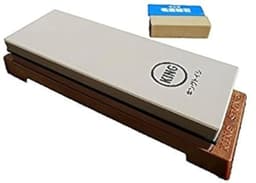
The classic 1000/6000 combination
King (Matsunaga) KW-65 1000/6000 Combination Whetstone
The stone that has taught more people to sharpen than any other. One side 1000-grit to set an edge, one side 6000-grit to polish it, made in Japan, for the price of a takeout dinner. Start here.
Read the full review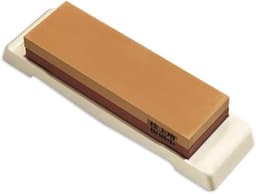
If you prefer a 3000 finish
Naniwa Combination Ceramic 1000/3000 (QA-0124)
A harder, cleaner-feeling Japanese ceramic than the King, in a practical 1000/3000 pairing — a 3000 finish is plenty sharp for a kitchen knife and gets there faster than jumping to 6000. A great step up from a learner stone.
See all five combination stonesFrequently asked questions
Is 1000 or 6000 grit finer?
6000 is much finer. On the grit scale, a higher number means smaller abrasive particles, so a 6000-grit stone leaves a far smoother surface than a 1000-grit one. The trade-off is speed: fine abrasive removes very little metal, which is why a 6000 stone polishes an existing edge rather than creating a new one.
Is a 1000 grit whetstone enough?
For most kitchen knives, genuinely yes. A properly finished 1000-grit edge with the burr cleanly removed will slice paper, tomatoes and everything else you cook. Going up to 6000 refines the edge and makes it glide more smoothly, but it does not make a badly sharpened 1000 edge good. If you buy one stone, buy 1000.
Do you start with 1000 or 6000 grit?
Always the coarser one first. Sharpening is a sequence: 1000 grit cuts a fresh apex and raises a burr along the whole edge, then 6000 refines the scratch pattern that 1000 left. Starting at 6000 does almost nothing, because a fine abrasive cannot remove enough metal to reach fresh steel.
Do I need a 6000 grit stone at all?
Not for a working kitchen knife. A 6000 finish is a real improvement in feel — the knife glides rather than bites — and it matters most on hard Japanese steel and on knives used for delicate slicing. For a German knife that gets honed every week, it is close to pointless. A leather strop delivers a similar refinement for less money and less time.
Is 3000 grit whetstone enough?
It is plenty. 3000 is a perfectly good finishing grit for a kitchen knife and some people prefer it to 6000, because it leaves a slightly toothier edge that bites into tomato and pepper skin instead of skating off. The choice between a 1000/3000 and a 1000/6000 combination stone is genuinely a matter of taste rather than quality.
Should I buy a combination stone or two separate stones?
A combination stone for a first purchase — one block, both grits, less money and less to store. Separate stones make sense later, because the 1000 side of a combination stone wears out long before the 6000 side and you cannot replace it independently. Most people never reach that point.
Sources
- Knife sharpening — Wikipedia — Reference on edge angle, coarse-to-fine grit progression, and honing vs sharpening (accessed July 21, 2026)
- Sharpening stone — Wikipedia — Reference on water, oil and diamond stones: Japanese water-stone grit ranges, why stones dish in the middle with use, and why a diamond plate retains its flatness (accessed August 13, 2026)
- How to Sharpen a Knife With a Whetstone — Montana Knife Company — Master-bladesmith walkthrough of whetstone angle, grit progression and deburring (accessed July 21, 2026)
Per-knife specs (steel, HRC, blade length, geometry) are read from each maker’s spec sheet or product listing and dated on the individual review cards above. “Not published” means the manufacturer does not state that figure — we flag it rather than guess.
Keep reading
Whetstone Grit Guide
The full grit scale, JIS against ANSI, and the bands explained.
Read the grit guideBest Combination Whetstones
Five two-in-one stones compared, with live prices.
See the roundupHow to Sharpen a Knife on a Whetstone
The full workflow, from soak to burr removal.
Learn the techniqueWhy Your Knife Won't Get Sharp
The burr you never raised, and five other causes.
Troubleshoot itIs a 1000 Grit Whetstone Enough?
Whether you need the fine side at all.
Read the answer