How to Sharpen a Single-Bevel Knife
One face does almost all the work and the other must stay flat. Get that backwards and you will not just blunt the knife — you will shorten its life.
How this is funded: we earn a commission if you buy through our links, at no extra cost to you. As an Amazon Associate we earn from qualifying purchases. It never changes which knife we recommend, and we’ll tell you when we’d skip one. Full disclosure.
A single-bevel knife — katabain Japanese — is ground on one face only. The yanagiba, usuba, deba and traditional kiritsuke all belong to this family. Sharpening one is not a harder version of ordinary sharpening; it is a different procedure, with a different failure mode, and the failure mode is permanent.
The good news is that one part of it is genuinely easier than a double bevel: you never have to guess an angle.
The parts, and why they have names
Every instruction below refers to a specific part of the blade, so it is worth learning four words. A specialist reference defines them precisely:
- Kireha— “the flat part from the Shinogi line to the edge.” This is the large beveled facet on the front face, and it is where almost all your work goes.
- Shinogi— the ridge line where the kireha meets the rest of the blade face. It is the visual reference for whether you are grinding evenly.
- Urasuki— “the concave part on the back.” A shallow hollow ground into the flat face.
- Uraoshi— “the small flat parts on the back (<2mm).” The narrow flat rim surrounding the hollow, including the strip that forms the very edge.
The urasuki hollow does two jobs. It creates an air pocket so slices release from the blade instead of clinging, and it means that when you lay the back on a stone only the narrow uraoshi rim makes contact — so deburring removes very little metal from a face made of hard steel.
The angle problem that does not exist
On a double-bevel knife, holding a consistent 15° is the whole skill, and every beginner’s first edges are uneven because of it. A single bevel removes that variable entirely: the kireha is a flat facet, so you lay it flat on the stone and the knife’s own geometry sets the angle. There is nothing to hold.
What replaces it is a different discipline — keeping that whole facet in contact, over its full length, on a genuinely flat stone. Which brings us to the prerequisite.
Flatten your stones. Every one, every time.
On a double-bevel knife a slightly dished stone produces a slightly rounded bevel, which is a nuisance. On a single bevel, the stone’s surface is transferred directly onto a large flat facet, so a hollow stone grinds a curve into the kireha and a hollow uraoshi. Both are real damage and both take a specialist to correct.
Flatten before each stone in the progression, not once at the start. A coarse diamond plate is the standard tool — how to flatten a whetstone covers the method. This is also a strong argument for a stone that resists dishing in the first place, which is what a glass-backed ceramic is for.
Grinding the kireha
Lay the beveled facet flat on the stone and work it. Use whatever stroke you prefer — back and forth, or edge-leading passes — and keep the pressure even over the whole facet rather than concentrating on the edge.
Watch the shinogi line. If it is migrating up the blade in one area, you are grinding that area harder than the rest, and over time that distorts the profile. Watch the scratch pattern too: fresh scratches should reach both the shinogi and the edge, not just the middle.
You are done when a burr has formed along the entire length of the edge on the back side. Same test as any knife: the burr is the proof the apex has been reached. On a long yanagiba this takes a while, because the facet is large and the steel is hard.
The back: a few passes, and no more
Turn the knife over and lay the back completely flaton the stone — no angle at all. Make a few light passes to release the burr. Then stop.
This is the step where single-bevel knives get ruined, and the reason is worth quoting directly: “if you sharpen the Uraoshi too much, you shorten the life of the knife by removing too much of the steel that forms the edge.” Every pass on the back widens the flat rim slightly. Once that rim grows past about two millimeters, the hollow has been substantially ground away and the knife needs a professional to re-establish the urasuki.
The instinct to work the back — because that is what you do on a normal knife — is exactly the instinct to suppress. Bevel side: minutes. Back side: seconds.
The koba, and why you want one
On your finishing stone, raise the spine a few degrees off the kireha and make a small number of passes. That puts a hair-thin secondary bevel — a koba— right at the apex.
The purpose is strength. A single bevel taken to a true zero apex is extraordinarily keen and extraordinarily fragile; the koba is a tiny amount of extra steel behind the very edge that stops it folding on first contact with a board. It is described as being “like the hem on fabric,” which is exactly right — a reinforcement at the boundary, not a change to the shape.
Should you own one at all?
Being honest about the answer is more useful than another paragraph of technique. Single-bevel knives are specialist tools: they are handed, so a left-handed cook needs a special-order knife (see left-handed Japanese knives), they steer through a cut rather than going straight, they do not rock-chop, and maintaining them properly requires flat stones and restraint.
For nearly every home kitchen the double-bevel equivalents do the job with none of the commitment: a sujihiki instead of a yanagiba, a nakiri instead of an usuba, a double-bevel kiritsuke instead of the traditional one. Buy a single bevel because you want to learn this specific craft, not because it appeared at the top of a list of impressive knives.
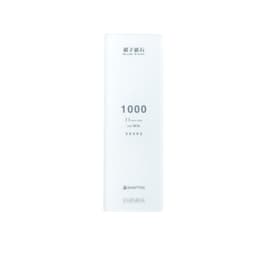
A stone that stays flat, which matters most here
Shapton GlassStone 1000
The upgrade once you know you're sticking with sharpening: a thin, hard ceramic layer bonded to glass. It's splash-and-go (no soaking), stays dead flat far longer than a soft stone, and cuts fast. You'll pay for it.
Read the full reviewPrice as of October 20, 2026. #ad How we’re funded
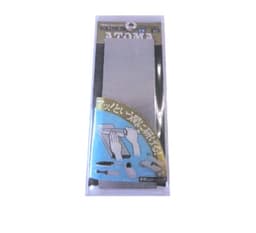
For keeping those stones flat
Atoma Diamond Sharpener #140 (Coarse)
Not really a sharpening stone — this is the flattening plate the Japanese stone world standardized on, and the tool that fixes the one problem every water stone develops. #140 is brutally coarse: it is for lapping stones flat and reprofiling wrecked edges, nothing else.
See how flattening worksPrice as of October 20, 2026. #ad How we’re funded
Frequently asked questions
How do you sharpen a single-bevel knife?
Lay the beveled face (the kireha) flat on the stone and grind it until a burr forms along the whole edge — that is where nearly all the work goes. Then turn the knife over, lay the flat back completely flat, and make a few light passes to release the burr. Work up through your grits and finish with a hair-thin micro-bevel on the beveled side.
Do you sharpen both sides of a single-bevel knife?
Not in the way you would a normal knife. Roughly 90 to 95 percent of the work happens on the beveled face; the flat back receives only light, careful strokes to remove the burr. Grinding the back is the classic beginner mistake — it widens the flat rim and permanently shortens the useful life of the knife.
What is the urasuki?
The shallow concave hollow ground into the flat back of a single-bevel knife. It does two jobs: it creates an air pocket so food releases instead of sticking, and it means there is far less steel to remove when you deburr, because only the narrow flat rim around it touches the stone.
What is the uraoshi and why does its width matter?
The uraoshi is the narrow flat land that runs around the edge of the urasuki hollow on the back of the blade — a specialist reference describes it as 'the small flat parts on the back (<2mm)'. Every time you work the back you widen it slightly. Once it grows past a couple of millimeters the knife needs professional attention, because the hollow is what makes the back easy to maintain at all.
What angle do you sharpen a single-bevel knife at?
You do not choose one. The bevel is a flat facet running from the shinogi line to the edge, so laying that facet flat on the stone sets the angle for you — this is genuinely easier than a double bevel in that one respect. The only place you pick an angle is the optional micro-bevel at the very end, which is a few degrees steeper.
Can a beginner sharpen a single-bevel knife?
It is a poor first project. The technique itself is learnable, but the consequences of getting it wrong are permanent rather than temporary: over-grinding the back cannot be undone at home, and single-bevel knives are expensive. Learn burr formation and deburring on a cheap double-bevel knife first.
Sources
- How to Sharpen Single Bevel Knives with Whetstones — Knifewear — Specialist walkthrough naming the parts — kireha ('the flat part from the Shinogi line to the edge'), uraoshi ('the small flat parts on the back (<2mm)'), urasuki ('the concave part on the back') and koba ('micro bevel') — with the warning that 'if you sharpen the Uraoshi too much, you shorten the life of the knife by removing too much of the steel that forms the edge' (accessed August 18, 2026)
- Japanese kitchen knife — Wikipedia — Reference on gyuto/santoku/nakiri, single- vs double-bevel (kataba/ryoba) and edge angles (accessed July 21, 2026)
- Knife sharpening — Wikipedia — Reference on edge angle, coarse-to-fine grit progression, and honing vs sharpening (accessed July 21, 2026)
- How to Sharpen a Knife With a Whetstone — Montana Knife Company — Master-bladesmith walkthrough of whetstone angle, grit progression and deburring (accessed July 21, 2026)
Per-knife specs (steel, HRC, blade length, geometry) are read from each maker’s spec sheet or product listing and dated on the individual review cards above. “Not published” means the manufacturer does not state that figure — we flag it rather than guess.
Keep reading
Kiritsuke Knife Guide
The shape most often sold in both single- and double-bevel forms.
Read the guideSujihiki Knife Guide
The double-bevel slicer that avoids all of this.
Read the guideLeft-Handed Japanese Knives
Why a single bevel is genuinely handed and a gyuto is not.
Read the guideHow to Flatten a Whetstone
Non-negotiable before single-bevel work.
Read the how-to