Knife Hardness Chart (HRC)
What the Rockwell number on a knife means in practice — band by band, steel by steel — and why the figure a listing claims is not always a figure anybody measured.
How this is funded: we earn a commission if you buy through our links, at no extra cost to you. As an Amazon Associate we earn from qualifying purchases. It never changes which knife we recommend, and we’ll tell you when we’d skip one. Full disclosure.
HRC is the single most quoted number in knife marketing and the least explained. It is a hardness figure from the Rockwell C scale: a diamond cone is pressed into the steel under a defined load, and the permanent depth of that dent is converted into a number. Deeper dent, softer steel, lower number. That is the entire measurement — it says nothing directly about sharpness, edge retention, toughness or quality.
What it does tell you is how the steel will behave, and that turns out to predict almost everything you care about. This page is the chart. If you want the argument about which steel to buy rather than what the number means, that lives in the knife steel guide.
The hardness chart, band by band
Kitchen knives occupy a narrower range than the internet suggests. Effectively everything you can buy sits between 54 and 64 HRC, and the practical differences cluster into four bands.
| HRC | What it’s like | Where you find it | How you maintain it |
|---|---|---|---|
| 54-56 HRC | Soft. Rolls rather than chips; dulls quickly under normal use | Stamped Western knives; Wüsthof's own figure for its non-forged line is 55-57 | A honing rod does most of the work. Stones cut it in seconds |
| 56-58 HRC | The German workhorse band. Tough, forgiving, dulls in weeks not months | Wüsthof Classic (~58), Mercer Genesis (~58), Zwilling Pro (~57) | Weekly honing, a 1000-grit stone two or three times a year |
| 59-61 HRC | The Japanese stainless sweet spot. Noticeably keener, holds it far longer | Tojiro DP (~60), Miyabi Kaizen II (~60), Shun Classic (~60-61), Enso HD (61) | Ceramic rod or strop between sharpenings; a 1000/6000 stone when it needs work |
| 62-64 HRC | Hard. Takes an exceptional edge and keeps it; chips if you twist or lever | Powder stainless (SG2/R2) and hard carbon steels (Blue #2) | Stones only. A steel rod at this hardness does damage, not maintenance |
| 65 HRC and up | Specialist territory — razors, laminated hard-carbon blades, cutting competitions | Not represented in mainstream kitchen catalogs | Fine stones and light hands; realistically not a home-kitchen proposition |
The trade-off in one sentence
Hardness is resistance to deformation, and an edge fails in exactly two ways: it deforms, or it breaks. Soft steel rolls — the very edge folds sideways, the knife feels dull, and a honing rod pushes it back. Hard steel does not roll, because it will not bend; when it fails it chips instead, and no rod fixes a chip. Everything else about the hardness argument is downstream of that.
This is why the German and Japanese traditions diverged. If your steel is going to roll anyway, you grind it at a wide 20° per side so there is enough metal behind the edge to survive, and you hand the cook a steel rod. If your steel is hard enough not to roll, you can grind it at 15° or less, which is what actually makes a Japanese knife feel sharper — the hardness is what permits the geometry. The full version of that argument is in Japanese vs German knives.
Hardness by steel
Hardness is a property of the heat treatment, not the steel — the same alloy can be run soft or hard. But every steel has a range its makers work within, and in practice the grade tells you where a knife will land:
- X50CrMoV15— the German stainless in almost every Western forged knife. Run at ~58 HRC by Wüsthof, Mercer and Zwilling’s Classic-tier lines. Wüsthof states 58 for its forged knives and 55-57 for its laser-cut ones, which is a rare piece of published honesty about what construction does to hardness.
- VG10— the Japanese stainless benchmark, run at about 60 HRC in the Tojiro DP line and at a published 61 in Enso’s HD line. Keen, durable, corrosion-resistant, and the reason VG10 became the default answer to “my first Japanese knife.”
- VG-MAX— Shun’s VG10 relative, ~60-61 HRC. A touch harder, a touch keener, and behind a Damascus jacket that does nothing for the cutting.
- FC61— Miyabi’s fine-carbide stainless at ~60 HRC, hand-honed to a 9.5-12° per side edge. The hardness is ordinary for a Japanese knife; the grind angle is what makes it feel extreme.
- Powder stainless (SG2 / R2)— 63-64 HRC. The edge lasts conspicuously longer and the knife becomes something you have to be careful with. Worth it if you already sharpen on stones; a liability if you do not.
- Carbon steels (White #2, Blue #2)— 61-64 HRC, keener than any stainless at the same hardness because the carbide structure is finer, and rusting the moment you leave them wet.
Published, claimed, and measured are three different things
This is the part the charts elsewhere leave out. An HRC figure can reach you three ways, and only one of them means anything.
A publishedfigure comes from a maker that controls its own heat treatment and states a number for a line it batch-tests. Wüsthof’s 58, Enso’s 61, Tojiro’s ~60: those are commitments a manufacturer has made in writing about a process it owns. A claimedfigure appears in a marketplace listing for a knife made to order by a factory the seller does not operate, and frequently no one involved has run a Rockwell test at all. The giveaway is a suspiciously round, suspiciously high number — “62+ HRC” on a knife that costs less than the stone you would need to sharpen it.
A measured figure means someone put a hardness tester on the actual blade. Almost nobody does this, including us. That is why our methodology records hardness as “Not published” when a maker declines to state one — MAC and Yoshihiro’s 16-layer Damascus line both do, and both make good knives. An empty field is information. An invented one is not.
What the number changes about your week
Take two knives that both cost about the same and sit two bands apart. The 58 HRC German knife gets ten seconds on a honing rod before you cook, and a stone perhaps twice a year. It will survive being put away wet, dropped in a drawer, and used to hack through a squash. The 60-61 HRC Japanese knife wants a ceramic rod or a strop instead of steel, goes on a stone maybe once or twice a year because it holds its edge that much longer, and will chip if you use it on a bone or twist it out of a stuck cut.
Neither of those is the better knife. They are two different maintenance contracts, and the HRC number is how the contract is written down. If you know you will not learn to use a stone, buy in the 56-58 band and hone it. If you enjoy the stone — and it is genuinely learnable in an afternoon — the 59-61 band is where the money buys something real.
How to use this chart when you shop
Read the hardness figure as the first filter and the grind angle as the second. A knife that publishes both is telling you what it is; a knife that publishes neither is asking you to trust a photograph. If a listing gives a hardness but no steel grade, treat the hardness as decorative — hardness without a named alloy is a number with nothing behind it, and every spec table on this site pairs the two for exactly that reason.
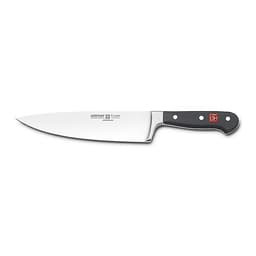
The 58 HRC band
Wüsthof Classic 8-inch Chef's Knife
The benchmark forged German chef's knife: a full-tang X50CrMoV15 blade at ~58 HRC with a bolster and heft that many cooks prefer for rock-chopping. Heavier and softer than a gyuto, and built to last decades.
Read the full Wüsthof Classic reviewPrice as of October 20, 2026. #ad How we’re funded
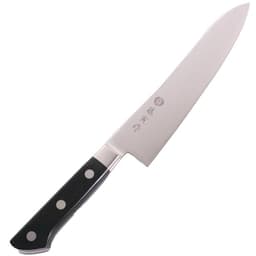
The 60 HRC band
Tojiro DP Gyuto 210 mm
The knife the internet has recommended to first-time gyuto buyers for a decade, and the numbers explain why: a real VG10 core at ~60 HRC for a fraction of the boutique price. Buy this before you spend three times as much.
Read the full Tojiro DP reviewPrice as of October 20, 2026. #ad How we’re funded
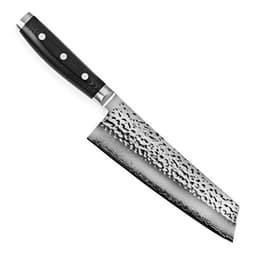
The 61 HRC band, with the figure published
Enso HD 7-inch Bunka
The bunka that actually publishes its numbers: a VG10 core at 61 HRC under 37 hammered Damascus layers, made in Seki. The reverse-tanto tip is the whole point of the shape, and this is the cheapest way to own one from a maker that states the hardness.
See where a bunka fitsPrice as of October 20, 2026. #ad How we’re funded
Frequently asked questions
What is a good Rockwell hardness for a kitchen knife?
For most home kitchens, 58 to 61 HRC. Below that the knife dulls faster than you will want to sharpen it; above it the edge gets keener but chips more readily and can no longer be maintained with a steel rod. German knives cluster around 56-58 HRC and Japanese stainless around 59-61, and both are perfectly good answers — they just ask different things of you.
Is a higher HRC knife better?
No, only different. Hardness buys edge retention and the ability to hold a thinner, more acute grind. It costs toughness: the same hardness that stops the edge deforming also stops it bending instead of breaking, so a 63 HRC blade chips where a 56 HRC blade would roll. The right number depends on whether you would rather sharpen more often or be more careful.
What does 58-60 HRC mean?
It means the maker heat-treated the blade to land somewhere in that range rather than at one exact figure — heat treatment has tolerances, so a range is the honest way to state it. A 58-60 HRC blade sits on the boundary between the tough German band and the keen Japanese band: harder than a supermarket knife, still safe on a honing rod.
How is knife hardness measured?
With the Rockwell C test: a diamond cone is pressed into the steel under a defined preliminary and total force, and the permanent depth of the indentation is converted to an HRC number. It is a destructive test on a finished blade, which is why makers test samples from a batch rather than every knife, and why a per-model figure is a statement about the heat treatment rather than about your individual knife.
Why do some knives not list an HRC figure?
Either the maker treats it as commercially sensitive, or nobody ever measured it. Established Japanese and German factories publish a figure for a line because they control the heat treatment and test it. Many marketplace-only brands print a number with no testing behind it, and a few good makers — MAC, for one — decline to publish at all. On this site an unpublished figure is recorded as 'Not published' rather than filled in with an estimate.
Can you sharpen a hard knife with a honing steel?
Not safely above about 60 HRC. A steel rod works by bending a rolled edge back into line, which needs steel that will bend. A hard Japanese edge will not bend — it will break off in microscopic pieces, which is why hard-knife owners use a fine ceramic rod or a strop instead, and go to a stone when the edge genuinely needs metal removed.
Sources
- Rockwell hardness test — Wikipedia — Definition of the Rockwell C (HRC) scale used to state knife-steel hardness (accessed July 21, 2026)
- HRC Definition (2021) — Bureau International des Poids et Mesures — The international metrology definition of the Rockwell C hardness scale (accessed July 21, 2026)
- Rockwell Hardness — an overview (ScienceDirect Topics) — Reference overview of Rockwell indentation hardness measurement (accessed July 21, 2026)
- The Difference Between WÜSTHOF Forged and Stamped Kitchen Knives — WÜSTHOF — Wüsthof's own account of both processes: forged blades start as a single piece of steel heated to over 2000°F and take 'over fifty-four manufacturing steps', hardened to '58 Rockwell'; non-forged blades are 'cut from a high-quality steel sheet using a precision laser' in 'thirty-five manufacturing steps' and run 'between 55 and 57 Rockwell' (accessed August 18, 2026)
- Enso Knives — Japanese Crafted HD, Hizashi, SG2, Hachi (Cutlery and More) — Published Enso HD line spec: 'VG10 stainless steel core. 61 Rockwell.', '37-layer Damascus with a hammered tsuchime finish', a triple-riveted canvas micarta handle, made in Seki, Japan (accessed August 18, 2026)
Per-knife specs (steel, HRC, blade length, geometry) are read from each maker’s spec sheet or product listing and dated on the individual review cards above. “Not published” means the manufacturer does not state that figure — we flag it rather than guess.
Keep reading
Knife Steel & Hardness Guide
Which steel to actually buy, and what each one is like to own.
Read the steel guideJapanese vs German Knives
The hardness argument, applied to a real buying decision.
Compare the twoThe Easiest Knives to Sharpen
Why softer steel is forgiving on a stone, and which knives have it.
See what makes a knife forgivingJapanese Knife Buying Guide
Steel, hardness, geometry and budget in one buying process.
Start here to buy