Knife Sharpening Angle Guide
Why 15° and 20° are the two numbers that matter, how to find out which one your knife already has, and three ways to hold an angle without buying a jig.
How this is funded: we earn a commission if you buy through our links, at no extra cost to you. As an Amazon Associate we earn from qualifying purchases. It never changes which knife we recommend, and we’ll tell you when we’d skip one. Full disclosure.
Short answer: sharpen at the angle your knife already has. For most Japanese knives and modern fine-ground Western lines that is about 15° per side; for traditional German and budget Western knives it is about 20°. Getting the number exactly right matters much less than holding whatever number you pickfor every stroke — consistency is the whole skill.
What the angle actually is
“15 degrees” means the angle between one bevel and the flat plane of the stone. Because a normal kitchen knife has two bevels, the total included angleat the apex is double that — 30°. This is a constant source of confusion: a listing advertising a “30 degree edge” and one advertising a “15 degree edge” may be describing the same knife. On this site, and in most sharpening discussion, the number quoted is per side unless stated otherwise.
The trade is straightforward. A more acute angle means a thinner wedge of steel, which meets less resistance and cuts more cleanly. It also means less steel supporting the apex, so it deforms or chips more easily. That is the entire argument, and it is why hardness and angle travel together: harder steel can hold a finer apex without folding, which is why a 61 HRC Japanese blade is ground at 15° and a 56 HRC budget knife is not.
| Suits | Trade-off | |
|---|---|---|
| 10-12° per side | Single-bevel Japanese knives, razors, specialist slicers | Extremely keen; fragile and demanding to maintain |
| 15° per side | Japanese gyuto, santoku, nakiri; modern fine-ground Western knives | The best all-round kitchen compromise on hard steel |
| 17-18° per side | A softer Western knife you want keener than stock | Noticeably better cutting; dulls a little faster |
| 20° per side | Traditional German and budget Western knives | Durable and forgiving; less keen |
| 25-30° per side | Meat cleavers, heavy outdoor knives | Survives bone and hard impact; a poor slicer |
Find the angle you already have
Do this before your first stroke. It takes thirty seconds and it saves an entire wasted session.
- Color the bevel along the whole edge with a permanent marker, on both sides.
- Take three or four light strokes on a wet stone at your best guess of the angle.
- Look at where the ink went.
- Ink removed evenly across the whole bevel— you have matched the angle. Carry on.
- Ink removed only at the very edge— your spine is too high, so you are cutting a steeper micro-bevel. Lower it.
- Ink removed only at the shoulder(the top of the bevel, away from the edge) — your spine is too low. Raise it.
This also tells you something worth knowing about your knife: if the ink pattern is uneven along the length, the factory grind is uneven, or the edge has been sharpened badly before.
Three ways to hold an angle without a jig
1. The coin stack.Lay the blade flat on the stone, then lift the spine by roughly two stacked coins for about 15°, three or four for about 20°. It is approximate — the correct lift depends on how tall the blade is — but it puts a beginner in the right region immediately, and you can refine it with the marker test.
2. The fold-and-halve method.A right angle is 90°. Half of that is 45°, half again is 22.5°, half again is about 11°. Hold the knife vertically against the stone, tilt to halfway (45°), halfway again (22.5°), then a touch further down for 20° or most of the way to the next halving for 15°. Crude, and surprisingly effective at building intuition.
3. Lock your body, not your wrist.The most common cause of angle drift is a wrist that rotates through the stroke. Set the angle, lock your wrist and elbow, and move from the shoulder. It feels stiff. It is also the single biggest improvement most beginners can make, and it is why guided systems work — they simply make wrist rotation impossible.
Cheap plastic angle-guide clips that sit on the spine are a fourth option. They help at first and they wear grooves in soft stones, so use them to calibrate your hand and then stop. If you would rather not learn the skill at all, a guided sharpening system sets the angle mechanically and is an entirely respectable choice.
Micro-bevels: the useful cheat
A micro-bevel is a very narrow secondary bevel at a slightly steeper angle than the main one — say a primary at 15° with a micro-bevel at 17–18°. You put it on in two or three ultra-light strokes per side at the end of a session.
Two reasons it is worth knowing about. It strengthens the apex slightly, which is genuinely useful on a hard, thin Japanese blade that would otherwise chip. And it makes touch-ups fast: next time, you only need to refresh the tiny micro-bevel rather than regrind the whole primary. Most people sharpening at home benefit from one, and almost nobody is told about it.
Angle when honing, not just sharpening
A honing rod is trying to bend an existing apex back into line, so you want to match the existing angle there too — roughly 20° for a Western knife, roughly 15° for a Japanese one. Too steep and you round the apex over; too shallow and you scrape the shoulder and achieve nothing.
Some rods build the guide in. Shun’s Sora combination steel molds a 16° guide into the handle, which is a sensible answer to the part beginners actually get wrong. We compare the options on the honing steels page, and sharpening vs honing covers why the two are separate jobs.
Everything above assumes a kitchen knife
The 15° and 20° numbers on this page are kitchen numbers. A folding pocket knife is ground wider on purpose — Benchmade publishes 30–35° inclusive, about 17–20° per side, for most of its range — because a knife that meets cardboard, rope and cable ties needs a bevel that survives them. It is also made from harder, more wear-resistant steel that a soft water stone will struggle to cut. If that is the knife in front of you, start with how to sharpen a pocket knife instead.
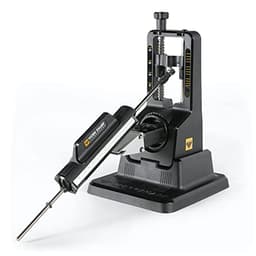
If you'd rather the jig held the angle
Work Sharp Precision Adjust Knife Sharpener
The guided system to buy if a whetstone has beaten you. The blade clamps, the angle sets by knob anywhere from 15 to 30 degrees in one-degree steps, and a rotating handle carries coarse diamond, fine diamond and a fine ceramic. It removes the one variable beginners cannot control: holding a consistent angle.
See all the systemsPrice as of October 19, 2026. #ad How we’re funded
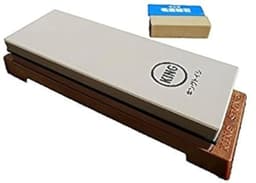
The stone to practice the angle on
King (Matsunaga) KW-65 1000/6000 Combination Whetstone
The stone that has taught more people to sharpen than any other. One side 1000-grit to set an edge, one side 6000-grit to polish it, made in Japan, for the price of a takeout dinner. Start here.
Read the full reviewFrequently asked questions
What is the best angle to sharpen a kitchen knife?
Match what the knife already has. About 15 degrees per side for Japanese knives and modern Western lines ground with a fine edge; about 20 degrees per side for traditional German and budget Western knives. Sharpening at a different angle than the existing bevel means grinding a whole new bevel before you touch the apex, which wastes a session and a lot of steel.
Is 15 or 20 degrees better?
Neither in the abstract — it is a trade between keenness and durability. A 15 degree edge meets less resistance and cuts more cleanly; a 20 degree edge has more steel behind the apex, so it survives harder use and lasts longer between sharpenings. Hard steel supports the finer angle better, which is why Japanese knives use it and softer Western steels traditionally do not.
How do I find out what angle my knife is?
Color the bevel with a permanent marker, take three or four light strokes on a stone at your best guess, and look at where the ink came off. Ink gone from the very edge means you are too shallow (spine too low); ink gone from the shoulder only means you are too steep. Ink removed evenly across the whole bevel means you have matched it.
What is the coin trick for sharpening angles?
A rough field guide: for a standard kitchen knife, lay the blade flat on the stone and lift the spine by about the thickness of two stacked coins for roughly 15 degrees, or three to four for roughly 20. It is approximate and depends on blade height, but it gets a beginner into the right neighborhood far faster than guessing.
Does the angle matter for honing too?
Yes, and for the same reason — you want to bend the existing apex back, not create a new one. Match the knife's edge angle as closely as you can on the rod. Some rods, including Shun's Sora combination steel, mold an angle guide into the handle to take the guesswork out.
What angle for a cleaver or an outdoor knife?
More obtuse. A meat cleaver wants roughly 25-30 degrees per side because it has to survive impact with bone, and heavy-use outdoor knives are often ground in the same range. A finer edge on a cleaver lasts exactly one rib. Guided systems with fixed guides usually offer 25 and 30 degree settings for precisely this.
Sources
- 20° & 25° Angle Guides for Whetstone Sharpeners — Work Sharp — Tool-maker reference for common Western (20°) vs finer (Japanese) sharpening angles (accessed July 21, 2026)
- Knife sharpening — Wikipedia — Reference on edge angle, coarse-to-fine grit progression, and honing vs sharpening (accessed July 21, 2026)
- Rockwell hardness test — Wikipedia — Definition of the Rockwell C (HRC) scale used to state knife-steel hardness (accessed July 21, 2026)
Per-knife specs (steel, HRC, blade length, geometry) are read from each maker’s spec sheet or product listing and dated on the individual review cards above. “Not published” means the manufacturer does not state that figure — we flag it rather than guess.
Keep reading
Best Sharpeners for Japanese Knives
The tools that can actually hold 15-16° while cutting hard steel.
See the picksHow to Sharpen a Knife
The full whetstone workflow, step by step.
Learn the methodBest Sharpening Systems
Jigs that set the angle for you, ranked.
See the systemsWhy Your Knife Won't Get Sharp
Angle drift is only one of six usual causes.
Troubleshoot itKnife Steel & Hardness Guide
Why hard steel supports a finer angle.
Understand the steelWork Sharp Precision Adjust Review
A dial that holds the angle from 15 to 30 degrees.
Read the reviewHow to Hone a Knife
Holding the same angle on a rod, without a jig.
Read the how-toHow to Sharpen a Single-Bevel Knife
The one knife where you never choose an angle at all.
Read the how-to